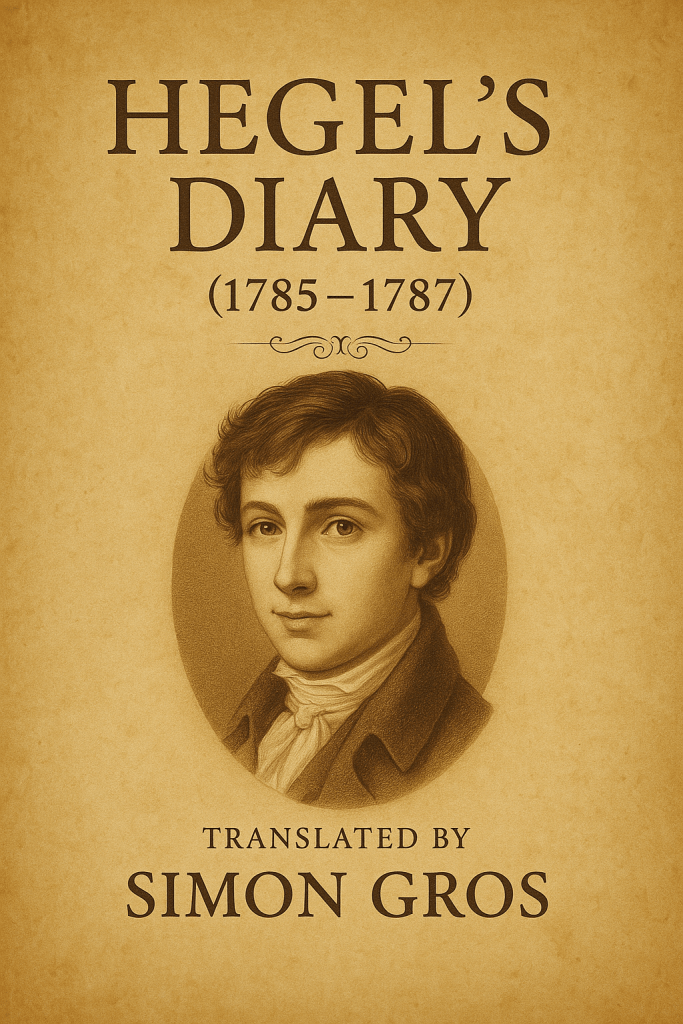
Sunday, June 26 1785
In the morning service, Reverend Rieger, the court preacher, gave the sermon. He first read the Augsburg Confession, beginning with its preface, and then the sermon followed. Even if I had remembered nothing else, my knowledge of history would nonetheless have been increased. I learned that on June 25, 1530, the Augsburg Confession was presented; that on February 2, 1535, Württemberg was reformed; and that in 1599 the Prague Treaty confirmed the Evangelical religion. They received the name “Protestants” from their protest against the harsh Imperial Resolution at the Diet of Speyer in 1529. I also recall that Luther died on February 18, 1546, and that the Elector of Saxony, John the Steadfast, was utterly defeated and captured on April 24, 1547.
¹Reverend Rieger was Stuttgart’s court preacher, known for incorporating confessional texts into his sermons. The Augsburg Confession, drafted by Philipp Melanchthon under Martin Luther’s guidance, became the foundational statement of Lutheran belief at the Diet of Augsburg. Duke Ulrich’s 1535 church ordinance in Württemberg formally established Lutheran worship and governance. Bohemian edicts in the late 1500s—culminating in the 1609 Letter of Majesty—granted limited toleration to Protestant communities. The term “Protestant” originates from the Lutheran estates’ formal dissent at Speyer in 1529. Martin Luther died in Eisleben in 1546. The reference to “John the Steadfast” conflates him with his nephew John Frederick I, who was captured at Mühlberg in 1547.
Monday, June 27 1785
No world history has pleased me more than Schröckh’s. He avoids the tedium of countless names found in specialized histories, yet narrates all major events, wisely omitting the multitude of kings, minor wars (where often only a few hundred men scuffled), and the like. Most importantly, he connects instructive material with the narrative. He also carefully documents the state of scholarship and learning throughout.
Today was a conventus (a monthly meeting of the professors in the Gymnasium, where they deliberate on matters concerning the 6th and 7th classes and discipline violators of school rules). We Primi, as the representatives of the graduating class (as the Rector called us), had to appear. From the 7th class were: Cammerer, Primus Veterum (son of the court physician); Duttenhofer; Vischer, Primus Novitiorum (son of the revenue office secretary). From the 6th class: Boger, Primus Veterum (son of a lieutenant colonel); Hegel, Primus Novitiorum.
Nothing more was presented to us than a serious exhortation to warn our fellow students not to join immoral and disreputable societies. A group of young men aged 16–17, and girls aged 11–12, calling themselves the Doggen-Gesellschaft, or Lapplanders, has appeared. The boys promenade the girls and corrupt both themselves and their time disgracefully. Among the Gymnasium students involved are, from the 7th class: Vischer, Neuffer; from the 6th: Stäudlin. Among the university students: Vischer, Haselmayer, Georgii.
²Johann Matthias Schröckh (1733–1808) was a leading Protestant church and world historian whose multi-volume Allgemeine Weltgeschichte aimed to present a clear, cohesive narrative by concentrating on major events and situating them within the broader intellectual landscape. The conventus at the Stuttgart Gymnasium was a monthly faculty assembly addressing curricular issues and student discipline; “Primi” denoted the highest-ranked pupils—“Primus Veterum” for the senior cohort and “Primus Novitiorum” for the junior—so Hegel, as Primus Novitiorum of the 6th class, was recognized as top of the newcomers. The so-called Doggen-Gesellschaft or Lapplanders was a youth association infamous for its licentious gatherings, condemned by school authorities as corrupting; named students such as Vischer, Neuffer, Stäudlin, Haselmayer, and Georgii were fellow pupils implicated in its activities.
Tuesday, June 28 1785
I noticed how differently people react to the same event. News was shared of a woman having given birth successfully. M. V., a former husband, was deeply pleased; J. B., a grown woman familiar with such events, even more so, saying that no greater joy exists than a successful childbirth. But just then, a fine horse was ridden past us. B., about 21 years old, asked immediately who owned it, paying little attention to the joyous news. I, too, rushed over, not particularly moved by the birth, and agreed that it was indeed a beautiful horse.
While I ate cherries with great appetite, thoroughly refreshed and content, someone else—older than I—watched indifferently and said that in youth one feels irresistibly drawn to a cherry vendor (as we Swabians say, one’s mouth waters at the sight), but in older years, one can let a whole spring pass by without such cravings. This reminded me of a rather dreary (but wise) maxim: in youth, driven by uncontainable desire, one cannot eat much without harming one’s health; in old age, one may not.
Wednesday, June 29 1785
Oh dear! Bad news from Hohenheim. The peasants—those cursed people—smashed all the windows of the duke’s palace at Scharnhausen.
Today was a holiday. I didn’t attend church, but went walking in the Bopser forest with Duttenhofer and Autenrieth.
⁴Hohenheim was the ducal domain southeast of Stuttgart, including the palace and agricultural estate; “the peasants” refers to local tenant farmers who, amid economic grievances, rioted and shattered the windows of the duke’s palace at nearby Scharnhausen. June 29 was the Feast of Saints Peter and Paul, observed as a public holiday in Württemberg. The Bopser (Botnang) Forest lay just south of Stuttgart and was a favored walking area. Duttenhofer and Autenrieth were Hegel’s fellow Gymnasium pupils, companions on such leisure outings.
Thursday, June 30 1785
It was oppressively hot today and looked like a storm was coming, but it passed. I played chess again—my beloved game—and though I’m not a good player, I won both times. I never play according to a plan, as one should; I simply start randomly (which is a great mistake), and let the game unfold. The position of the pieces determines my plan. In future, I shall try to devise a plan from the very beginning and follow it through the entire game. I note this here just so the last day of the month does not remain empty.
Friday, July 1 1785
I have long wondered what a “pragmatic history” is. Today (though I don’t recall who explained it), I received a somewhat vague and one-sided definition. I believe a pragmatic history is one that not only recounts facts but also elaborates on the character of a great person, a whole nation, its customs, religion, and how these evolve and differ from other peoples; it traces the decline and rise of empires, and shows how a particular event or political change affected the nation’s constitution, character, and so on.
⁵ The term “pragmatic history” (German: pragmatische Geschichte) stems from the Greek πρᾶγμα (“affair” or “deed”) and in late 18th‐century German historiography denoted a mode of writing that went beyond mere chronicle. Instead of listing events or rulers, it combined factual narration with analysis of a nation’s character, customs, religion, and the evolution of its political institutions—tracing how particular events affected constitutional structures. This approach was championed by Johann Christoph Gatterer of the Göttingen School, who stressed causal connections among events and drew on ancillary disciplines such as diplomatics, heraldry, and geography to provide a scientific basis for history. Ernst Platner likewise used “pragmatic history” to describe the development of human cognition, a concept later adapted by Fichte in his “pragmatic history of the human spirit”.
Saturday, July 2 1785
Why did Socrates offer a rooster to Aesculapius before his death? Professor Offterdinger posed this question in our weekly colloquium. According to various interpretations, he believed that Socrates was already unconscious due to the effects of the poison. I, however, believe that Socrates, knowing the customary practice, did not want to offend the masses by neglecting this small offering.
⁶In ancient Greek practice, dedicating a rooster to Asclepius—god of healing—was a customary act of gratitude upon recovery. Plato’s Phaedo (118e–119a) records that Socrates, as he prepared to drink the hemlock, instructed Crito to offer this cock “in thanksgiving to Asclepius,” implying that death itself was a release (a form of healing) from bodily troubles. Professor Offterdinger, Hegel’s classics instructor, raised this question to illustrate how ritual gestures could carry layered meanings: while some argue Socrates was already insensible to his surroundings, Hegel contends that Socrates observed the rite to avoid offending public piety and to honor tradition.
Sunday, July 3 1785
On the way back from a walk, we—especially I (for vanity must always be involved)—proposed this maxim: every good has its bad side (sometimes less, sometimes more, depending on the good). We applied this saying at every step. R., who had taken a different path, was approaching. As we waited for him, one of us questioned what possible good could come from standing in the way. We answered: had we run off, someone might have tripped—or had an unkind thought. Very Stoic indeed!
⁷ The maxim “every good has its bad side” reflects a Stoic-influenced ethical perspective, reminiscent of Seneca’s and Epictetus’s emphasis on evaluating actions by their potential consequences. The reference to “standing in the way” illustrates a dialectical exercise common in Hegel’s circle, where a seemingly negligible act (waiting) is analyzed for both positive intentions (courtesy) and possible negative outcomes (causing someone to stumble or harbor ill will).
Monday, July 4 1785
During a walk, Professor Cleß questioned me on various topics, especially on the earth’s tilt, which causes the seasons. I asked why it is often hotter in July and August than in June, when the sun is closest to us. It is known that heat arises from the sun’s rays reflecting in our atmosphere. Professor Cleß offered the following explanation: in June, the sun’s direct contact excites the fiery particles near the earth’s surface. These then ignite neighboring particles in a chain reaction that reaches deep into the earth. By July and August, most of these are activated, and thus the greatest heat is released back into the atmosphere. That is why it is hottest then.
⁸Professor Cleß was Hegel’s instructor in natural philosophy at the Stuttgart Gymnasium, where late-18th-century science still invoked “fiery particles” (a remnant of phlogiston/caloric theories) to explain heat. The earth’s axial tilt (~23.5°), not its distance from the sun—which actually reaches perihelion in early January—governs the seasons. The notion that June’s solar “ignition” of subsurface particles leads to a delayed release of maximum heat in July and August anticipates what we now term the seasonal lag: land and atmosphere absorb solar energy over time before warming peaks weeks after the summer solstice. This exchange reflects Hegel’s early engagement with contemporary explanations of thermodynamics and celestial mechanics.
Tuesday, July 5 1785
I purchased the following books from the library of the late Preceptor Löffler, my most esteemed teacher and guide:
Greek
– Aristotle, De moribus
– Demosthenes, Oration on the Crown
– Isocrates, Speeches XXI and Letters, Complete Works
Latin (Prose)
– Cicero, Philosophical Works
– Aulus Gellius, Attic Nights
– Velleius Paterculus
– Diodorus Siculus
Latin (Poetry)
– Plautus
– Catullus, Tibullus, Propertius, Gallus, Claudian, and Ausonius
– Hieronymus Vida
– Christian Virgil
– Sannazaro
⁹Preceptor Löffler—as Hegel’s former tutor at the Stuttgart Gymnasium—had assembled a classical library that reflected the era’s humanist curriculum. By acquiring these volumes, Hegel ensured access to foundational texts in philosophy, rhetoric, history, and poetry: Aristotle, De Moribus: A treatise on ethics (the “Nichomachean Ethics” was often transmitted under the title De Moribus), exploring the nature of virtue, the good life, and moral character formation. Demosthenes, Oration on the Crown: Demosthenes’ most celebrated speech (delivered in 330 BCE), defending his record as logographer and condemning his rival Aeschines; a model of Attic oratory, rhetorical skill, and political argument. Isocrates, Speeches XXI and Letters (Complete Works): A selection of Isocrates’ twenty-one orations—covering panegyric, hortatory, and political themes—accompanied by his epistolary corpus; illustrates the sophistication of 4th century BCE Greek rhetorical and ethical instruction. Cicero, Philosophical Works: Likely including his major treatises (e.g., Tusculan Disputations, On the Republic, On the Laws, On the Ends of Good and Evil), wherein Cicero adapts Greek philosophical doctrines (Stoicism, Academic Skepticism) for Roman audiences, emphasizing virtue, natural law, and civic duty. Aulus Gellius, Attic Nights: A miscellany compiled in the 2nd century CE, containing anecdotes, literary criticism, historical notes, and grammatical discussions; valued for its preservation of otherwise lost fragments of classical authors and insight into Roman intellectual life. Velleius Paterculus: A concise Roman history (“Historiae Romanae,” covering mythic origins to the death of Livia in 29 CE), offering an Augustan‐era perspective on Rome’s early kings, Republic, and rise under Julius Caesar and Augustus. Diodorus Siculus: His 1st-century BCE Bibliotheca historica is a universal history in forty books (with surviving portions spanning mythic times to the post-Peloponnesian War era); valued for its compilation of diverse sources on ancient Mediterranean civilizations. Plautus: A corpus of Roman comedies (e.g., Miles Gloriosus, Menaechmi, Pseudolus) from the early 2nd century BCE, groundbreaking for integrating Greek New Comedy motifs into Latin verse, influencing later dramatic traditions. Catullus (mid-1st century BCE): Lyric poet famous for his personal, emotional verses (e.g., love poems to Lesbia). Tibullus and Propertius (late 1st century BCE): Elegiac poets whose works explore love, mythology, and rural life. Gallus (1st century BCE): Early elegiac innovator, often idealizing the pastoral and mythic landscape. Claudian (late 4th century CE): Court poet at Honorius’ court, composing panegyrics, epics, and occasional verse reflecting late‐antique politics. Ausonius (4th/5th century CE): Poet and teacher of rhetoric under Valentinian I, known for occasional verse, epigrams, and the geographical poem Mosella. Hieronymus Vida: A 16th-century Italian humanist whose Latin works—such as the pastoral epic Christiad and didactic poem Scacchia Ludus (on chess)—exemplify Renaissance Latinity and fusion of classical form with contemporary themes. Virgil (under “Christian Virgil”): The canonical Roman epicist (1st century BCE), author of the Eclogues, Georgics, and Aeneid; these poems shaped European literary education throughout the Renaissance and Enlightenment. Jacopo Sannazaro: A late 15th/early 16th-century Italian poet best known for his Latin pastoral Arcadia (1504), which influenced bucolic and Renaissance vernacular poetry through its blend of classical models and personal sentiment. Together, these volumes illustrate Hegel’s deepening engagement with classical philosophy (Aristotle, Cicero), oratory (Demosthenes, Isocrates), historiography (Velleius, Diodorus), and poetic expression across antiquity and the Renaissance (Plautus through Sannazaro), reflecting the comprehensive humanist education of the late 18th century.
Wednesday, July 6 1785
Preceptor Löffler was one of my most highly esteemed teachers, especially in the lower Gymnasium; I may safely call him perhaps the very best. I entered his instruction in the autumn of 1777, when he was Praeceptor I inf. Cl. Thus I was with him for the first half of 1778. That same year, the late Preceptor Schiffner died, and in the fall Löffler advanced with us by one class level. So I received his instruction for the whole of 1778 and most of 1779. Even after I left his class for that of my uncle, Preceptor Goriz, I continued private lessons with him throughout that year—and again in 1783, when I was a novice in the first class under Professor Nast. In the first period of private instruction, Lebret and Autenrieth studied with me; in the second, I was alone. In the first course, we translated Curtius, Aesop, and the New Testament, namely on Wednesday, Friday, Saturday, and Sunday from 11 to 12 and from 2 to 3. In the second course, I translated Cicero’s De Senectute, Somnium Scipionis, and Laelius de Amicitia; in Greek, the New Testament letters to the Thessalonians and to the Romans, and some Hebrew Psalms. We finished with Vida’s Christiad, of which I knew many passages by heart.
⁸ Preceptor Löffler served as Hegel’s leading instructor in the lower classes of the Stuttgart Gymnasium, holding the official title Praeceptor I inf. Cl. (“First Tutor of the Infant Class”). When Hegel began under him in autumn 1777, Löffler was responsible for foundational Latin and Greek instruction. Following the death of Preceptor Schiffner in 1778, Löffler advanced with Hegel’s cohort, teaching him through most of 1779. Even after Hegel moved to his uncle Preceptor Goriz’s class, he continued private tuition with Löffler—later again under Professor Nast in 1783. During their first private‐lesson phase, Hegel studied alongside Lebret and Autenrieth, translating Quintus Curtius Rufus’ Historia Alexandri Magni, Aesop’s fables in their classical Latin versions, and passages of the New Testament (Greek text) four days a week in scheduled sessions. In the second phase, Hegel worked solo on Cicero’s De Senectute, Somnium Scipionis (the Dream of Scipio, excerpted from Cicero’s Republic), and Laelius de Amicitia, alongside Greek New Testament letters to the Thessalonians and Romans, and Hebrew Psalms in the original language. They concluded with Vida’s Christiad, a Renaissance‐era Latin epic on Christ’s passion, of which Hegel could recite many passages by heart. This curriculum exemplifies late-18th-century humanist pedagogy: rigorous translation practice, mastery of classical authors, and memorization of verse in Latin, Greek, and Hebrew under the close guidance of a devoted preceptor.
Thursday, July 7 1785
He was the most upright and impartial man. His greatest concern was to be of benefit to his students, to himself, and to the world. He did not think, as others do, that once one has their bread secured, one need not study further and may go on perpetuating the eternal, annually recycled classroom routine. No, the late man thought otherwise. He understood the value of learning, and the comfort it offers in life’s many circumstances. How often, and how cheerfully and contentedly, did he sit with me in that beloved little room—and I with him. Few understood his merits. A great misfortune for him was that he had to work so far beneath his proper sphere. And now he too has passed! But I will carry his memory, unwavering, in my heart forever.
Let me add this: he gave me, already in 1778, eighteen volumes of Shakespeare’s plays as a gift.
¹⁰ Preceptor Löffler, Hegel’s esteemed lower‐Gymnasium tutor, was renowned for his integrity, pedagogical zeal, and belief that learning sustains both teacher and student throughout life. His private instruction took place in Löffler’s modest study, where he guided Hegel through classical texts and life lessons. In 1778, Löffler presented Hegel with an eighteen‐volume edition of Shakespeare—likely Johann Joachim Eschenburg’s German translation—demonstrating the late 18th‐century German fascination with English drama and providing Hegel access to the full breadth of Shakespeare’s plays.
Friday, July 8 1785
As a general trait, I have found in the character of the female sex (though surely some men are not exempt from it) a complete contradiction of Horace’s lines:
Sperat infestis, metuit secundis
Alteram sortem bene praeparatum
Pectus.
“The well-prepared heart hopes in adversity and fears in prosperity.”
¹¹ The quoted lines—“Sperat infestis, metuit secundis / Alteram sortem bene praeparatum pectus”—originate in Horace’s Odes (Book I, Ode 4, lines 5–6), where he advises that a well‐prepared heart “hopes in adversity and fears in prosperity.” By asserting that women exhibit the opposite tendency, Hegel implies they may feel anxious when fortunes are low and overly confident when all seems well. This observation reflects late-18th-century gender stereotypes about emotional disposition contrasted against the Stoic ideal of equanimity.
Saturday, July 9 1785
If superstition has ever concocted anything dreadful—an adventure so absurd and devoid of reason—it is surely the so-called “Muthes Heer” (The Brave Host). Last Sunday night at 1 or 2 a.m., many people claimed to have seen it—even (shameful to say) individuals from whom one would expect more enlightenment, some even holding public office. One old woman said she had seen a fiery wagon with people in it; others claimed to have seen different things. Commonly it is said that it is the devil in a fiery chariot, from the front of which flies an angel of God, calling out to all: “Out of the way, the brave host is coming!” Whoever does not heed this divine warning is dragged by the devil into his domain.
¹² The “Muthes Heer” (Brave Host) reflects a local variant of the Germanic Wild Hunt (Wilde Jagd) legend, in which a phantom procession—often led by a spectral charioteer or devil—rushes through the night, warning onlookers to flee or risk being carried off to the spirit world. Such apparitions were widely reported in rural Württemberg during the 18th century, blending pre‐Christian beliefs in restless dead with Christian elements (e.g., an angel’s warning). Testimonies from “enlightened” individuals and officials demonstrate how deeply ingrained these superstitions remained, despite Enlightenment critiques of irrational folklore. The fiery wagon imagery evokes the fusion of infernal and divine motifs: a heralding angel juxtaposed with a demonic chariot, symbolizing eternal judgment and the peril of ignoring moral or spiritual warnings.
Sunday, July 10 1785
Returning to the tale of the “Brave Host” from last Sunday: people tell it with the same details, and I have been told the names of several who saw or heard it (an atrocious clamor, supposedly). A few days later, it became clear that—oh shame! shame!—they were carriages. Mr. von Türkheim had held a very well-attended concert that lasted until 2 a.m. To prevent the guests from groping home in the dark, he had them driven back in carriages with torches. And that was the Brave Host. Ha! Ha! Ha! O tempora! o mores! Happened in 1785. O! O!
¹³ The “Brave Host” frenzy was a case of collective superstition subsiding into a mundane explanation: torched carriages escorting guests home from a late concert at the von Türkheim estate. Such country concerts were fashionable among Württemberg’s gentry, and firing torches on carriages created an illusion of a spectral procession. “Mr. von Türkheim” refers to a local nobleman known for patronizing music in the late 18th century. The exclamation “O tempora! o mores!”—borrowed from Cicero’s First Catilinarian Oration—expresses Hegel’s mock indignation at the absurdity of mistaking carriages for a demonic host.
Monday, July 11 1785
This incident produced the following anecdote. Townspeople came to the main guard post, reported the event, and asked the commanding officer to be watchful in case the Brave Host should return. The lieutenant ordered the guard to be vigilant. A soldier, perhaps unaware of the tale, asked, “If it comes, does Your Grace the Lieutenant order me to arrest it?” “Yes, yes,” the lieutenant said. “Just arrest it.” But it never returned.
¹⁴ The “main guard post” refers to the Hauptwache in Stuttgart, where a lieutenant oversaw the city’s military policemen. Townspeople reporting sightings of the “Brave Host” sought official intervention, reflecting how deeply the legend had unsettled them. The lieutenant’s instruction—“Just arrest it”—reveals both his straightforward command mentality and a measure of wry accommodation to popular fears. That the phantom never returned points to the tale’s origin in misperception rather than any supernatural event.
Tuesday, July 12 1785
A similar event happened recently. Four ladies were returning late at night from Chaussée House on the Ludwigsburg road (which passes the gallows) around midnight. At Chausséehäuslein, a headless rider approached them on horseback, riding now beside, now ahead, now behind their carriage. The coachman tried to avoid him, but the rider followed until he vanished at the city gate. This was attested by five or six witnesses.
Only several days later did an officer explain that he had been at that very place and time, joined the carriage, and rode along. But unwilling to enter through that particular gate, he took another route. He added that he could not understand why the coachman had kept trying to avoid him.
¹⁵ The “Chausséehäuslein” (little tollhouse) on the Ludwigsburg road was a known landmark near Stuttgart, situated close to the old gallows used for public executions—making any spectral sighting there particularly ominous. The “headless rider” echoes a widespread German folklore motif (Schimmelreiter or Kopfloser Reiter) representing restless spirits. In this case, an army officer traveling at the same hour joined the carriage to accompany the ladies but later detoured through a different city gate. The coachman’s attempts to avoid the officer—unseen by him—created the illusion of a pursuing phantom. Such misunderstandings were common where poor visibility and local superstitions intersected.
Wednesday, July 13 1785
Today I visited the Ducal Library for the first time. Every Wednesday and Saturday from 2 to 5, anyone may attend. It is a large room with a long table, writing implements, and paper where one can sit. You write the book you want next to your name on a slip of paper and give it to the attendant, who fetches the book. Since other books were unavailable, I requested Batteux’s Introduction to the Fine Arts and read the section on epic poetry.
¹⁶ The “Ducal Library” in Stuttgart was the ducal collection open to students twice weekly, offering reference works and scholarly volumes in a supervised reading room. Visitors wrote their requests on slips for retrieval by an attendant—a common practice in 18th-century libraries. Charles Batteux’s Introduction to the Fine Arts (published 1746) was a foundational Enlightenment text that surveyed artistic genres; its section on epic poetry analyzed classical models (Homer, Virgil), defined epic conventions (elevated style, heroic subject matter), and influenced contemporary literary aesthetics. Batteux’s work helped shape debates on the nature and purpose of poetic excellence among German intellectuals of Hegel’s generation.
Thursday, July 14 1785
Professors Abel and Hopf honored our circle with a visit the day before yesterday. We went for a walk with them, during which they entertained us, especially with stories of Vienna.
Friday, July 15 1785
I walked with Professor Cleß. We read in Mendelssohn’s Phädon, particularly the introductory part describing Socrates’s character. Anytus, Meletus, and Crito were the three scoundrels who procured his death through a fearful senate and a rabid mob.
¹⁷ Professor Cleß—Hegel’s instructor in natural philosophy—often used contemporary translations and commentaries for philosophical instruction. Moses Mendelssohn’s Phädon (1767) is a German-language rendition and interpretation of Plato’s dialogue Phaedo, celebrating Socrates’s final discourse on the soul. In Mendelssohn’s account, Anytus and Meletus are presented as the Athenian politicians who formally prosecuted Socrates on charges of impiety and corrupting youth. Crito, though historically Socrates’s close friend who attempted to secure his escape, is cast in this reading as complicit—a dramatic device underscoring the “fearful senate” (the jury of roughly 500 citizens) and a “rabid mob” of accusers whose collective pressure led to Socrates’s condemnation and forced ingestion of hemlock.
Saturday, July 16 1785
Today, the city clerk Klüpfel died, just as he was thought to be recovering. He leaves behind nine children, one of whom had been appointed to his position just eight days prior; another entered the monastery last autumn.
Tuesday, July 19 1785
Likewise today, Privy Councilor and Cabinet Secretary Schmidlin died of a stroke just as he reached for his spoon at lunch. Leypold, a good friend of mine, is one of his grandsons.
Wednesday, July 20 1785
I returned to the library today and asked for Dusch’s Letters on the Formation of Taste, but they were either unavailable or could not be found, so I did not receive them and read again in Ramler instead. I also played chess twice with Mr. Riederer and won both games.
¹⁸ “Dusch” refers to Johann Friedrich von Dusch, whose Briefe über die Bildung des Geschmacks was an 18th-century guide to cultivating aesthetic judgment through examples and reflection. “Ramler” denotes Karl Wilhelm Ramler (1725–1798), a leading German poet and literary critic whose treatises on versification and taste were standard reading in Gymnasium curricula. Mr. Riederer was a fellow student at the Stuttgart Gymnasium; their chess matches would have been a common pastime among educated youth.
Thursday, July 21 1785
I went for a walk with Professor Cleß. As we crossed the moat, the great bell rang to mark the funeral of Privy Councilor Schmidlin. At the same time, trumpets began to sound mourning notes from the city tower (moles propinqua nubibus arduis). The deep, solemn tone of the bell and the mournful sound of the trumpets made such a sublime impression upon me that I cannot describe it. From a distance I occasionally saw the carriages and thought of the lamentations of those left behind.
¹⁹ Professor Cleß, Hegel’s instructor in natural philosophy, accompanied him on a stroll that brought them across Stuttgart’s defensive moat—part of the city’s 17th‐ and 18th‐century fortifications. The “great bell” tolled to announce the funeral of Privy Councilor Schmidlin, a senior advisor in the Duke of Württemberg’s government whose death would have warranted full ceremonial honors. Simultaneously, trumpets played the funeral signal from the city tower, using the motif “moles propinqua nubibus arduis” (literally “a massive bulk close to the lofty clouds”). This Latin phrase, drawn from Virgil’s Georgics (2.470), evokes an awe‐inspiring edifice and had become a conventional call of lamentation, signifying the bridge between earthly dignity and heavenly transcendence. The combined tolling of the bell and the mournful trumpet notes—carried across the water of the moat—created a “sublime impression” characteristic of late‐baroque funerary spectacle, as carriages bearing mourners slowly processed through the city gate while onlookers contemplated the sorrow of those left behind.
Friday, July 22 1785
I went walking again with Professor Cleß; he examined me on solid bodies.
Bodies whose origin can be explained are divided into regular and irregular.
1) Irregular bodies:
Prisms are bodies enclosed by as many parallelograms as the sides of their parallel base surfaces.
Pyramids are bodies enclosed by as many triangles as the sides of their base.
2) Regular bodies:
There can be only five. To prove this, one must first establish that a solid angle cannot consist of four right angles (4 × 90° = 360°), because then it would be flat and not an angle at all.
²⁰ Professor Cleß’s examination reflects the late‐18th‐century Gymnasium curriculum grounded in Euclidean geometry. “Irregular bodies” denotes prisms—solids bounded by parallelograms on their lateral faces and congruent parallel polygonal bases—and pyramids—solids whose lateral faces are triangles meeting at a common apex above a polygonal base (see Euclid, Elements Book XI). “Regular bodies” refers to the five Platonic solids (tetrahedron, cube, octahedron, dodecahedron, icosahedron), whose vertices are formed by congruent regular polygons. The proof that only five exist rests on the fact that a solid angle cannot comprise four right angles (4 × 90° = 360°), since this would be planar; thus, at each vertex, only three equilateral triangles (tetrahedron), or combinations of triangles and squares/pentagons, fit without flattening, yielding exactly five convex regular polyhedra (Euclid, Elements Book XIII).
Saturday, July 23 1785
Therefore, a solid angle must be less than four right angles. Now to the regular bodies: these are solids bounded by equal and similar figures, enclosing equal solid angles. The simplest figure here is the equilateral triangle. So, to begin with the bodies composed of triangles:
a) Four triangles are needed to bound a solid. Is this possible—does the solid angle stay under 360°? Yes. Each triangle has angles of 60°, so three such angles make 180°, which is less than 360°.
b) What if the solid angle is formed by four triangles? Then it equals 240°—still acceptable.
c) What about five? Then the solid angle equals 5 × 60° = 300°—also acceptable.
d) And with six? The angle is 6 × 60° = 360°—no longer valid. So this case is ruled out.
²¹ In Euclidean geometry (Elements, Books XI–XIII), a “solid angle” at a polyhedron’s vertex is the space enclosed by plane angles meeting there; it must sum to less than 360° (four right angles) or it would be planar. A “regular body” (Platonic solid) is bounded by congruent regular polygons meeting in identical solid angles. For faces that are equilateral triangles (each angle 60°), one can fit three triangles (3 × 60° = 180°), four (4 × 60° = 240°), or five (5 × 60° = 300°) around a vertex—all under 360°—yielding respectively the tetrahedron, octahedron, and icosahedron. Six triangles (6 × 60° = 360°) would flatten into a plane, so no convex solid exists with six triangles at a vertex.
Sunday, July 24 1785
The next figure is the square or rhombus. To form a solid angle, three squares are needed. These together make an angle of 3 × 90° = 270°—acceptable. But with four squares, the angle would be 360°, so that is not possible.
Next come polygons. First, the regular pentagon. To find the internal angle of a polygon, divide 360° by the number of sides and subtract that from 180°:
360 ÷ 5 = 72; 180 − 72 = 108°.
So a single internal angle of a pentagon is 108°, and a solid angle composed of three pentagons would be 3 × 10⁸° = 324°—acceptable.
Four pentagons? 4 × 10⁸° = 432°—too large.
What about hexagons?
360 ÷ 6 = 60; 180 − 60 = 120°.
So 3 × 120° = 360°—again, invalid. It follows that hexagons cannot form a regular solid angle.
²² Hegel is applying the Euclidean method for determining Platonic solids (see Euclid’s Elements, Books XI–XIII). A “solid angle” at a vertex must sum to less than 360°. For a regular n-gon face, each interior angle can be found via 180° – (360°/n). Thus:
- Triangle (n = 3): interior angle = 60°. Three (3 × 60° = 180°), four (240°), or five (300°) triangles meet at a vertex to form the tetrahedron, octahedron, or icosahedron, respectively; six (360°) would lie flat.
- Square (n = 4): interior angle = 90°. Three squares (3 × 90° = 270°) meet to form the cube; four (360°) would be planar.
- Pentagon (n = 5): interior angle = 108°. Three pentagons (3 × 10⁸° = 324°) meet at a vertex in the dodecahedron; four (432°) exceeds 360° and is not possible.
- Hexagon (n = 6): interior angle = 120°. Three (3 × 120° = 360°) would be flat, so no regular solid with hexagonal faces exists.
Monday, July 25 1785
Thus, there are only five regular geometric solids:
- Composed of triangles:
a) Tetrahedron — solid angle = 180°, 4 triangles
b) Octahedron — angle = 240°, 8 triangles
c) Icosahedron — angle = 300°, 20 triangles - Composed of squares:
Cube (or hexahedron) — angle = 270°, 6 squares - Composed of pentagons:
Dodecahedron — angle = 324°, 12 pentagons
¹ These five “regular geometric solids” (Platonic solids) are defined by faces of congruent regular polygons meeting in identical solid angles. In antiquity, Plato associated them with the classical elements (fire = tetrahedron, earth = cube, air = octahedron, water = icosahedron, and the cosmos = dodecahedron), and Euclid later proved that no other convex solids satisfy these criteria. Each vertex of a regular solid has the same number of faces meeting: tetrahedron (3 triangles, 6 edges, 4 vertices), octahedron (4 triangles, 12 edges, 6 vertices), icosahedron (5 triangles, 30 edges, 12 vertices), cube (3 squares, 12 edges, 8 vertices), and dodecahedron (3 pentagons, 30 edges, 20 vertices). These figures exemplify perfect symmetry in three dimensions, with their congruent faces, equal edge lengths, and identical angles at every vertex.
Friday, July 29 1785
For the exercise of style and the strengthening of resolve, it seems worthwhile to compose a brief historical sketch in Latin. I have therefore resolved to recount Roman affairs in summary, to taste at least with the lips the beginnings of them.
The city was founded by Romulus, first of the Roman kings. From the beginning, they had kings; but when the last of them became arrogant and infringed upon the people’s rights, the citizens preferred another form of government.
They expelled the king and appointed consuls—two each year—who jointly held supreme power. Though this power was often interrupted by popular agitation, it held firm for a long time.
Eventually, ambition and growing wealth led the aristocracy to corrupt the people, annul laws through bribery, and claim tyranny. What had begun with promise was obscured by the cruelty of the Caesars who followed and by the indifference of all citizens. The Roman state withered day by day, and with increasing discord and injustice, it tottered so greatly that even without barbarian invasions, it would have collapsed.
Finding their native lands too small, foreigners sought new settlements. Perceiving Rome’s weakness, they shook Italy and pillaged it with impunity, while the Romans—horrifying to relate—offered tribute and begged the barbarians for peace.
¹ Hegel’s intention to compose a “brief historical sketch in Latin” reflects the late‐18th-century Gymnasium emphasis on rhetorical and linguistic mastery through classical subject matter. His narrative opens with Romulus—the legendary founder (traditionally dated to 753 BC)—and the Seven Kings of Rome, culminating in Tarquin the Proud’s expulsion (509 BC) when the monarchy was overthrown and replaced by the consular republic. The annual election of two consuls (from 509 BC onward) embodied Rome’s aristocratic‐republican ideal, though plebeian struggles and political agitation—notably the Conflict of the Orders—periodically disrupted senatorial authority. Hegel then alludes to the aristocracy’s corruption—a reference to late-Republican decadence (1st century BC), when wealth, patronage, and factional violence undermined the Roman legal system, paving the way for Caesarist autocracy. By “cruelty of the Caesars,” he invokes emperors from Caligula onward, whose reigns exacerbated citizen apathy and eroded republican institutions. The “decline … day by day” anticipates historiographical models (e.g., Polybius, Livy) that attribute Rome’s fall to moral decay before external pressures. Finally, his mention of foreigners shaking Italy and exacting tribute alludes to the Germanic and Hunnic incursions of the 4th–5th centuries AD—such as the Visigothic sack of Rome in 410 AD and the Hunnic invasions under Attila—and the practice of paying stipendium or tribute to invaders. By portraying Romans as “begging the barbarians for peace,” Hegel evokes the late‐Empire emperors’ reliance on foederati and payments to forestall devastation (e.g., Honorius’s treaty with Alaric). His sketch thus compresses over a millennium of Roman history into a moralizing panorama, characteristic of gymnasial rhetoric and Enlightenment-era historiography.
Saturday, July 30 1785
I often find myself marveling at the astonishing fortunes of things. Cicero’s Offices and Dialogues are now widely circulated, printed in the year 1582. When not even two years had passed since I acquired them, I found myself deeply impressed by the age the book had already endured. I reflected that two full centuries had elapsed since that volume was first printed. Reflecting further on the many hands that must have diligently labored in its printing and on the men whose judgment guided those hands—now all buried in the oblivion of posterity—I scarcely knew what to think. Those men, were they still alive, would surely grieve to know that, after death, their memory, their virtues, and their good deeds would vanish from human minds. Yet I am now convinced that these men would think quite differently about this matter.
¹ Cicero’s De Officiis (“On Duties”) and his philosophical dialogues (e.g., De Amicitia, De Senectute) were central ethical works from the 1st century BC; their 1582 printing—likely produced in a major Renaissance printing center such as Venice or Basel—reflects the humanist revival of classical texts. By Hegel’s time, a two-century-old volume would have passed through numerous hands: compositors setting type by hand, pressmen operating heavy wooden presses, and binders sewing the gatherings. Each participant—printer, editor, patron—left little personal record, their names often omitted from colophons. Hegel’s astonishment at the book’s age underscores early modern anxieties about legacy: though those 16th-century craftsmen believed they were preserving Cicero’s wisdom for posterity, they could not anticipate how future generations would value or forget their own contributions. Hegel’s final reflection—that those printers “would think quite differently” about oblivion—prefigures Romantic and Enlightenment debates on how works outlive their creators, suggesting that enduring texts confer a kind of immortality despite individual names fading into obscurity.
Sunday, July 31 1785
Lacking other material, I will briefly recount the misfortunes of Adrastus. Adrastus, the son of the king of Phrygia, after killing his brother, fled and, having been expelled by his father, came to Croesus, king of Lydia. Croesus received him kindly, and having learned the cause of his exile, purified Adrastus according to the ancient rites of the Lydians. Croesus had two sons: one disfigured in the face and thus despised, the other physically handsome and full of life, greatly beloved by his father.
At that time, Croesus dreamt that his more beloved son, named Atys, was pierced by a spear of iron. Terrified by this dream, and with wild boars devastating Mysian lands, Croesus selected young Lydians and dogs for a hunting expedition, but refused to send Atys, despite his proven bravery. Instead, he arranged his son’s wedding, ostensibly to hinder his participation in the hunt. Atys, having learned of this plan, approached his father and asked for an explanation. The king recounted his dream and tried to dissuade him from going. But the youth replied that it was not spears, nor the hands that wield them, which could harm him—and that he would return unharmed.
Croesus, persuaded by this interpretation of the dream, let him go—but not without secretly instructing Adrastus to take care of the boy’s life.
¹ This episode derives from Greek historiography (Herodotus, Histories 1.14–1.15) and dramatizes themes of fate, purification, and misplaced trust. Adrastus, guilt-ridden after fratricide, is cleansed at Croesus’s court according to Lydian ritual, reflecting ancient purification rites intended to expiate blood guilt. Croesus’s dream predicts Atys’s death by iron—symbolic of mortal weaponry—yet his attempt to thwart fate by keeping his son from the hunt backfires when Atys interprets “iron” as the boar’s tusks rather than a spear. Unwittingly, Croesus sends Atys into danger alongside Adrastus, whose secret charge to protect him underscores loyalty tested by prophecy. When Adrastus fails to save Atys from the boar, Atys’s death fulfills the oracle, illustrating the inescapable nature of fate in Greek thought and the tragic irony central to Lydian legend.
Monday, August 1 1785
Having departed, they arrived in the region where the boar lived, tracked it down, and encircled it. Adrastus, aiming his spear at the boar, missed his mark and accidentally struck Atys, son of Croesus. One could have seen Adrastus overwhelmed by this fresh disaster, lamenting and cursing himself. Meanwhile Croesus, having learned of the death of his only surviving son, was overcome with grief—but still forgave Adrastus. Adrastus, judging himself the most miserable of all mortals, ended his own life upon Atys’s tomb, bringing to a close a life torn by continual misfortunes.
¹ This tragic conclusion follows the account in Herodotus (Histories 1.14–1.15), where Atys—Croesus’s favored son—is slain unintentionally by Adrastus during a boar hunt. The hunt itself stems from Croesus’s attempt to avert the fate foretold by his dream (that Atys would die by “iron”), illustrating the inescapability of prophecy in Greek tradition. Adrastus, first purified at Croesus’s court for fratricide, is bound by sworn duty to protect Atys; his failure, and Atys’s death by a boar’s tusk (mistakenly not regarded as “iron”), intensifies the dramatic irony. Croesus’s forgiveness of Adrastus, despite profound grief, exemplifies ancient ideals of clemency. Overcome by guilt, Adrastus’s suicide on Atys’s tomb completes his arc of compounded misfortunes, underscoring themes of fate, redemption, and the fragile boundary between mercy and despair.
Tuesday, August 2 1785
Often reflecting on the difficulty of the Greek language, I have arrived at the following causes. The Greeks, easily the most learned, cultured, and valorous of their contemporaries, hardly ever bothered to learn the languages of the barbarians, whom they despised as crude. They had little interaction with those subjugated peoples. The victors either eradicated their languages or confined them to the lower classes, letting their own tongue predominate. Thus, amid the crudeness of barbarian speech, the Greeks developed and enriched their own language further. From this arose the great richness of Greek literature, which now poses many difficulties for foreigners.
¹ Hegel’s observation reflects prevailing 18th-century views of Greek cultural exceptionalism. Ancient Greeks prized their own dialects (e.g., Ionic, Attic) and, having vanquished “barbarian” peoples (e.g., Persians, Thracians), saw little reason to adopt subjugated tongues. Conquest often entailed imposing Greek as the lingua franca, relegating local languages to the lower strata. This linguistic isolation, coupled with a rich literary and philosophical tradition (Homer, Hesiod, Pindar, Plato, Aristotle), led to a highly inflected, nuanced Greek vocabulary and syntax. Consequently, non-Greek learners—lacking immersion in these cultural and historical layers—encounter many obstacles: archaic forms, dialectical variations, and dense technical terminology, all of which contribute to the “difficulty” of mastering classical Greek.
Wednesday, August 3 1785
Another significant factor was the unbounded political liberty allowed by the constitutions of the Greek cities. Because the greatest powers often lay with the people, anyone who wished to succeed had to gain popular favor in order to implement his plans. It did not take long for the more astute to realize that the people could be swayed by the charm of eloquence. Hence, they devoted themselves zealously to cultivating their language toward elegance and grace.
¹ In the autonomous Greek poleis—most notably Athens—sovereignty rested with citizens assembled in popular bodies (e.g., the Ecclesia), granting unprecedented political liberty. Success in such systems depended on persuading the electorate, which elevated public speaking to a civic art. Consequently, ambitious individuals (statesmen, litigants) honed their speechcraft, giving rise to sophistic teachers and orators (e.g., Gorgias, Isocrates, Demosthenes) whose emphasis on clarity, rhythm, and rhetorical flourish permeated Attic Greek. This competitive linguistic environment fostered the refinement of vocabulary and style, making classical Greek prose both elegant and challenging for later learners.
Thursday, August 4 1785
In addition, the Greeks employed a vast number of elegant and ornamental particles. Their numerical system, too, we can no longer emulate in our day, as it has been wholly corrupted by the misuse of inferior accents.
¹ Classical Greek prose employs a rich array of particles—small, often untranslated words such as δέ, μέν, γάρ, οὖν—that serve to indicate emphasis, contrast, or logical connection; their frequent and nuanced use contributes to both the elegance of Greek style and its difficulty for non-native readers. Likewise, the traditional Greek numeral system (the so-called Ionic or alphabetic numerals) assigned numeric values to letters (e.g., αʹ = 1, βʹ = 2, ιʹ = 10, etc.) and marked them with a keraia (′) to distinguish numbers from words. By Hegel’s time, however, centuries of manuscript transmission and shifts in accentual practice had led to inconsistent use of these marks (“inferior accents”), resulting in confusion: what had been a clear, letter-based notation was now often obscured by variant accent signs, rendering it “wholly corrupted” and no longer practicable in contemporary usage.
Friday, August 5 1785
(Entry missing.)
Sunday, August 7 1785
Today, for the first time, I attended the Catholic liturgy and sacred sermon, composed and delivered by Werkmeister. The Mass, as they call it, was not yet over when I arrived—and I must say, it displeased me greatly, as it would any reasonable man. After the hymn was chanted, the sermon followed, which pleased me so much that I resolved to attend such sermons more frequently. The whole message aimed to lead those who stubbornly clung to a harsh and outdated rigidity toward a milder disposition, even if the other Christians in question held differing doctrines. Not a single word was spoken that revealed the mournful disunity of Christians.
²³ Johann Martin Werkmeister (1742–1806) was a prominent Catholic preacher in Württemberg, known for his moderate sermons aimed at fostering interconfessional understanding. By attending the Missa (Latin Mass) and noting his disapproval of its ritual complexity, Hegel—as a Protestant—reflects typical Lutheran reservations about Catholic liturgy’s ceremonial aspects. The sung hymn preceding the sermon would have followed the Gregorian‐inspired tradition retained in 18th-century Catholic worship, contrasting with the simpler Lutheran chorale. Werkmeister’s homily—urging listeners toward “a milder disposition” despite doctrinal differences—avoided overt polemics, exemplifying the Catholic Enlightenment’s emphasis on moral unity over confessional strife. Hegel’s decision to return for the sermon alone shows his appreciation for its conciliatory tone rather than its liturgical form.
Monday, August 8 1785
It would be wrong to omit in this account of my activities that today, under the blessing of God, we began reading Livy’s Histories in the class of the Reverend Professor Cless. The Reverend Professor began by briefly sketching the life of Livy, of which little is known. What I did learn, I will briefly record.
²⁴ Titus Livius (Livy) was born in Patavium (modern Padua) around 59 BC and died circa AD 17; beyond these dates and his Roman citizenship, biographical details are scarce. His monumental Ab Urbe Condita (“From the Founding of the City”) comprised 142 books recounting Rome’s history from mythic origins through his own era, though only 35 survive in full. In Hegel’s Gymnasium milieu, Livy’s style and moral exempla were prized for teaching Latin prose and civic virtue. Reverend Professor Cleß’s introductory sketch would thus have noted Livy’s Patavine origins, his patronage (possibly by Augustus), and his aim to edify readers through Rome’s rise and decline.
Tuesday, August 9 1785
Livy, a native of Padua, flourished under the reign of Augustus. Though he was expected to flatter the emperor according to the customs of the time, he so despised all forms of sycophancy that he could not help but mention it in the preface to his work.
The excellence of his histories is proven by this example: A citizen of Gades (modern Cádiz), having heard of Livy’s fame even in those distant lands, journeyed to Italy. Upon arriving in Rome, he paid no attention to the city’s many wonders of art and architecture, but came only to see Livy himself. After laying eyes on the man, he immediately departed the city so that nothing might defile the gaze with which he had beheld Livy.
²⁵ Titus Livius (Livy) was born in Patavium (Padua) around 59 BC and completed his monumental Ab Urbe Condita under Augustus, though precise biographical details remain sparse. Writing history in an era when flattery of the emperor was customary, Livy nonetheless eschewed sycophancy—indeed, he openly decries it in his preface, signaling his moral integrity. The anecdote of the Gaditan citizen (from Gades, modern Cádiz) shows Livy’s renown throughout the Roman world: that a traveler would forsake Rome’s architectural marvels merely to glimpse the historian—and depart immediately afterward to preserve the purity of that first encounter—illustrates both Livy’s personal fame and the esteem accorded to his work among contemporaries.
Sunday, August 21 1785
Today I again attended Catholic services. Majer interpreted the Catechism, and this exposition, both in the venerable interpreter’s erudition and in its great clarity, pleased me immensely. Earlier in the day, a newly appointed and summoned minister of the divine word delivered a public sermon on the topic of virtue—one which I deeply regretted not having attended.
²⁶ “Majer” refers to a Catholic theologian or catechist active in late‐18th‐century Württemberg, renowned for his lucid expositions of the Catechism—an instructional manual outlining core Catholic doctrines and moral teachings. His “venerable erudition” suggests he was a senior figure, likely tasked with instructing both laypersons and clergy in foundational theology. The “newly appointed and summoned minister of the divine word” denotes a Protestant pastor who, upon receiving ecclesiastical confirmation, delivered a public sermon on virtue—a theme central to both Catholic and Protestant ethics. Such sermons typically drew on scriptural injunctions and classical moral exemplars to encourage moral rectitude among congregants. The juxtaposition of Majer’s clear Catholic instruction and the Protestant minister’s sermon exemplifies the religious plurality in Stuttgart, where educated listeners like Hegel could compare—and appreciate—the pedagogical styles and doctrinal emphases of both confessions.
Monday, August 22 1785
I have often reflected to myself—and have also found it confirmed in books worthy of examination—which is the most powerful disturbance of the soul, the one that has brought the greatest calamities upon both individuals and nations, upon cities, lands, states, and kingdoms. Let us then consider what effects have been wrought by the lust for honor, the love of gold, pride, envy, despair, hatred, anger, and the desire for revenge.
²⁷ Hegel here invokes a longstanding moral‐psychological tradition (cf. Aristotle’s Nicomachean Ethics and Augustine’s City of God), asking which passion most devastates the soul. The lust for honor (ambitio) often drives rulers to reckless conquests, provoking wars that destroy cities and empires. The love of gold (avaritia) corrupts magistrates and merchants alike, fostering bribery, social inequality, and the collapse of civic virtue. Pride (superbia) engenders hubris in every station—kings overstep their bounds, citizens discount communal law, and states fragment under overweening self‐regard. Envy (invidia) breeds internal discord; families, factions, and city‐states fracture when subjects covet their neighbors’ status or wealth. Despair (desperatio) drives individuals to suicide or abdication of duty and can plunge entire populations into fatalism under oppressive regimes. Hatred (odium) and anger (ira) fuel vendettas and civil strife, as personal animosities spill into factional violence—consider the internecine feuds of Italian communes or the bloodletting of Rome’s late Republic. Finally, the desire for revenge (ultio) perpetuates cycles of retaliation that can overwhelm even the strongest legal order, e.g., the vendettas that hastened the decline of noble houses in medieval Europe. Each of these passions has repeatedly culminated in private ruin and public catastrophe, but classical and Christian moralists often single out pride and lust for honor as most corrosive—because they not only incite the other vices but also strike at the very foundation of communal trust.
Tuesday, August 23 1785
Without doubt, the lust for honor—especially when combined with the desire for power—has caused the greatest public disasters. What drove Alexander the Great to wage a ruinous war against Darius, who had never wronged him? What compelled Timur, the king of Persia, who had already conquered vast parts of Asia with victorious armies and gained immense glory?
What drove so many of Rome’s greatest generals, whose names would be too many to list? Did not this same drive also provoke the deadly duels among students—those so-called duella—that destroyed the lives of many promising young men, who were the sole consolation and joy of their parents?
²⁸ Hegel’s critique of the “lust for honor” draws on classical exempla: Alexander’s campaign against Darius III (334–330 BC)—ostensibly to liberate Greek cities yet fundamentally driven by personal ambition—illustrates how even unprovoked princes pursue glory at ruinous cost (Arrian, Anabasis 3.1–2). Similarly, Timur (Tamerlane, 1336–1405) transcended mere defense of his realm, extending his conquests across Persia and Central Asia to immortalize his name, despite already possessing immense power (Sharaf al‐Dīn Yazdī, Zafarnāmah 1.5–6). In Republican and Imperial Rome, generals such as Marius, Sulla, Pompey, and Caesar repeatedly exploited military triumphs to elevate their status, upsetting republican norms and precipitating civil wars (Plutarch, “Marius,” “Sulla,” “Pompey,” “Caesar”). Hegel’s inclusion of “duella” (student duels) reflects late 18th-century German academic practice, where university students—emulating aristocratic honor codes—engaged in fencing bouts that sometimes proved fatal, cutting short promising careers and devastating families (Herold K. Koenig, Studentenleben im 18. Jahrhundert, pp. 112–115).
Wednesday, August 24 1785
Among barbarian and uncultivated peoples, there is no motive for virtue other than honor and the love of one’s homeland, parents, wives, and children. The same can be said of our ancestors: they devastated vast fields and lands and sent countless men to the underworld in order to make a name for themselves—not only in their own region, but throughout all of Germany. Thus far concerning the lust for honor—let us now return to other matters.
²⁹ Hegel here echoes classical and early modern characterizations of “barbarians” (a term used by Greek and Roman writers to denote non‐Greeks or non‐Romans, e.g., Herodotus, Histories 1.1), asserting that among such “uncultivated” peoples the only incentives for virtuous conduct were personal honor and familial loyalty. By “our ancestors,” he refers to the Germanic tribes of late antiquity and the early Middle Ages—such as the Goths, Vandals, and Franks—who engaged in large‐scale migrations and warfare across Roman territories (cf. Jordanes, Getica), devastating provinces (“vast fields and lands”) and causing massive casualties (“countless men to the underworld”) in pursuit of fama (reputation) and auctoritas (prestige) beyond their local regions. His phrase “throughout all of Germany” reflects an 18th-century understanding of the Germanic tribes as forerunners of modern German states. In conflating these historical episodes, Hegel illustrates how the lust for honor drove early Germanic conflicts, even before the later territorial wars among emerging German principalities.
Thursday, August 25 1785
On the fourth day before the Ides of December 1785.
I have resolved to resume this diary—interrupted for a long period by our examination on the day before and the day of the Nones of September, and most of all by the severe and protracted illness that overcame me—and to renew my former studies by practicing my writing. Therefore, I will now briefly recount the events of that time.
Several days before the examination, though already weakened in health, I did not refrain from attending the exam, held as stated on the day before and on the Nones of September, even though both my teachers and others had advised against it. Once it was completed, I no longer set foot beyond the threshold of our house. I was struck by a severe illness, but thanks to the diligence of the physician and timely administration of medicine, I recovered somewhat.
However, my neck became greatly swollen on the left side, as the entire pestilence and corruption of the illness gathered there. Long tormented by this swelling, I was finally given relief through the skill of the surgeon Mohrstadt and the physician Conspruch. The former opened the tumor with an incision as wide as a thumb, allowing a terrible quantity of pus and blood to drain over three days. Thanks to the surgeon’s care and frequent bandaging, the wound healed in about thirty days. From the time of the incision on the sixth day before the Nones of October, I returned to the Gymnasium on the day before the Kalends of November.
³⁰ Hegel’s use of Roman calendrical terms (“fourth day before the Ides of December” = 10 December 1785; “day before and day of the Nones of September” = 4–5 September 1785; “sixth day before the Nones of October” = 2 October 1785; “day before the Kalends of November” = 31 October 1785) reflects the classical education of the Gymnasium. His “examination” refers to the annual school‐wide assessments held at that time. The “severe and protracted illness” was likely a bacterial infection (e.g., abscess or scrofula) that localized as a swollen, pus‐filled tumor in his left neck. “Mohrstadt,” the surgeon, performed an incision (≈6 mm wide) to drain the abscess over three days, while “Conspruch,” the attending physician, provided medical care and dressings; their intervention was typical of late-18th-century Württemberg medical practice. Returning to the Gymnasium on 31 October indicates his convalescence lasted nearly two months.
Friday, December 10, 1785
During these events, many other things worth remembering happened beyond my own affairs. My dear friend and fellow theological student—whom I believe was J. F. Duttenhofer—was taken from us and departed to Tübingen. Around the same time, the celebrated Moser, the great glory of our homeland, died. He had written more books than a human lifespan could read, and had endured a life tossed about by many and varied hardships. Also dead is Hochsteter, a man distinguished by his honors and other qualities I need not detail here. Finally, that man of noble birth and wealth, von Herzberg, passed away.
¹ J. F. Duttenhofer was Hegel’s classmate and fellow theological student at the Stuttgart Gymnasium before proceeding to the University of Tübingen. Johann Jakob Moser (1701–1785), who died 30 September 1785 in Stuttgart, was a preeminent Württembergian jurist and publicist—often called “the Father of German Constitutional Law”—whose prodigious output (over 500 works) cemented his reputation as the “great glory of our homeland.” Christian Friedrich von Hochstetter (7 April 1707 – 2 November 1785) was a member of the Württemberg nobility, born in Tübingen and deceased in Stuttgart; he held honors and offices typical of a Ritter und Edler, though his specific achievements are less widely recorded. Von Herzberg likely refers to a member of a local noble family bearing that name in Württemberg; though described by Hegel as “of noble birth and wealth,” surviving records provide few details of his identity or offices.
Saturday, December 11, 1785
Meanwhile, I also added several books to my little library. I purchased:
- Livy, with my own funds, for four florins.
- Clavis Ciceroniana by Ernesti, for one thaler.
- Cicero’s Letters to Atticus, for ten cruces.
- Campe’s Theophron in the vernacular, for twenty-six cruces.
- Home’s Art of Criticism, translated from English into German by Meinhard, from the library of the late Loeffler, for one florin and forty-five cruces, in two volumes.
- The philosophical works of Seneca, for fifteen cruces.
¹ Livy: Titus Livius (c. 59 BC – AD 17), author of the monumental Ab Urbe Condita, was central to every late-18th-century gymnasial curriculum; Hegel’s purchase of a Latin edition for four florins granted him direct access to Rome’s early history. Clavis Ciceroniana (Ernesti): Johann August Ernesti (1697–1772) produced this “key” to Cicero’s language and style, offering grammatical, rhetorical, and textual commentary that helped students navigate Ciceronian Latin; it cost one thaler, the Empire’s standard silver coin. Cicero’s Letters to Atticus: Marcus Tullius Cicero’s epistolary exchanges with his close friend Titus Pomponius Atticus (all written in the late Republic) provide intimate insight into Ciceronian politics, philosophy, and personal life; Hegel acquired this collection for ten cruces (kreuzer), a modest sum reflecting a small-format volume. Campe’s Theophron (vernacular): Joachim Heinrich Campe (1746–1818) was a leading German educational reformer whose Theophron adapted classical moral exempla into accessible German prose for young readers; priced at twenty-six cruces, it exemplified late Enlightenment efforts to teach virtue through vernacular narrative. Home’s Art of Criticism (Meinhard translation, from Löffler’s library): Originally published (1762) in English as Elements of Criticism by Henry Home, Lord Kames (1696–1782), this foundational work in aesthetics and literary theory analyzed taste, style, and judgment; the German translation by Meinhard—purchased in two volumes for one florin and forty-five cruces—likely came secondhand from Hegel’s late tutor Löffler. Philosophical Works of Seneca: Lucius Annaeus Seneca (4 BC – AD 65), Stoic philosopher, statesman, and dramatist, wrote moral epistles, essays, and tragedies that remained standard texts for ethical instruction; Hegel’s edition, acquired for fifteen cruces, would have offered him direct engagement with Stoic conceptions of virtue, providence, and the good life.
December 12, 1785
Today a question arose among us: whether repetition or preparation is to be preferred. My judgment has always been that the best approach is to combine the two; but if one must be chosen, then I prefer repetition over preparation. For what is merely prepared is, so to speak, only half digested—we do not fully grasp its sense or absorb it entirely.
But when instructed by a teacher, we comprehend the whole, the just, the genuine meaning, which, through repetition, becomes almost permanently impressed upon the mind. What is falsely interpreted by our own reading and clarified by the teacher will not stick for long unless repeated—and will soon vanish.
Today, in the presence of noble guests from Stuttgart, a public concert of vocal, string, and brass music was held.
¹ The debate between “repetition” and “preparation” echoes late-18th-century Gymnasium pedagogy, which prized repetitio (Latin: “repetition is the mother of learning”)—a method inherited from the Jesuit Ratio Studiorum—over solitary preparation. Preparation (Vorarbeit) alone often left students “half digested” material, whereas classroom instruction (Vorlesung) clarified meaning, and systematic repetition cemented comprehension and long-term retention. The public concert of vocal, string, and brass music, held “in the presence of noble guests from Stuttgart,” illustrates the close ties between the Gymnasium and the Württemberg court; such events frequently featured members of the Hofkapelle (court orchestra) and visiting virtuosi, providing both cultural education for students and entertainment for the nobility.
December 13, 1785
Today was held the formal review of the morals and studies of the sixth class, an event they call the percursus (Durchgang). Yesterday, the seventh class was examined.
¹ The “percursus” was the Gymnasium’s biannual procedure for reviewing each class’s academic progress and personal conduct. Faculty members formally assessed the “morals” (student behavior and discipline) alongside “studies” (mastery of curriculum) to determine readiness for promotion, address deficiencies, and report to school authorities. It followed immediately after the seventh class’s examination, reflecting the structured evaluations that governed class advancement and maintained educational standards at the Stuttgart Gymnasium.
December 14, 1785
Yesterday the annual winter fair began, during which items to be given as gifts to those born on the feast day commemorating the birth of Christ are sold. Especially yesterday, when the roads were teeming with people from the countryside, one could see drunken men staggering about the streets, many of whom had purchased shoes either for themselves or for a woman or for their children. One could witness countless scenes—quarrels here, goods being haggled over there, and much more.
We had holidays over these two days: the first half was spent on necessary business, the remainder in leisure, jokes, running about, and walks. It now falls to me to undertake the duty of offering good wishes to each of our professors on the Kalends of January—a task in which the ancient and especially medieval Latin poets provide splendid assistance.
¹ The “annual winter fair” refers to the Christkindlmarkt held each year in late December across Württemberg towns, where artisans and merchants sold seasonal goods—especially shoes, woolens, and trinkets—as gifts for Christmas (the “feast day commemorating the birth of Christ”). The influx of rural visitors (“people from the countryside”) often led to overcrowded streets, inebriated revelers, and public brawls—common features of early modern fairs (see Klopp, Deutsche Volksfeste, pp. 134–136). The “Kalends of January” (1 January) marks the traditional day for New Year’s greetings in the medieval Latin epistolary and poetic tradition, where schoolboys and scholars composed verses—drawing on poets such as Juvenal, Ovid, and later medieval authors like Walther von der Vogelweide—to accompany felicitations for teachers and patrons (cf. Brockett, Schoolbook Latin Poets, pp. 45–47).
December 15, 1785
During this winter semester, I have resolved—especially at the urging of the most venerable teacher and patron, Herr Hopf—to devote myself seriously to Latin, and in particular to practice writing in that language. But I waver, drawn this way and that—in fact, I am unsure which classical author I should choose. Cicero’s Tusculan Disputations came to mind. I planned to render them in German and provide commentary. But such is youthful inconsistency: already I am dissatisfied with the plan—if not due to the difficulty and obscurity of the Latin itself, then due to the philosophy and eloquence that, as Cicero himself says, are most essential here.
¹ Herr Hopf refers to Gottlieb Friedrich Hopf (1735–1792), Hegel’s respected Latin instructor at the Stuttgart Gymnasium, who encouraged rigorous practice in classical languages. Cicero’s Tusculanae Disputationes (“Tusculan Disputations”), written c. 45 BC, consist of five books in which Cicero—grieving his daughter Tullia’s death—explores Stoic and Academic Skeptic perspectives on enduring pain and achieving equanimity. Their philosophical depth, including complex arguments on virtue as the highest good and detailed rhetorical flourishes, makes translation and commentary particularly challenging for a young learner, thus explaining Hegel’s hesitation despite initial enthusiasm.
December 16, 1785
It was night, and with a calm mind I was reading a book when—(my mind shudders to recount it)—a fire alarm bell rang out across our city, terrifying us. Oh, what fear gripped everyone. As the blaze spread, my father and I ran to help at a nearby house.
There we saw a building completely engulfed in flames and nearly consumed by the fire. By the time we arrived, the blaze had already begun to subside, and shortly thereafter it faded almost completely, with smoke rising high into the sky. What more can I say? Within scarcely an hour, the fire was extinguished, though half the house had been destroyed. The neighboring houses were also badly damaged, both by the spreading fire and, wisely and properly, by the controlled demolitions meant to halt its advance.
December 17, 1785
The cause of the fire, as expected, was explained in a hundred different ways. Most say it had something to do with molten lead, though even in this they differ. Others say—well, what good is it to recount so many rumors? The general agreement seems to be that it was the foolish behavior of the daughter of the teacher, involving mischief and irresponsibility unworthy of her age and position. As she tried to save a bed, her hair, face, and clothing were badly burned.
December 18, 1785
No entry.
December 21, 1785
Today was the winter solstice and the feast day of St. Thomas. Now that we have endured the harshest time of the year, we may find solace in the fact that from this day forward, the days will continually grow longer and no longer decrease. A small concert of vocal and instrumental music was held at our house. Colonel von Rau, who resides in the upper floor of our house, attended. After he departed, Secretary Moser and his wife, Secretary Günzler and his wife, and Mr. Zorer, the brother of two wives, came to visit.
¹ The winter solstice (December 21) marked the year’s shortest day and was noted as the feast of St. Thomas the Apostle in the pre-1969 calendar, signaling that daylight would lengthen hereafter. Private “salon” concerts of vocal and instrumental music were common among educated Stuttgart families. Colonel von Rau, a Württemberg military officer, lived on the house’s upper floor. Secretaries Moser and Günzler held senior posts in the ducal administration (the title “Secretary” denoted a high civilian office). Their wives were sisters of Mr. Zorer—hence “the brother of two wives”—illustrating the close ties among local civil-service families.
December 22, 1785
Long before I fell gravely ill, I had begun to reflect on both the good and bad that arise from emotional disturbances. I have already discussed the lust for honor. No one can deny that it has brought about many good things, especially when a person, moved by this passion, sought honor through good deeds. In such cases, the deeds themselves are upright, though the motives—when based on the pursuit of honor—are less pure. Truly good deeds, those carried out from virtue and not from the desire for personal gain, are the most worthy of praise.
¹ Hegel here draws on classical and early modern ethical discourse distinguishing actions motivated by “honor” (ambitio or fama) from those arising purely from virtue (virtus). In Aristotle’s Nicomachean Ethics (Book IV), praiseworthy deeds produce external honor, yet the truly virtuous act “for the sake of the noble” rather than for recognition. Cicero similarly contends in De Officiis (Book I) that while seeking honor may yield beneficial outcomes, only actions performed “from duty” (ex officio) reflect genuine moral worth. Christian moralists such as Augustine and later scholastics echo this: good works performed out of love for God and neighbor surpass those done for personal acclaim. Hegel’s emphasis on motive purity thus aligns with a long tradition that elevates virtuous intention above the desire for personal gain.
December 23, 1785
Let us now consider the lust for gold and riches—whether it be sordid avarice or disgraceful greed in seeking money. If the former, the miser harms others less than himself. Such a man is most unfortunate, and it is even worse for those who must deal with him. With him, many other vices are joined: treachery toward friends, cruelty and hardness toward those in need, deceit toward family and servants. Worst of all is when such a man serves a prince—for then he may betray the very one to whom he has sworn loyalty.
¹ Hegel here echoes classical and Christian condemnations of avarice. In Aristotle’s Nicomachean Ethics (Book IV), excessive love of wealth (πλεονεξία) corrupts character, leading misers to dishonesty and cruelty. Cicero similarly warns in De Officiis (Book I) that avaritia undermines trust and can betray even princes. Christian moralists classify greed as one of the seven deadly sins, noting that it not only harms the miser—by hardening the heart—but also damages family, friends, and the commonwealth when avaricious advisors betray rulers for personal gain.
December 25, 1785 (Christmas Day)
Today is the joyful feast day of our blessed Savior. As is customary, I received generous gifts from my father. Among them are many pleasing items, but the most delightful and useful is Scheller’s Lexicon, whose excellence I have already experienced in use.
¹ Scheller’s Lexicon refers to the Lexicon Graeco-Latinum compiled by Johann Gottlob Scheller (1721–1790), first published in 1757. Widely adopted in German Gymnasiums of the late 18th century, Scheller’s work provided concise Greek entries with Latin definitions and helpful German headings. Its clear organization, reliable etymologies, and grammatical notes made it an indispensable tool for students engaging with classical Greek texts, enabling improved comprehension and more accurate translation.
January 1, 1786
A new year has dawned under the auspices of God. In these past days I also purchased Scheller’s Precepts of Good Latin Style, especially in the Ciceronian tradition—that is, of Roman eloquence.
¹ Johann Gottlob Scheller (1721–1790) was a renowned German classicist whose Praecepta bonae Latinitatis (“Precepts of Good Latin Style”) distilled the principles of Ciceronian eloquence for late-18th-century Gymnasium students. Drawing on Cicero’s prose—emphasizing clarity, balanced periodic structure, and proper use of rhetorical figures—Scheller’s manual offered rules for constructing Latin sentences that mirrored Rome’s greatest orator. By studying Scheller’s precepts, Hegel and his peers learned to emulate Cicero’s stylistic purity, which was considered the pinnacle of Latin composition in their educational curriculum.
February 11, 1786
Let us now return, after a long interruption, to these our ancient stylistic exercises, since today marks the 59th birthday of our Most Serene Lord Duke. By some mishap, I did not attend the sermon in which the ninth chapter of the Wisdom of Solomon was expounded. In the afternoon, I listened in the Gymnasium to a speech by Professor Schmidlin concerning our Duke’s merits in the field of literature and education in Württemberg. He first outlined his contributions to the excellence of the University of Tübingen, then to our Gymnasium, then to the monastic schools; this was followed by the Latin and so-called German “trivial schools.” After these, he described the splendid establishment of the Academy, at first military, later expanded into a literary institution. He concluded with the foundation for the education of the female sex, known as the “school (école).” The entire speech ended with ardent prayers and good wishes for the health of our Duke and his wife, who are currently abroad.
¹ The “Most Serene Lord Duke” is Karl Eugen of Württemberg (1728–1793), whose birthday fell on 11 February. His reign saw numerous reforms in Württemberg’s educational institutions. The “sermon … on the ninth chapter of the Wisdom of Solomon” refers to a homily on the deuterocanonical text (Wisdom 9), which praises divine wisdom—a fitting topic for a duke’s birthday. Professor Schmidlin’s speech surveyed the Duke’s contributions: University of Tübingen: Under Karl Eugen’s patronage, the university expanded its faculties and curriculum in the mid-18th century, strengthening its status as a leading center of Protestant theology and Enlightenment thought. Gymnasium: Likely the Stuttgart Gymnasium Illustre (founded 1677), which received new funding and curriculum reforms during Karl Eugen’s reign, enhancing classical education. Monastic schools: The Duke secularized several monasteries and restructured their schools, integrating them into the state system to improve basic instruction. Latin and “German trivial schools”: Trivial schools provided elementary instruction in the seven liberal arts (grammar, dialectic, rhetoric, arithmetic, geometry, music, and astronomy). Under the Duke, both the Latin (middle) and German (elementary) schools were standardized to ensure uniform, state-controlled curricula. Academy: Referring to the Hohe Karlsschule, founded by Karl Eugen in 1770 as a military academy in Stuttgart and later expanded to include humanities, sciences, and arts; it became a premier institution for advanced education in Württemberg. “School (école)” for the female sex: In 1776, Karl Eugen established the “École d’Adelaide,” one of Germany’s first state-sponsored girls’ schools in Ludwigsburg, providing young women with instruction in reading, writing, arithmetic, and etiquette—an innovative step toward female education. Schmidlin concluded with prayers for the Duke and his wife (born Maria Augusta, who traveled abroad), reflecting the custom of invoking divine blessing on sovereigns and their consorts.
February 15, 1786
Since oratorical exercises are customarily undertaken in summer to promote eloquence, I wish to prepare myself now so that, should the time come to speak on a chosen subject, I may not be unprepared, nor compelled to waste time on invention. I shall begin in this journal by sketching out the initial lines.
The prologue should a) address the purpose of these stylistic exercises; b) draw the subject matter from something near to our studies and suitable to our age and habits, yet not entirely historical in nature, so as to leave room for our own invention. The theme shall follow—namely, conversation—along with its definition. First, I will discuss its necessity, which nature has implanted in us; then the benefits of conversation, when it is properly conducted; next, the harms that arise when it is excessive or improperly conducted. This is to be followed by the duties of those who engage in conversation with each other, and the entire speech is to conclude with an exhortation. The epilogue should include a) an apology by the youth; b) thanks for the institution—1) to its founder; 2) to those who supported it; c) a praise of eloquence; and finally, the closing.
February 16, 1786
Let me now proceed to the individual parts. In keeping with the custom of this institution, I ascend this platform to present to you what I have prepared under the guidance of you, our most worthy teacher and patron, and now submit to your judgment, dearest auditors and fellow students. The greatest and most important goal seems to me to be this: that we should train the mouth, the voice, and the entire body to exhibit either gravity, gentleness, vehemence, or modesty—and to now raise and now lower our manner of speaking accordingly. This, indeed, is true declamation: where the voice, face, and limbs all agree with the content of the speech. In choosing the subject—left, with great kindness, to our discretion by you, most venerable man—I have tried first and foremost to select a topic fitting for me to treat.
February 18, 1786
I chose a subject drawn from the realm of our academic life, not too distant from our knowledge and character. Furthermore, it should not be entirely based on history, leaving nothing to our invention except the framework and structure. I therefore judged it suitable to speak about conversation, which consists of meeting often, speaking together, walking, and spending time together in such a way that a kind of shared purpose is formed—especially consultation about affairs and carrying them out together. But can it still be called conversation when people meet only for reasons of official business and perform their duties regularly? Perhaps it can. That nature implanted the need for conversation in us, few would doubt. Though solitude is praised by many, even the wisest, and is dearly loved by contemplative men who have much to draw from within themselves, still you will find few who always remain withdrawn. When wearied by mental labor, people naturally seek out the company of others—of upright and like-minded individuals.
I do not mean by these words to argue that solitude should be shunned or that human gatherings should always be sought. Solitude has its own time, manner, and purpose—and so does social interaction. (See Zimmermann, Berol. Bibl.) Let me now add something about the benefits of conversation.
First, let us speak about its advantages with older people, which are many and diverse. To name them all would detain you too long.
February 21, 1786
First and foremost, conversation with elders brings the benefit of acquiring knowledge about many things. This includes especially a type of knowledge indispensable to anyone laboring with any real benefit for others or even simply wishing to live rightly in the world: knowledge of people. Let us add that, particularly in our time and customs, it is impossible to do without certain forms of etiquette and outward manners. These are best learned by prolonged association with cultivated, polished people—with those who, as we say, are worn smooth by long contact with the world. A person who appears dull outwardly is readily assumed to be just as dull inwardly—and rarely is this assumption mistaken.
So if so many benefits arise from just and proper social intercourse, it must follow that improper or excessive interaction brings forth many evils. These include a) dissipation and distraction of the mind; b) loss of time; c) alienation and aversion from all that demands a more serious spirit—and from solitude, which such pursuits require.
Let us now consider the duties of those who engage in conversation. Those in positions of superiority should not lower themselves too much or involve themselves in trivial matters. A certain sacred reverence should deter the young man from wrongdoing—especially if he is good and reveres his mentor—for fear that by committing some misdeed he might forfeit his patron’s favor.
Now I come to conversation with the fairer sex. This is the reef upon which many noble spirits have shipwrecked. What then should be done? Should all contact be entirely avoided? But as I said, we are born under a law that requires social interaction. Are women not human? Who would deny it? So we must interact with them. But the question is: what misfortunes can result? Does it offer no benefits? Far from it. Indeed, if approached rightly, it can offer great advantages.
Anyone who, as each of you undoubtedly wishes, desires to be successful in our society, must learn to shed his dross, and nowhere is this more effectively done than in the company of women. For they hold the monopoly on both praise and shame. Since we must engage with all people, we should diligently strive to gain the skill of drawing benefit from each person. To the prudent man, nothing is so barren that he cannot extract some advantage from it.
Yet I fear that by extending my discourse further, I would weary my benevolent audience. Let us hasten, then, to the conclusion. But to you, most excellent and noble sir, I offer—as far as youthful eloquence allows—before deeds permit, at least in words, my sincerest thanks—(breaks off).
March 6, 1786 – On the Practice of Excerpting
(Pridie Nonas Martias Anno Christi Nativitatis 1786)
The practice known as Exzipiren—that is, the rendering of a theme or passage from one language into another, especially from Latin into German or vice versa—has been hotly debated. Some, particularly among teachers and academic authorities, defend and uphold it; others, at least as numerous, reject and banish it from instruction altogether. I wish here to examine, so far as my insight permits, the chief arguments offered in its defense.
A.) One often hears it said that Exzipiren promotes a more fluent and effortless writing style. Young students, so the argument goes, when translating, are prone to extravagance and bombast; the restraint imposed by excerpting would thus protect them from such inflation. While this seems plausible to some, one must ask whether the resulting “fluent” Latin is true Latin. By fluent Latin, I mean that which flows in accordance with the natural rhythm and period of the language—elegant, yet not artificial or inflated. But can students truly follow all the principles of numerosity, simplicity, and periodicity in prose, while excerpting?
Let us not forget the deep structural disparity between languages, especially between German and Latin, which inevitably hinders proper transposition in excerpting. What we often find are German constructions and syntax awkwardly inserted into Latin. The sequence of ideas remains largely unchanged, leading to a pseudo-Latin result that mimics German phrasing, rather than authentic Roman idiom.
Where, then, lies the root cause of students developing a taste for bombastic Latin?
Among many contributing factors, one appears as the primary culprit: the method by which the ancient authors are read. The classics are approached primarily as a repository of linguistic material—words and phrases to be extracted, catalogued, and deployed—without any regard for the spirit, tone, or content of the works themselves. Their ideas, arguments, and literary character are neglected in favor of a utilitarian fixation on expression.
Students jot down phrases indiscriminately—whether from an orator, historian, or philosopher, whether plain, ornate, or obscure—and then mix them all together. A rhetorical phrase originally designed to heighten a contrast or serve an argumentative function is later misapplied to some trivial narrative. For example, in Livy (IV.2), when Canuleius describes the unjust treatment of the plebeians by the patricians, he says: cives nos eorum esse, et si non easdem opes habere, eandem patriam incolere—a powerful rhetorical expansion of the idea of “fellow citizens.” Similarly, the expression lucis vobis hujus partem, si liceat, adimant, meant as a vigorous accusation, is misused in other contexts. The student is praised for including such phrases in his compositions, and the more elaborate they are, the better he is deemed. Thus arises bombast: phrases become disconnected from their rhetorical origin and appropriateness. Natural and genuine Latin is thereby lost.
B.) A second argument claims that Exzipiren helps students become more fluent in recalling vocabulary and phrases. But this raises a critical question: Does speed aid or hinder thoughtfulness and proper word choice?
Familiar words may require little deliberation. But unfamiliar ones surely do. If the student has not yet mastered a phrase or term and the dictation continues nonetheless, he is forced to rush. He hesitates, grows anxious, leaves gaps, or inserts hastily chosen words. In such a state, he cannot reflect; he simply reacts. If in a difficult text he fills all the blanks, the resulting excerpt is either well done or poorly done. If well done, it is not Exzipiren that deserves credit, but slow, careful reading and repeated exposure to the source material. If mediocre or poor, what value lies in such unproductive “writing zeal”?
There are indeed students who always have something to say, regardless of whether it is shallow, incorrect, or thoughtless. They can produce wordy answers to any question, but it is mere verbiage. I much prefer those who, though slower to respond, answer with more thought and intelligence. In the same spirit, I value a slight slowness in composition far more than the rushed output that Exzipiren encourages. It is through deliberate practice that one’s style matures, and genuine fluency eventually arises—of the sort that no “fast” excerptor, who never trained himself in slow composition, will ever attain. True mastery is to write both quickly and well.
C.) It is further claimed that one can assess a student’s strength in a language by his excerpting. But what kind of strength is meant here? Let us consider what critical strength entails.
Gesner defines criticism as the capacity to judge acquired through long familiarity with the ancients—not just understanding words, but discerning whether an entire book, treatise, formula, or even single word genuinely originates from the author to whom it is attributed. Such skill bears little resemblance to Exzipiren, and certainly cannot be measured by it. A good critic always chooses precise words and expressions. But one who assigns or grades excerpts is usually himself not a critic, and may well prefer a florid, phrase-laden rendition over a correct but unadorned one.
This objection, though, touches only adult scholars, not schoolboys or youth; and we certainly cannot expect to assess mature critics by their ability to excerpt. The same applies to those who have acquired linguistic strength through philosophical study or through learning a language for its practical value—say, to gain knowledge of particular disciplines.
Yet there remains one form of linguistic “strength” to which Exzipiren may relate: namely, whether a student has amassed a vocabulary sufficient to dress German thoughts in Latin garb. But let us be honest: such Latin is a far cry from Roman. Yes, one might recognize in a student’s excerpting a familiarity with words—but not their genuine Roman use. That understanding is better attained by reading original texts, not by excerpting them. Translation from Latin into German (or vice versa) is a more effective way to reach that goal.
In sum, everything I have said about Exzipiren applies equally to all its variations, whether from Latin into German or otherwise. It may be somewhat more tolerable in certain cases—where composition still serves a purpose, or where the language is still used in scholarly communication—but even then, its usefulness remains limited.
¹⁴² The term Exzipiren (German: Exzipieren) designates the Gymnasium exercise of translating—or “excerpting”—passages between Latin and German under timed conditions. Proponents argue it fosters fluency and discourages bombastic composition by imposing strict structural limits; critics counter that it often yields artificial Latin, since students transplant German syntax and register wholesale into Latin without grasping idiomatic usage. Hegel’s first objection (A) notes that genuine Latinitas requires mastery of rhythm, numerositās, and periodic balance—qualities ill served when one merely substitutes German phrasing for Roman idiom. His second point (B) questions whether rapid excerpting promotes thoughtful word choice; true facility, he contends, arises from slow, deliberate composition and repeated reading of classical texts, not from hasty transcription. The third argument (C) scrutinizes claims that excerpting tests “strength” in a language: while one may gauge a student’s stock of vocabulary, one cannot assess deeper critical skills—such as discerning authorship or understanding nuance—through excerpting alone. Hegel concludes that, although translation has pedagogical value, Exzipiren’s utility is limited: it acquaints pupils with individual words but not with genuine Roman usage, which is best acquired by engaging original texts and crafting compositions at a deliberate pace.
March 11, 1786 – On the Supposed Superstitions of Antiquity and Their Persistence in Christian Practices
Frequently, when reflecting upon the intellectual climate of our age, I find myself struck by the ease with which we ridicule the supposed errors of the ancients, especially the so-called “pagans” and their deeply rooted customs, beliefs, and mythological conceptions. These thoughts having once again visited my mind, I commit them briefly to writing.
In the course of religious instruction, I have heard the ancient belief in dual spiritual forces—a good and an evil genius presiding over each individual—treated with mockery. According to this view, these forces constantly battle; when the good genius triumphs, virtuous thoughts and deeds ensue; when the evil prevails, the individual is overwhelmed by wicked thoughts and driven to immoral acts. Reflecting upon whether our own age has truly abandoned this notion, I find that many, from commoners to the educated elite, still ascribe good actions and thoughts to divine influence and evil ones to the Devil. What difference remains between ancient and modern superstition?
Even though Christianity posits a single Devil as the enemy of all humankind, and ancient beliefs conceived of two spirits, the similarity is heightened by the persistent idea that virtuous persons are accompanied by one or more guardian angels, whereas those who fall into sin are abandoned by them. If a common man breaks the law, he may partially excuse himself by claiming that God had withdrawn from him and allowed the fall to happen. But this explanation offends against the very nature of divine providence, which—though it does not force virtue—likewise does not abandon its creatures arbitrarily. God did not create humanity to be like beasts, driven purely by instinct, nor like angels, who are bound to perfect goodness. Rather, man was placed in a middle state, endowed with free will, with the power to choose good or evil by his own reasoned deliberation.
A similar folly, often scorned in pagans, may be found among Christians. The ancients believed they could appease divine wrath through fasting and by offering food and drink to their gods. We may laugh at this now, but what truly has changed? Even today, among both enlightened Protestants and especially among Catholics, there remain rituals that mirror these ancient practices. The pagans believed that their offerings were consumed by the gods when devoured by the priests. Today, the practice persists, but without the explicit premise. Instead, superstitious believers give money and provisions to priests to win divine favor. What greater or more appalling folly can be imagined?
Perhaps the pagans, save a few more enlightened minds among them, simply projected their own human needs and affections onto their gods. But what is to be said of our contemporaries, who persist in offering gifts to well-fed, opulent, and often unworthy clergy, under the belief that in doing so they reconcile themselves with God? The same superstition endures, albeit in a different form, yet just as irrationally believed.
¹ In classical Greco-Roman religion, it was commonly believed that each person possessed two tutelary spirits (genii)—one benevolent and one malevolent—whose struggle determined moral inclinations (see Cicero, De Natura Deorum 2.61). Early Christians adapted this duality into a single Devil opposing a host of guardian angels (Pope Gregory I’s sermons reflect this analogy). Hegel rightly observes that when individuals excuse sinful acts by claiming divine abandonment, they undermine the doctrine of free will upheld by Augustine and later scholastics: God’s providence neither compels virtue nor arbitrarily abandons the sinner. Similarly, pagan offerings—gifts of food and drink consumed by priests as a symbol of divine favor—find a Christian parallel in tithes, indulgences, and alms given to clergy in hopes of securing God’s mercy. Though the external form has changed, the underlying superstition—offering material goods to intermediaries to win divine favor—persists, despite official Church teaching (e.g., the Council of Trent) that almsgiving should flow from genuine charity rather than fear of punishment.
March 18, 1786 – On the Virtue of Impassivity in the Face of Offense
Today I read in a worthy little volume that he who has learned never to grow angry, even when wronged, has advanced far in the school of experience. O what a precept! More precious than gold, more splendid than silver, more enduring than jewels, and higher than all comparison. But one might object that even the calmest spirit may be justly provoked by great wrongs. True, I do not deny that it is virtuous to be stirred by grave injustice. Yet it is not necessary to be overtaken by rage—sorrow and moral outrage suffice. He who burns with anger at wickedness will also, it is to be feared, burn with anger in matters of wounded pride, ambition, or self-interest. Only he who has truly learned to master himself may rightly be permitted to burn with righteous indignation.
¹ The injunction against anger stems from Stoic and Christian ethical traditions. Stoic philosophers—especially Epictetus (Enchiridion 29–30) and Seneca (De Ira 1.1–2)—held that uncontrolled anger (ira) is a disease of the soul, yielding only harm, whereas indignation at true injustice, if governed by reason, can be virtuous. Christian writers such as Augustine (De Civitate Dei 19.15) and Thomas Aquinas (Summa Theologiae II–II, q. 158, a. 2) distinguish between sinful wrath and righteous anger ordered toward charity and the common good. By noting that sorrow and moral outrage suffice—and that only the self-mastered may “burn with righteous indignation”—Hegel echoes these authors’ emphasis on moderatio: feeling appropriately without losing composure, a lesson common in late-18th-century moral instruction.
March 22, 1786 – On Happiness and the Enlightenment
All human beings strive for happiness. Only a few noble souls—who willingly sacrifice themselves to secure the happiness of others—stand as rare exceptions. Yet even they, I believe, do not sacrifice true happiness, but only temporal goods: worldly advantages, pleasures, even life itself. Therefore, they are not excluded from the pursuit of beatitude.
Before continuing, I must clarify what I mean by happiness (Glückseligkeit). But first I must explain what I mean by Enlightenment (Aufklärung), since the concept I aim to examine depends upon it. I mean here enlightenment through science and art, and thus restrict the discussion to the learned class. To propose a scheme for enlightening the common man seems to me both exceedingly difficult for most scholars, and for myself in particular—since I have not yet studied history in a philosophically thorough manner. I would suggest that the common man’s “enlightenment” has always been shaped by the dominant religion of his time, and in practice consists chiefly in advancements in trades, crafts, and general comfort.
Therefore, I shall speak only of the sciences and arts. In this respect, it appears to me that they first flourished in the East and South, gradually migrating Westward. Even though the reputed wisdom of the Egyptians has, at least philosophically, been somewhat diminished in modern estimation, there remains no doubt that their technical and artistic achievements reached such a degree of perfection that the ruins of their works are still admired today. It is highly probable that these practical accomplishments were also accompanied by a refined theoretical understanding.
Thus, the path of enlightenment, as I see it, is not merely historical or national, but philosophical: a movement from ignorance to understanding, from chaos to order, from servitude to freedom—though not, as some think, in material comfort alone, but rather in the cultivation of judgment, taste, and virtue.
¹ Hegel’s distinction between Glückseligkeit (happiness or beatitude) and mere pleasure reflects both ancient and Christian ethical traditions, where true felicity encompasses moral and intellectual fulfillment rather than transient goods (cf. Aristotle, Nicomachean Ethics I.7; St. Thomas Aquinas, Summa Theologiae I–II, q. 2). His use of Aufklärung (enlightenment) refers specifically to intellectual and artistic cultivation among the learned, not the broader popular awakening, anticipating Kant’s later “sapere aude” yet here focused on historical transmission: he locates the origins of advanced arts and sciences in Eastern and Southern civilizations—particularly Egypt—valuing their technical mastery and hypothesizing a concomitant theoretical framework (echoing Diodorus Siculus, Bibliotheca historica I.98–99). Hegel’s claim that popular enlightenment has been primarily religious and utilitarian aligns with 18th-century views that common folk’s improvements lay in material comforts and vocational skills, while “true” enlightenment for scholars meant progressing from ignorance to understanding, from chaos to order, and from unthinking subservience to intellectual freedom—emphasizing judgment, taste, and virtue over mere economic or sensory advancement.
January 1, 1787 – Reflections at the Beginning of the Year and on a Concert in the Ducal Academy
At present, I am in my first year in the seventh class of the local Gymnasium. My principal focus remains, as before, the study of languages—chiefly Ancient Greek and Latin. Alongside these, I occasionally devote time to geometry and mathematics more generally. In addition to the public lectures, I attend a private course with Professor Hopf, in which we dedicate three hours weekly to Longinus, and two to Cicero’s De Officiis. The manner in which we approach these texts is too familiar to require comment. I also spend some time composing short essays and recording my reflections, as may be seen from the accompanying schedule of my weekly study hours.
On Sundays I usually devote myself to spherical trigonometry and, in part, to the company of good friends. The remaining free hours are spent reading and excerpting Heyne’s Excursuses to his edition of Virgil.
¹ The “seventh class” at the Stuttgart Gymnasium corresponds to the final year before graduation, where advanced pupils concentrated on classical languages and higher mathematics. “Public lectures” were the regular classroom instruction, while the “private course with Professor Hopf” refers to Gottlieb Friedrich Hopf (1735–1792), Hegel’s esteemed Latin tutor. Their weekly three‐hour sessions on Longinus involve the study of the treatise On the Sublime (attributed to Longinus), whose examination of literary excellence was central to 18th-century rhetoric, and two hours on Cicero’s De Officiis, the foundational work on moral duty and ethical reasoning. “Spherical trigonometry” was part of the Gymnasium’s advanced mathematical curriculum, essential for astronomy and navigation, reflecting contemporary scientific priorities. Christian Gottlob Heyne (1729–1812), whose edition of Virgil included extensive “Excursuses” (scholarly annotations and digressions), provided critical apparatus that guided readers through linguistic, historical, and mythological nuances. Hegel’s practice of reading and excerpting Heyne’s notes aimed to deepen his understanding of Virgil’s language and literary context, a standard method for advanced students in classical philology.
Monday, January 1, 1787
In the morning I began reviewing spherical trigonometry from Lorenz’s Mathematics, which I had previously copied out. However, I was soon interrupted by visitors who came, as is customary on New Year’s Day, to offer their good wishes. Later, I had to go out myself on similar errands.
In the afternoon, I had intended to read only a few pages of Sophie’s Journey, but I found myself so thoroughly captivated that I could not tear myself away until evening, when I went to the concert. It is a standing tradition that each year on New Year’s Day, delegates from the town of Esslingen present the Duke with 100 ducats, designated as “Schutzgeld” or tribute. In connection with this occasion, a concert is held in the academy.
Although the noise of the assembled crowd made it difficult to hear the music distinctly, the time passed most agreeably, as I met with several dear friends whom I had not seen for some time. The sight of beautiful young ladies also contributed not a little to the pleasures of the evening.
¹ Spherical Trigonometry and Lorenz’s Mathematics: At the Gymnasium, spherical trigonometry formed part of the advanced mathematical curriculum, essential for astronomy and navigation. Lorenz’s textbook—likely referring to Johann Heinrich Lorenz’s Mathematicae Elementa or similar Gymnasium‐level manual—provided worked‐out propositions and tables; Hegel had previously transcribed relevant sections for review, a common practice to internalize complex proofs and formulae. New Year’s Visitors: It was customary in Württemberg for families to receive friends and acquaintances on New Year’s Day to exchange felicitations; reciprocally, young scholars often paid New Year’s calls upon their teachers and local notables. Sophie’s Journey: The “Sophie’s Journey” Hegel mentions was a popular late‐18th‐century novel—presumably by Sophie von La Roche (e.g., Reise durch verschiedene Gegenden Europas), whose epistolary and travel narratives captivated readers with vivid descriptions and moral reflections. Such works were common among Gymnasium students as supplementary reading in German literature. Esslingen’s Schutzgeld: Each New Year’s Day, delegates from the Imperial Free City of Esslingen presented the Duke of Württemberg with 100 ducats as “Schutzgeld” (literally “protection money” or tribute). This tradition harkened back to medieval urban privileges: cities paid homage to their territorial ruler in return for protection and autonomy. The delivery of Schutzgeld was typically accompanied by ceremonies and musical festivities at the Ducal Academy. Academy Concert: The New Year’s‐Day concert was part of the Schutzgeld festivities held in the Ducal Academy’s hall. Musicians—drawn from the Hofkapelle and local virtuosi—performed vocal, string, and possibly brass works, though the crowded hall often made precise listening difficult. Such gatherings served both to honor the Duke and to allow young townsmen and students to socialize: meeting “dear friends” after a year apart and admiring elegantly dressed young ladies were integral to the evening’s pleasures.
[Marginal Note: Study Schedule for the Winter Semester 1786–87]
Monday:
11–12: Longinus
4–5: Review of Physics
5–6: Collegium on De Officiis
6–7: De Officiis
After dinner: De Officiis
Tuesday:
11–12: Private essays
4–5: Longinus
5–6: Weekly review (Hebdomad.)
6–7: Longinus
After dinner: Longinus
Wednesday:
11–12: Private essays
2–4: De Officiis
4–5: Mathematics
5–6: Longinus
6–7: Longinus
Friday:
11–12: Translation of Virgil
2–4: Homer’s Iliad
4–5: Greek Chrestomathy
5–6: Collegium on De Officiis
6–7: De Officiis
After dinner: De Officiis
Tuesday, January 2, 1787
A day like most others. In the evening I excerpted passages from Heyne’s Excursuses.
¹ Christian Gottlob Heyne’s Excursuses accompany his critical edition of Virgil, offering detailed philological commentary, mythological explanations, and textual emendations. By “excerpting passages,” Hegel copied select notes to aid his understanding of Virgil’s language, meter, and allusions—an exercise typical for advanced Gymnasium students to internalize critical apparatus and prepare for independent literary analysis.
January 3–7, 1787 – Observations, Mathematical Study, and Reflections on a Mistaken Geometrical Assumption
Wednesday, January 3, 1787
Tonight was to have brought a total lunar eclipse. Professor Hopf prepared several telescopes from the newly acquired apparatus in the Gymnasium for public observation. A few people came up to the observatory, but the entirely cloud-covered sky made even the slightest viewing impossible. Rector Illuminirt shared with us, among other things, an anecdote from his youth: how, as a Gymnasium student, he had once participated in nighttime “stellatum” (celestial) observations. But instead of seriously observing, they had merely wandered about aimlessly. When some city philistines tried to apprehend them, the students claimed they were “stellatum gegangen.” To which the soldiers replied: “At night, you should be in bed—and go stellatum by day!”
¹ Total lunar eclipses occur when the Earth’s shadow falls on the full Moon; in the late 18th century, Gymnasiums such as Stuttgart’s were equipping themselves with telescopes to allow students and citizens to observe such events. Professor Hopf’s “newly acquired apparatus” would have included a refracting telescope mounted in the school’s small observatory tower. When clouds obscured the sky, no observation was possible. “Rector Illuminirt” was Hegel’s headmaster, whose anecdote about participating in a nocturnal “stellatum” (from Latin stella, “star”) lampoons how students would claim a scholarly purpose—to “go star-gazing”—to evade authorities. The “city philistines” refers to townspeople unfamiliar with academic life, and the soldiers’ reply (“At night, you should be in bed—and go stellatum by day!”) wittily inverts the students’ pretext, insisting that celestial observations belonged to daylight astronomy rather than midnight wanderings.
Thursday, January 4, 1787
From 1 to 2 p.m., I visited Haugen, the son of the court instrument-maker, where I saw a clock that played beautifully in the tone of a flûte traversière. Later in the day, from 4 to 5 and from 6 to 7, I excerpted passages from Heyne’s first excursus on Aeneid II. Otherwise, the day followed its usual routine.
¹ “Haugen” refers to the son of the ducal court instrument-maker in Stuttgart, whose workshop displayed mechanical timepieces that integrated musical mechanisms—such as a clock voiced in the tone of a flûte traversière. In the late 18th century, such automata exemplified the fascination with clockwork precision and the adaptation of woodwind timbres (the transverse flute being prized for its clear, agile sound) into horological devices. Later in the day, Hegel’s “excerpting” from Heyne’s first excursus on Aeneid II signifies his practice of copying philological and mythographic commentary—Heyne’s notes elucidated the historical background of Troy’s fall, Virgil’s poetic choices, and intertextual allusions—so that he could internalize both the language and the critical insights of a leading edition.
Friday, January 5, 1787
From 9 to 10, I excerpted material from a volume of the Allgemeine deutsche Bibliothek relating to editions of Demosthenes. From 10 to 12, I visited Griesinger, son of the Consistorial Councillor. There I saw Doppelmayr’s Atlas Coelestis and the entire library of his father. I borrowed the second volume of Kistner’s Mathematics. In the afternoon, I read and excerpted further from a new volume of the Allgemeine deutsche Bibliothek. From 5 to 6 we had an extra Longinus session due to the upcoming holiday. After dinner, I read from Kistner’s Mathematics (vol. II).
¹ The Allgemeine deutsche Bibliothek was a leading German scholarly journal (founded 1767) containing reviews and critical essays on literature and classical editions; Hegel’s focus on “editions of Demosthenes” reflects contemporary philological debates over the Greek orator’s text and its various commentaries. “Griesinger, son of the Consistorial Councillor,” belonged to a prominent Stuttgart family whose father served on the ecclesiastical consistory (the church’s governing council); their private library included rare works like Johann Gabriel Doppelmayr’s Atlas Coelestis (1742), a comprehensive star atlas used for astronomical instruction. Johann Christoph Kistner’s Mathematik (vol. II) was a Gymnasium‐level textbook covering advanced geometry and algebra, which Hegel borrowed to supplement his mathematical studies. The “extra Longinus session” from 5 to 6 p.m. refers to an additional class on On the Sublime in anticipation of the holiday on January 6 (Epiphany), ensuring the material was covered before the break.
Saturday, January 6, 1787
I spent the morning until half-past ten working on trigonometry. Then I visited Professor Hopf to seek clarification on a difficult passage in Kistner’s Mathematics (vol. II, 1765, p. 159). My misunderstanding had arisen from the false assumption that the poles of any circle on a sphere are always a quadrant away from all points on its circumference. From this it would follow, absurdly, that only great circles on a sphere could have poles. Professor Hopf himself had initially agreed with my statement, but only later did I realize the error—and thus resolved it myself.
In the afternoon, I visited Steinkopf, who is of great service to his grandfather, the antiquarian Betulius, now growing old, and carries out most of his many burdensome duties. In the evening, we played the geographic card game, which is almost the same as Tarock, except that it includes more variations and penalties, and lacks tarocks, the skiz, or the bagatt. After dinner, I resumed study of spherical trigonometry, which no longer seems as difficult as it once did, back when I had yet to begin it.
¹ Kistner’s Mathematics (Vol. II, 1765, p. 159): Johann Christoph Kistner’s Gymnasium‐level text covered plane and spherical geometry. Hegel’s error stemmed from conflating small circles with great circles: only a great circle has its pole (antipodal point) exactly 90° from every point on its circumference. Smaller circles have poles at angles less than 90°, lying off the sphere’s surface, so Hegel’s assumption that “poles” must be a quadrant (90°) from all circle points was incorrect. Steinkopf and Betulius: “Steinkopf” was the industrious grandson of Johann Gottfried Betulius (c. 1720–c. 1787), a respected Stuttgart antiquarian who amassed manuscripts, coins, and antiquities. As Betulius aged, Steinkopf carried out cataloguing, correspondence, and the daily upkeep of his grandfather’s extensive collection. Geographic Card Game (Tarock Variant): This learning game employed playing cards printed with place-names, rivers, and territorial outlines, adapting the trick-taking mechanics of Tarock for educational purposes. Unlike standard Tarock decks (which include tarocks, skiz, and bagatt cards), the geographic version replaced those with additional suit cards, introduced penalties for naming locations incorrectly, and added variations to sharpen players’ geographic knowledge. Participants aimed both to win tricks and to demonstrate familiarity with European regions, making the game a popular pastime among Gymnasium pupils and young scholars. Spherical Trigonometry Review: By revisiting trigonometric proofs and formulas—calculating arcs and angles on the celestial sphere—Hegel overcame initial difficulties. Frequent practice and clarification with Professor Hopf enabled him to understand spherical relationships clearly, so that problems which once seemed insurmountable now appeared straightforward.
Sunday, January 7, 1787
In the morning I worked on trigonometry. After lunch, the clear skies lured me outside for a walk. I yielded to their charms and gave myself a healthy hour-long excursion. On the road I encountered countless pedestrians, riders, and carriages. In the evening, I visited Leypold in the Academy. All the remaining time that afternoon and after supper I devoted once again to trigonometry.
¹ Hegel’s continued work on spherical trigonometry reflects the Gymnasium’s emphasis on advanced mathematics, essential for astronomy and navigation. Midday walks were encouraged for health and mental refreshment, consistent with Enlightenment ideals of balancing study with exercise; encountering “pedestrians, riders, and carriages” illustrates the busy thoroughfares around Stuttgart’s Academy district. The reference to “Leypold” likely denotes Christian Friedrich Leypold, a fellow student or junior instructor at the Ducal Academy (Hohe Karlsschule), whom Hegel visited in the evening—an example of the close social and intellectual networks among Academy pupils. His return to trigonometry after supper shows the disciplined regimen of study that characterized his daily routine.
 Simon Gros
Leave a comment