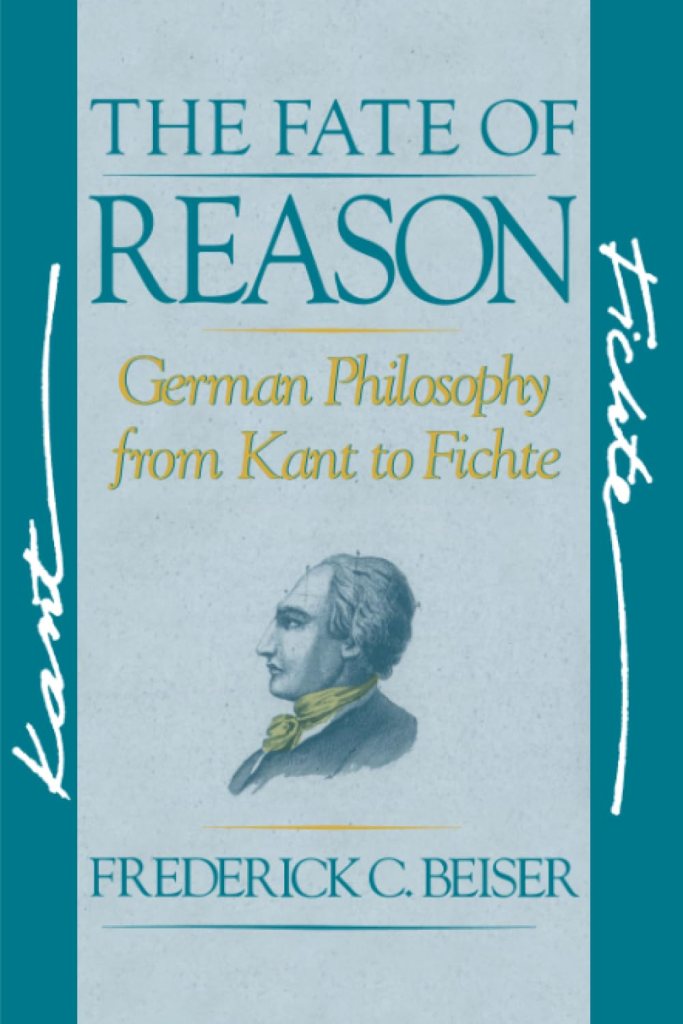
This book is a journey into one of the most transformative eras in the history of modern thought, a thorough chronicle that illuminates the turbulent passage of German philosophy between the publication of Kant’s first Critique and Fichte’s early Wissenschaftslehre. It is presented with an extraordinary depth of research that captures the uncertainty and the soaring aspirations of a singular age.
The debates it surveys—from the impassioned disputes over the Enlightenment project and its trust in reason, to the controversies that swirled around Spinoza’s alleged atheism and Jacobi’s defense of faith, and culminating in the early tremors of post-Kantian idealism—give shape to a period in which the possibility of all knowledge and the very authority of human reason came under the most merciless scrutiny. The book tells a story of intellectual tempests whose reverberations remain vivid for every philosopher who asks whether reason is still the ultimate arbiter of truth. It is praised for having a lucid style and great scholarship, an engrossing narrative and serves as an indispensable reference for specialists, precisely because it combines relentless historical documentation with philosophical insight, so that readers at every level feel guided through the arena of eighteenth-century debates.
The volume offers a far-reaching study of the climate in which Kant’s first Critique was both celebrated and attacked, showing how a whole generation of post-Enlightenment thinkers wrestled with the specter of Humean skepticism and with the vexed question of whether the dictates of reason can undermine faith. In so doing, it captures how the Enlightenment’s trust in human rationality—whose dictates were held to be universal and impartial—found itself shaken by its own internal developments.
The picture that emerges reveals a critical age on the brink of redefining philosophy itself. The text recreates the Pantheism Controversy that erupted when Lessing allegedly confessed Spinozism in private, triggering an avalanche of allegations about the corrosive effects of reason’s mechanistic worldview. It shows how Jacobi’s proclamation that consistent philosophy collapses into nihilism disturbed contemporaries. It depicts Hamann’s and Herder’s misgivings about the exalted position accorded to abstract reason, as well as their insistence that language and culture embody thought far more than any Platonic realm of pure intellect. It explores the fierce reaction of the so-called Lockeans, Popularphilosophen, and Wolffians, who viewed Kant’s claims as a threat to centuries of metaphysical tradition. It clarifies the manner in which luminaries such as Eberhard, Garve, Feder, Pistorius, Flatt, Maimon, and Schulze converged or clashed, each raising subtle criticisms that would reshape the destiny of German thought.
One of the book’s virtues is its ability to weave these disputes and sometimes acrimonious quarrels into a single, integrated narrative. The flow of ideas is tracked with painstaking care, allowing the reader to recognize how apparently minor figures exerted decisive influence on Kant’s revisions or on the directions of up-and-coming philosophers. A number of readers, reflecting on the comprehensiveness of this account, have noted that the volume manages to be free from pedantry, even while it commands a formidably complete grasp of the period’s writings. In these pages, Mendelssohn, Jacobi, Reinhold, Maimon, and many others appear not just as names but as truly great minds whose concerns about skepticism, atheism, and the place of practical faith in moral life still speak to perennial philosophical anxieties.
The discussion of how Kant’s early admirers and detractors hammered at his doctrine of the thing-in-itself is detailed in all its twists, highlighting how Reinhold’s attempt to give the new philosophy a firmer foundation led to the Elementarphilosophie, and how Schulze, with incisive doubts, exposed the vulnerability of any solution that did not return to a systematic questioning into consciousness itself. The story continues into the fascinating encounter with Maimon’s remarkable mind, which, on the one hand, carried the skeptical challenge further than most of Kant’s initial readers suspected and, on the other, tried to refine transcendental idealism from within, suggesting that the tension between concept and intuition could be resolved only by a rigorous theory of determinability. In these developments, the book shows, the seeds of future philosophical systems were laid; the impetus that led to Fichte’s calls for an even more radical exploration of human freedom and its absolute foundations can be traced to these early battles over the meaning of the critical philosophy. The entire narrative casts new light on how Hegel, too, later wrestled with these metaphilosophical questions regarding the unity of concept and object, or reason and reality, recognizing that the crises of this age left behind questions that only a vast system of spirit, phenomenology, and logic could hope to address.
The scholarship throughout has garnered descriptions such as luminous, magisterial, and authoritative. Many voices have remarked upon the sheer greatness of scope with which the arguments of lesser-known polemicists are rendered alive again, thereby illustrating how “greater fish as well as lesser ones” contributed to the collective drama. The sense of immediacy one gains from seeing the historical context—the personal relationships among Kant and his critics, the impetus for Jacobi’s revelations, the personal stake that thinkers like Hamann and Herder had in preserving faith from the corrosive side of Enlightenment rationalism—reflects the author’s detailed knowledge of archival material and original texts in the German sources. The animating tension behind each philosophical conflict renders it an enthralling chronicle that repays careful study time and again.
Echoing the testimony of other scholars in journals devoted to the history of philosophy, several have praised the unified picture the work creates of an entire generation of professional, university-oriented philosophers. Some have noted that the crisis in the Enlightenment faith in reason as recounted here—involving the apparently inevitable slide toward solipsism, atheism, or leap-of-faith dogmatism—possesses parallels with metaphilosophical quandaries that arise in contemporary thought. By discovering how thinkers like Jacobi, who championed the superrational leap, or Maimon, whose relentless challenge to Kant forced new developments, the reader is made aware that certain contemporary discussions about the limits of reason, the role of language, and the social embeddedness of thought have deep roots in the eighteenth-century controversies. The universal laws of nature that once seemed self-evident under Newton’s influence became, in this age, the basis for agonizing reflection on whether the unity of reason and reality is itself but a creation of the mind, or a cosmic order threatened by the unstoppable dissolution into empiricism, skepticism, or moral despair.
Within this sweeping narrative, the volume pays homage to the momentous shift that carried Europe from the heyday of the Aufklärung’s confidence in critical thought to the beginnings of a Romantic sensibility in which language, history, and intuition would reveal new depths of reality. The demise of old Wolffian metaphysics, the traction gained by the Sturm und Drang, and the surging interest in Spinoza’s one substance—viewed by some as a testimony to reason’s farthest reach, by others as the embodiment of a godless machine—are all revealed as part of one of the most revolutionary and fertile intervals in modern philosophy. The text therefore becomes more than a linear account of who said what in response to Kant; it is an in-depth exploration of the internal logic that propelled the era from trust in reason’s critique to the suspicion that reason devours itself through its own reflexive capacity. That tension, which would crystallize in post-Kantian idealism, was already brewing in controversies that took place often in ephemeral pamphlets and polemical reviews, a vast literature that this study unfolds systematically.
Commentators who bring the volume into their own teaching or their own advanced research have commended its style for being simultaneously accessible and full of nuanced detail. One reader noted that it supplies everything one could want for a deep dive into the era, that it covers obscure thinkers almost nobody else discusses in any substantial way, and that this inclusivity is part of its intrinsic value. Another has called it simply tremendous, declaring it one of the best books on philosophy ever, pointing out that, for those who venture far into the original texts of the late eighteenth century, there is no substitute for the wide-ranging documentation on offer here. Yet another reflection has shown how crucial it becomes to anyone wanting to deepen an initial reading of the Critique of Pure Reason. Because it foregrounds the controversies that surrounded Kant’s first efforts, it clarifies even the subtlest changes in the editions of the Critique—so that details of Kant’s transcendental idealism come into sharper focus once one perceives the nature of the criticisms from Eberhard, Pistorius, or Maimon, to say nothing of the richly personal and philosophical motivations of Hamann, Herder, or Jacobi.
Philosophers who seek an integrated approach to the problem of reason’s fate—whether it succumbs to skepticism or rises to new heights in its post-Kantian reconstructions—cannot bypass this work. It is a cornerstone for clarifying the broader transitions in German Idealism, since it shows why the vacuum left by the failure of old proofs for God, providence, and immortality could not easily be remedied by Kant’s practical faith, and why this in turn brought forth so many efforts to anchor certainty in a system that overcame the phenomenon–noumenon split. One appreciative account has singled out the fact that it can also be read, quite profitably, by contemporary philosophers who might not ordinarily venture into eighteenth-century German texts, because the problems about the legitimacy of reason, the nature of freedom, and the relation between experience and conceptual structures still resonate. The impetus to acknowledge that there might be no reason to trust reason if it undermines the very beliefs that sustain morality and social life is a worry that remains relevant. The searing question of how to avert nihilism remains alive in the face of scientific advance and the older metaphysical claims that might or might not support moral and religious faith.
The text has also garnered admiration for its ability to serve as a genuine sourcebook, something one can turn to when grappling with the arguments of someone like Schulze—who insisted that even the critic of metaphysics needs a justification for any first principle of critique—or for unraveling Maimon’s provocative thesis that only an infinite mind could truly unify concept and intuition. By painting these figures on a large canvas, the volume prevents us from relegating them to footnotes. In so doing, it challenges the widespread simplifications that reduce the period to Kant and a few major successors. Instead, one realizes that the post-Kantian panorama—eventually culminating in Fichte’s call for a Wissenschaftslehre, Schiller’s aesthetic turn, Schelling’s explorations of nature, and Hegel’s sweeping system—emerged out of very specific pressures that Kant’s critics forced him to acknowledge. There is even a pronounced contemporary relevance, as the epistemological and metaphilosophical crises of that era have uncanny parallels to many current debates about objectivity, historicity, and the cultural shaping of rational standards.
The book’s style is lucid, unpretentious, even graceful, but also painstakingly complete. Part of what sustains the reader’s attention is the author’s sense of storytelling. The controversies come alive as personal struggles, just as they are embedded in academic intricacies. This blending of philosophical substance and historical detail evokes praise from readers who appreciate that the interpretive lens of the volume never loses sight of the raw intellectual drama. It is a work to be savored gradually, equally suited for advanced scholarship and for guiding curious newcomers to the fundamental questions of post-Kantian philosophy. Its demonstration that the period’s fervent search for a renewed foundation, be it in faith or in the formal conditions of consciousness, originated in widely read pamphlets and sometimes ephemeral interventions offers valuable reminders that philosophy arises in real controversies, not in abstract isolation.
Writers who have commented on the significance of this exposition for understanding Hegel in particular have noted that the epochal concerns recounted in these pages—the tension between a faith in reason’s universality and the realization that reason must question itself—shape Hegel’s own vantage point, where the dynamics of consciousness, social life, and historical development becomes the key to surmounting the deadlocks that earlier thinkers confronted. Others have singled out how the attempts to salvage or reject the thing-in-itself, so thoroughly documented here, form a crucial step in the genealogical chain that leads to absolute idealism. The volume, therefore, not only reconstructs the tensions of the last decades of the eighteenth century, but it helps us see why the characteristic forms of Romanticism and idealism were direct responses to inescapable philosophical predicaments.
Readers frequently mention the deft combination of close reading and strong narrative flow, noting how the author resurrects neglected pamphlets and obscure treatises, yet always keeps an eye on the big questions about the nature and scope of criticism, the status of metaphysics, and whether reason can provide a justification for the beliefs necessary to practical life. Some observed that the approach here bridges the divide between historically oriented scholarship and philosophical analysis, engaging the analytic reader through rigorous argumentation, while also remaining faithful to the original textual complexities. It is both a model of lucidity and a good read, one that demonstrates the power of narration to convey an entire generation’s pursuit of solutions to the “fate of reason.”
The weight of its reflections on how the Enlightenment’s confidence in scientific naturalism precipitated an existential or theological crisis, has caused many to assert that no serious student of German Idealism can forgo this book. Its survey of how the era’s top minds responded to the question of whether reason’s critique devours its own grounds—whether we tumble into solipsism, fatalism, or leaps of fideistic commitment—shows the importance of the final years of the eighteenth century for the destiny of European thought. A number of readers have insisted that this single volume is indeed fundamental to comprehending the modern world’s deeper intellectual underpinnings and that it clarifies why the Enlightenment’s legacy is so ambivalent: reason’s aspirations uplift but also destabilize, leading to the real possibility of radical skepticism. The coverage of the culminating moment in which Kant’s critiques triggered a wave of theological, epistemological, and metaphysical contention is perhaps the most thorough anywhere in English, making this book irreplaceable for reference and for the sheer pleasure of seeing the dust of historical battles settle into meaningful perspective.
By focusing so acutely on the course pursued by German philosophy during those concluding decades of the eighteenth century, the book achieves what many believed impossible: it furnishes a unified yet detailed account of how an entire generation of thinkers made their living primarily from academic disputes and how that very institutionalization of philosophical debate molded its results. The scholarship displays a sense of proportion that incorporates larger figures like Jacobi and Reinhold alongside lesser luminaries whose works formed a palette of arguments and counterarguments. This approach has led more than one reviewer to judge the volume indispensable. It is the text to own for anyone who wants a single, comprehensive guide to what happened after Kant first declared that the critical path is the only one left open. The outcome was never predetermined, and in its pages we can witness the fragile negotiations between a reason that aspires to universality and a desire to preserve moral, religious, and communal values. The author’s thoroughness ensures that these complexities never reduce to a linear storyline; instead, one sees how many possible paths lay open, only some of which were eventually followed into the subsequent century.
Across its copious references and reflections, the book allows the reader to taste something of the philosophical life in late eighteenth-century Germany, at once embedded in small university towns yet also entangled in controversies that concerned the shape of modern reason itself. Here is a demonstration that the apparently technical problem of the categories’ application to phenomena speaks in fact to the heart of human freedom, that the philosophical puzzles about causality and the thing-in-itself bear the enormous burden of deciding whether one can trust reason to ground the moral and religious convictions that govern social life. In recounting these developments, the book has shaped a narrative of far more than antiquarian interest, reminding us how every generation must, in its own way, confront the question of why we obey the laws of reason and whether that obedience might undercut the very faith we rely on to bestow meaning on our lives.
The Fate of Reason is a singular contribution to the history of ideas, one that combines absorbing readability with a scrupulous fidelity to the sources. The commanding knowledge of the era has allowed it to become not just a reference but a lens that changes how readers view the entire transition from the Enlightenment to post-Kantian idealism. The twin pillars of the Cartesian tradition—universal reason and the primacy of epistemology—lose their self-evidence once one sees them subjected to the full brunt of Humean doubt, religious crisis, and the claims of individuality. This sense of crisis sets the stage for the new philosophical beginnings that soon followed, and the presentation of that crisis here has been called so full of life that many find it riveting. Even those who do not share the same abiding passion for eighteenth-century debates learn to respect them as immediate challenges that speak to the mind’s own self-reflective powers.
It is fitting that the author has been credited with a talent for showing the enduring philosophical substance behind these centuries-old disputes, bringing forward ideas that resonate with modern concerns about whether reason can ground itself or must instead rest on unprovable presuppositions. As many have stated, it is the very thoroughness of the presentation, the refusal to skip over lesser-known figures, that demonstrates how the climate of that age was truly revolutionary.
The volume is thus a great example of the complexities, stakes, and consequences that accompanied the completion of Kant’s philosophical project and the advent of post-Kantian idealism. By reading it, one acquires not only a sense of the grand achievements and missteps of the critical period but also a renewed awareness of the abiding question of whether human reason can justify its own authority or whether it must, in the end, yield to leaps of faith. This tension, more than any single chapter or polemical exchange, is the great subject of the book, which makes the tale of the fate of reason a motif of both historical fascination and philosophical depth. It is the seamless unity of broad historical perspective and philosophical rigor that truly sets these pages apart and establishes the book as a landmark in modern scholarship.
 Simon Gros
Leave a comment