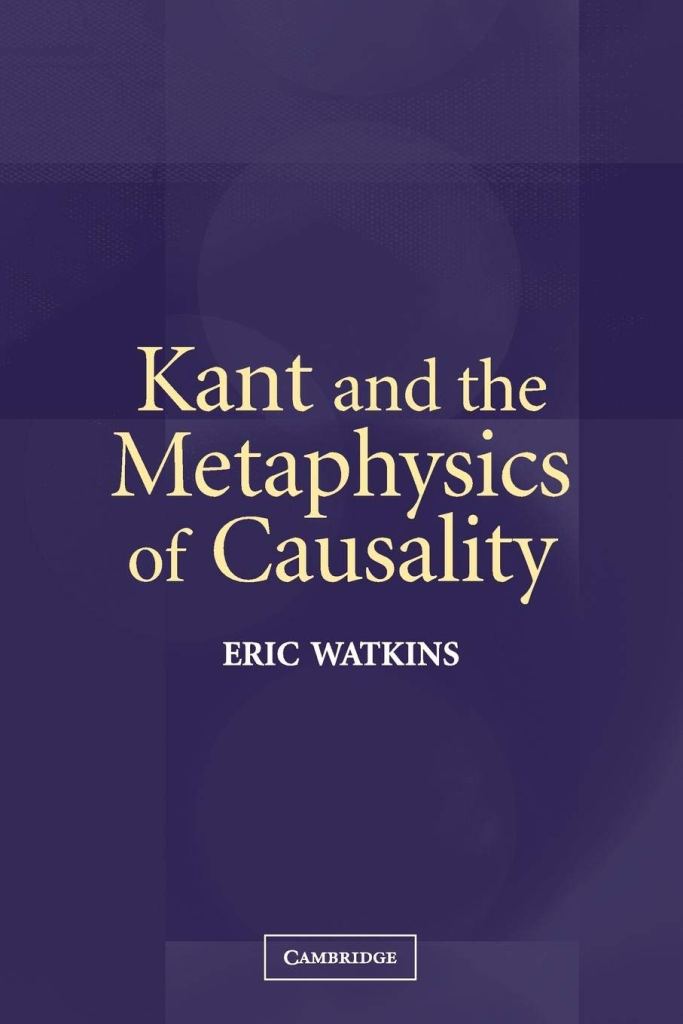
Eric Watkins’s Kant and the Metaphysics of Causality presents a uniquely thorough and philosophically substantial account of how the architectonic structure of eighteenth-century German thought shaped Kant’s understanding of the causal principles that undergird the fabric of experience.
The work does not merely highlight the ways in which Kant responded to a single empiricist challenge or advanced a purely epistemological framework; instead, it goes deeply into the Leibnizian and anti-Leibnizian currents of Kant’s era to show how those disparate influences coalesced into Kant’s critical philosophy. It thus situates the Critique of Pure Reason, especially Kant’s pivotal reflections on causality, within a broad variety of arguments that informed German philosophical debates at the time—debates that reached far beyond the somewhat linear succession often presented in standard histories of early modern thought. For anyone investigating how Kant came to believe that metaphysics and epistemology are jointly necessary for grasping why causal connections are indispensable in grounding the objectivity of experience, this book provides some of the most nuanced discussions available in contemporary scholarship.
In reconstructing the intellectual milieu in which Kant worked, the author demonstrates that Kant’s mature model of causality cannot be reduced to the familiar event-event sequence so commonly associated with the empiricist critique. Instead, Kant conceives of causal relations as interactions between enduring substances endowed with intrinsic powers—powers that they exercise according to their natures and the circumstances in which they find themselves.
By following how Leibniz’s complex doctrines of monads and pre-established harmony were received and modified within eighteenth-century German philosophy, the book reveals how Kant was motivated to move beyond the purely epistemological reading of Hume’s skepticism, incorporating as well the sophisticated metaphysical concerns about grounding and causal force that featured prominently in discussions initiated by such figures as Leibniz’s followers, Wolff, and their anti-Leibnizian critics. The author shows that, rather than ignoring these metaphysical underpinnings, Kant deftly reworked them into his critical project, preserving certain rationalist assumptions about the reality of causal connections even while recasting them in the mold of transcendental philosophy.
One of the central virtues of this interpretation is its insistence that Kant’s canonical passages on the causal principle—particularly his arguments concerning the Second Analogy of Experience, his treatment of the necessity of mutual interaction in the Third Analogy, and his approach to freedom and determinism in the Third Antinomy—all contain dimensions that are both metaphysical and epistemological. Indeed, the book insists that, for Kant, neither purely rationalist nor purely empiricist approaches can address the deep question of how objective succession or coexistence is secured in experience. Instead, Kant’s commitment to causal principles emerges from the conviction that knowledge of objectivity requires not only that the mind organize appearances according to certain categories, but also that the real structures of substances themselves be endowed with powers that exercise genuine efficacy. This shared necessity—the rational necessity of understanding how we can conceive objects as standing in necessary relational patterns, and the real necessity that the world itself be outfitted with causal capacities—demonstrates the thorough integration of epistemology and ontology throughout the critical period.
The author makes a substantial contribution to the ongoing discussion of how exactly Kant frames his reaction to Hume. Rather than picturing Kant’s philosophy as a largely psychological or epistemological counterattack on empiricist skepticism, the book documents that Kant’s writings on causal powers, time-determination, and mutual interaction have roots in the controversies that enveloped eighteenth-century German scholars, many of whom were more concerned with the details of Leibnizian metaphysics and its contested reception than with the debates that dominated British empiricism. This expands our view of the Critique by setting into relief Kant’s encounters not just with Hume’s denial of necessary connections, but also with the animated discussions around physical influx, pre-established harmony, and the attempt to reconcile philosophical theology with mechanical science. The result is a much clearer understanding of Kant’s logical procedures in the Analogies of Experience, where he connects his categories of substance, causality, and community with both the metaphysical concept of grounding and the empirical need to distinguish objective time-orders from subjective sequences of impressions.
The work stands out for the precision with which it clarifies subtle textual questions and unravels complex arguments. Readers come away with a sharper sense of what Kant intended to accomplish in insisting that no perception of succession can be experienced as objective without presupposing that something genuinely active grounds it, or that substances must reciprocally determine each other in order to populate a unitary spatiotemporal framework. These matters can remain obscure when one simply treats Kant’s categories as mental constructs or focuses only on the transcendental deduction of concepts in the abstract, without looking to their embeddedness in an earlier tradition that demanded robust metaphysical explanation. Drawing on the full range of Kant’s corpus—from his pre-critical reflections on causal grounds through the systematic positions of the first Critique and the metaphysics lectures that followed—this book provides a remarkable resource for comprehending Kant’s desire to harmonize epistemic conditions with real causal relations, thereby preventing either side from collapsing into one-dimensional theories.
Because the author places great emphasis on historical context, particular attention is paid to how the so-called German rationalists examined questions about the ontological foundations of causal influence and the real possibility of finite substances acting on one another. Various versions of pre-established harmony, theories of occasionalism, and physical influx doctrines became battlegrounds on which issues of freedom, substance individuation, and divine concurrence were hotly debated. By illuminating the ways that Kant navigated and partially reconciled these rival views, the volume sheds new light on aspects of the Third Antinomy regarding freedom and determinism, revealing that Kant’s account of transcendental freedom must be seen in the broader light of his philosophy of nature, where substances actively determine one another according to causal powers, while simultaneously preserving the possibility that rational agents can be the ultimate sources of their own free acts. This, in turn, shows how Kant’s metaphysics of causality is designed to hold together the laws of empirical science and the demands of moral accountability in a single architecture.
In its presentation of Kant’s realism about causal agency, the book also addresses contemporary philosophical concerns and reminds us that causation remains a live issue in fields like the philosophy of science. Far from confining itself to the specialized realm of Kant exegesis, the argument engages with broader metaphysical questions about whether causal connections can be fully replaced by event regularities or whether they require something more robust—namely the notion of irreducible causal power anchored in the nature of the interacting entities. By explaining how Kant’s model avoids the dilemma of having to choose between purely logical necessity and subjective psychological expectation, it presents a vision of causation that remains relevant for modern debates over how to unify the laws of physics with philosophical accounts of what ensures their consistency. In that sense, the book not only recasts the Kant–Hume confrontation from a more nuanced historical perspective, but also reopens a door to questions about whether classical notions of causal realism can still contribute to ongoing inquiries in areas such as quantum theory, philosophical theology, and the metaphysics of science.
Readers who commit themselves to the sustained interpretive effort demanded by this richly argued volume will be rewarded with some of the most incisive insights into Kant’s central project: it proves how vital it is to interpret Kant’s remarks on causality not as isolated psychological arguments but as integrated elements of a larger conception of how knowledge of the empirical world is possible in the first place. The writing is extremely clear, though the reader must bring patience and a willingness to follow subtle and complex lines of reasoning. The clarity of the exposition is, in fact, a rarity in treatises dealing with such intricate debates, and it has been recognized by many who emphasize how challenging it can be to unravel the subtleties of Kant’s interplay between metaphysics and epistemology. The book likewise takes pains to include straightforward explanations of how the deeper metaphysical concerns about real relations, the necessity of universal interaction, and the determination of substance in time all shaped Kant’s novel approach to the underlying structures of cognition.
The result is a study that stands as one of the deepest questionings of Kant’s approach to causality, eclipsing purely psychological or narrowly epistemological treatments in order to capture the metaphysical details that Kant himself took seriously. Few volumes have so effectively illustrated how the neglected metaphysical dimension of Kant’s work in the Analogies of Experience, the Third Antinomy, and his overarching framework for transcendental philosophy can be brought together to show that Kant never abandoned a firmly realist stance on the causal infrastructure of nature. This vantage also clarifies that any interpretation that restricts Kant’s critique to an answer to Hume alone misrepresents the full ambition of Kant’s engagement with the Leibnizian tradition and its critics. Consequently, the book significantly reshapes the historical narrative, explaining how Kant’s more challenging concept of causal power played an essential role in constructing the philosophical architecture of the first Critique.
Readers who approach Kant’s critical system with more than a casual interest in the transformation it wrought on modern philosophy will find that this work provides an essential map for navigating those deeper metaphysical pathways that are too often left uncharted. It not only restores causal realism as a crucial pivot in Kant’s attempt to reconcile the deterministic demands of natural science with the freedom required for moral and theological commitments but also places that reconciliation in its historical location: a philosophically vibrant eighteenth-century Germany grappling with the competing legacies of rationalism, emergent scientific ideas, and the ramifications of global transformations in physics and theology.
With its rigor, comprehensiveness, and far-reaching scope, this book indeed constitutes a fundamental resource for philosophers, historians, and scholars of the Enlightenment alike, casting new light on how Kant’s model of causality stands firmly at the crossroads of metaphysics, epistemology, and moral theory. It is thus an indispensable read for anyone seeking a full and richly documented account of why Kant believed that grounding necessary connections in a world of substances endowed with active causal powers was not merely an epistemic demand but an essential condition for the coherence of nature and the dignity of human agency.
 Simon Gros
Leave a comment