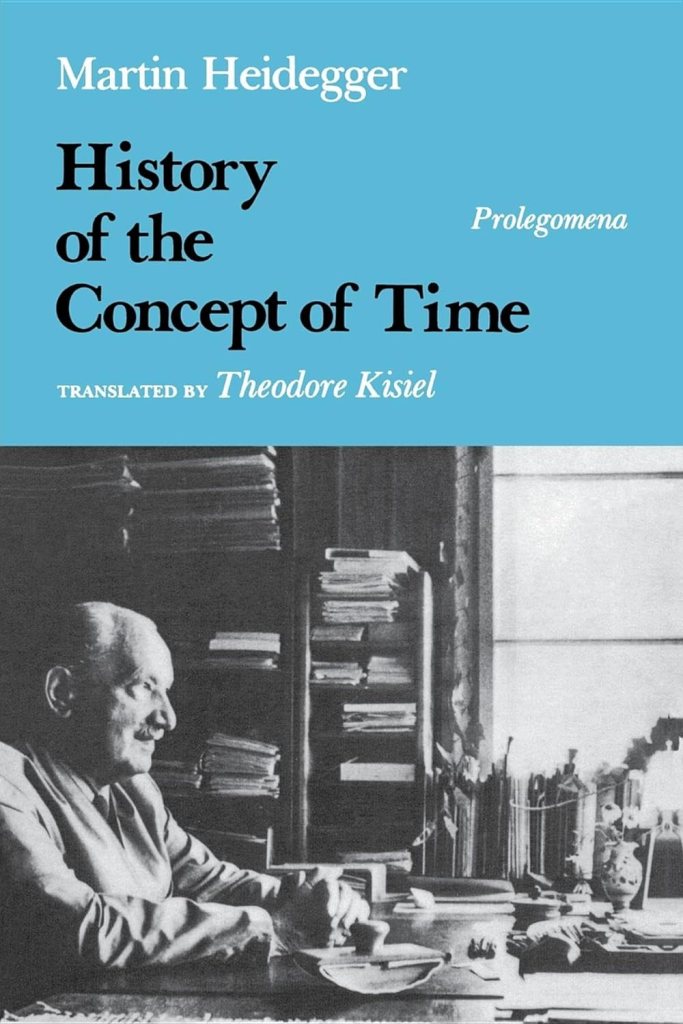
Martin Heidegger’s History of the Concept of Time is a singular entry into the philosophical canon, offering a precursor to Being and Time that reveals the formative motivations and conceptual groundwork behind Heidegger’s later masterpiece. Originating from a 1925 lecture course at the University of Marburg, it presents a phenomenological analysis in which Heidegger explores the structures that define the question of being, establishing the necessity of posing that question anew by showing how profoundly it is bound to the phenomenon of time. As one progresses through the work, it discloses how Heidegger conceives of human existence—Dasein—as the site where being and time converge, entangled with everydayness, worldhood, and the structures of care. Through this lens, History of the Concept of Time foreshadows many developments that would emerge in Being and Time, while retaining a spontaneous directness that unveils the impulse behind those final formulations.
This text offers a glimpse into how Heidegger grapples with Husserl’s phenomenology, Descartes’s subject-object dichotomy, and the necessity of returning to “the things themselves” beyond categories of psychology and epistemology. Across its pages, Heidegger examines how consciousness and the acts of intending—judgment, representation, value—point to a deeper question of the mode of being that makes such acts possible. In doing so, the lecture course both builds on phenomenological insights regarding intentionality, categorial intuition, and evidence, and propels itself beyond a purely theoretical framework, sketching a vision of time as the fundamental horizon in which existence—including death and conscience—must be interpreted.
A major fascination here is the portrait of a transitional Heidegger, still aligned with Husserlian technique but already venturing into deeper questions about the meaning of existence. The text shows how philosophy often conflates time with measurable frameworks, concealing the primordial sense in which we experience temporality as the condition of being-in-the-world. Those interested in empirical or historical treatments of time will find that Heidegger’s approach rejects both purely positivist and exclusively historiographical views, emphasizing time as a phenomenon inseparable from the way human existence interprets its own possibilities. “History,” in Heidegger’s hands, is no longer just a chronology but an ontological inquiry into how finite, project-driven beings confront temporal unfolding.
Since this course predates Being and Time, many readers find that it eases entry into Heidegger’s later thought. Its expository style clarifies fundamental issues—being-in-the-world, everydayness, care—and shows intersections with thinkers such as Dilthey and Brentano. By centering Dasein’s everyday existence, the lectures open a path for investigating spatiality, worldhood, and temporality, culminating in an early exploration of death and conscience. Although these sketches are briefer than those in Being and Time, they point to the key connection between human finitude, conscience, and time.
This 1925 presentation preserves a freshness often overshadowed by the final 1927 text. Many readers note its capacity to challenge rational empiricist models, unveiling a radically new perspective on how reality is encountered. Heidegger rearticulates Descartes’s and Husserl’s contributions, criticizing both the modern obsession with representations and the classical conflation of existence with constant presence. Rather than dismiss scientific approaches, he demands that science be grounded in an ontological investigation of its own meaning—an expansion of habitual thinking that shows how all theoretical or practical activity depends on our mode of being and the overarching phenomenon of time.
Even newcomers to Heidegger can discover in these lectures a more direct path into phenomenological ontology. While no less profound than Being and Time, History of the Concept of Time has been praised for clarifying central ideas in a more accessible way. It also elaborates on intentionality in a manner that reframes what it is to be human, and addresses authentic versus inauthentic ways of being—topics resonant with philosophical anthropology and existential thought. Though the text’s title might suggest a purely historiographical treatment, Heidegger instead excavates how time became a central problem for philosophy, demonstrating how any “history” of a concept must account for the tradition that has shaped, contested, and sometimes obscured it.
In English translation, the work has been commended for its careful rendering, capturing Heidegger’s use of Greek and Scholastic terms. It underscores the pivotal role of time for human existence—not an inert dimension but the horizon where our being unfolds. Through analyses of worldhood, dread, and care, Heidegger reveals how we always understand ourselves in light of future possibilities, shaped by finitude, so that time emerges as the essential lens through which the meaning of being is disclosed.
From a historical standpoint, this text represents a crucial moment when phenomenology was pushed to a radical edge, inspiring intense debate. Reading these lectures immerses one in the overlapping philosophical strands of Descartes, neo-Kantianism, and Husserl, all coalescing around a reconfigured concept of human existence. Students of existentialism and hermeneutics often cite the course as an ideal vantage point from which to witness Heidegger’s move from static descriptions of consciousness to the dynamic presence of lived life. Despite its far-reaching significance, the text retains a modesty that invites reflection on the conceptual seeds that would soon grow into one of the most influential philosophical works of the twentieth century.
History of the Concept of Time: Prolegomena thus grants indispensable insight into Heidegger’s shift toward fundamental ontology, revealing why the question of being and the question of time must be asked together. It illuminates the inception of ideas like everydayness, being-in-the-world, care, guilt, and death—cornerstones of later existential inquiry. The volume is indispensable for anyone wanting to see Heidegger’s signature themes as they emerge or to inhabit the intersection of phenomenological theory and lived experience. With its accessible translation, it serves as a compelling invitation to pursue Heidegger’s fundamental question, underscoring how time, once genuinely understood, becomes the key to grasping what it means to be.
 Simon Gros
Leave a comment