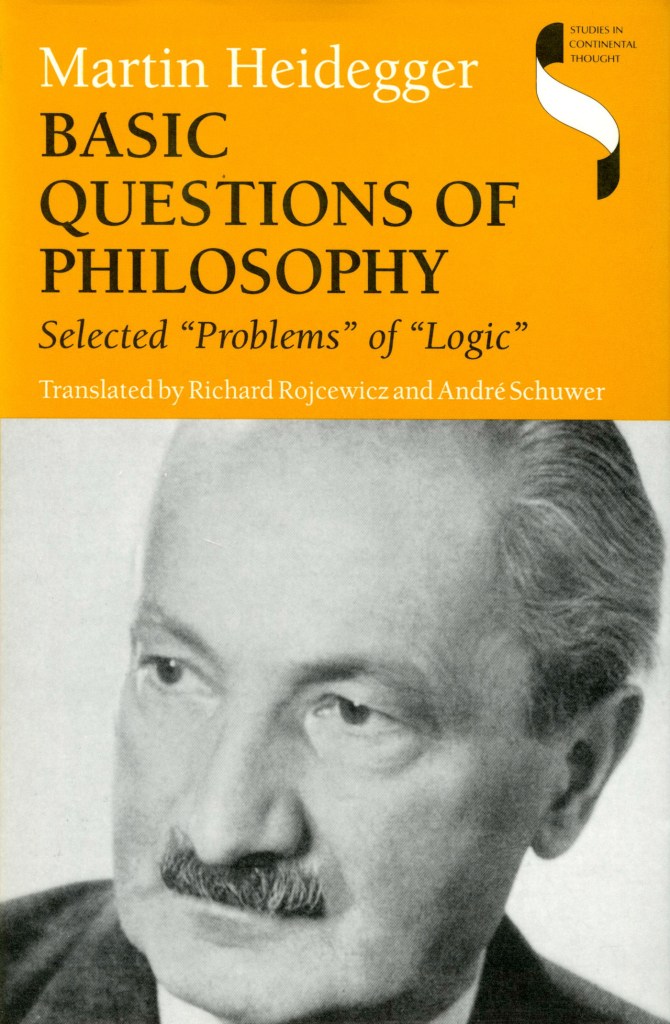
Martin Heidegger’s Basic Questions of Philosophy, emerging from lectures delivered during the Winter semester of 1937–1938 at the University of Freiburg, forms a singular point of entry into the deeper stratum of his philosophical path. The original German text, now part of his posthumously published “Collected Works” (Gesamtausgabe, volume 45), retains its uncompromising directness precisely by eschewing critical commentary, supplementary essays, and editorial embellishments. Both the German editor and the translators present Heidegger’s words as they stand, refusing to mitigate the challenging textures of his thinking with indexes or conventional guides. In that very decision, they reinforce the sense of urgency that pervades these lectures, an urgency deriving from Heidegger’s central claim that philosophy is not a mere academic or disciplinary activity but something far more radical: it is a sovereign, if immediately “useless,” endeavor that alone can pose the single, all-important question from which thinking draws its necessity. Thus, despite the work’s title, the reader quickly learns that for Heidegger, there is ultimately but one fundamental question—namely the question of Being—and that it must be approached by relentlessly putting into question the truth of what is, or, more precisely, the truth of that which allows beings to stand forth as beings at all.
Yet the lectures are not framed as an abstract questioning into “Being” that proceeds along empty conceptual lines. What emerges immediately is a concern with how one must bring oneself into the correct relation with what Heidegger terms Seyn (a spelling he sometimes adopts to differentiate a more originary sense of Being from entitative conceptions). This relation calls forth a particular disposition, named “restraint” (Verhaltenheit), in which terror and awe converge. Terror arises in the face of the most intimate and unavoidable fact: that beings simply are, rather than not; awe springs from the furthest and most concealed aspect of those same beings, namely that through them, Being itself holds sway. In that sense, philosophy, rigorous as it is in the austerity of its thinking, is nonetheless charged with disposition: not the fleeting moods of daily life, but a stance in which one preserves rather than resolves the tension inherent in confronting the concealed essence of Being. Heidegger insists that to speak lightly of such “dispositions” is to trivialize them. The element of terror remains as forceful as the dimension of awe, and these lectures repeatedly warn against any shallow popularization of that fundamental attunement.
From this vantage point, the book clarifies the unique position of philosophy with respect to other human pursuits. Heidegger distances his concept of philosophical thinking from both “world-view” and “science.” Whereas science busies itself with measurable results, data, and derivable laws, whereas world-views seek to impose overarching interpretative grids upon human existence, philosophy alone looks beyond the immediate correctness of statements to the more primordial region in which truth itself is decided. The lectures establish that philosophy must be useless in a practical sense, precisely because it opens new domains of questioning and draws the essence of things into a light that ordinary discourse rarely glimpses. This sovereign un-usefulness ensures that philosophy does not simply tack additional results onto established knowledge; instead it unsettles and transforms the very field in which knowledge operates. Heidegger’s barbed remarks about the “technologizing” of the sciences, and his wry observation that scientists are “the most miserable slaves of modern times,” further underscore his conviction that the pursuit of truth in philosophy cannot—by its essence—be subjugated to the ends and means that drive technical rationality.
In these lectures, the question of truth is introduced first as it has long been transmitted in the tradition of Western metaphysics: truth as the correctness of statements. Heidegger observes that since Plato and Aristotle, truth has been localized within the sphere of “logic,” conceived as λογιϰή ἐπιστήμη, or knowledge of assertion (λόγος). According to this schema, a statement becomes “true” if it correctly represents the being about which it speaks. Over two millennia, the concept of truth has taken shape around this axis—something is true if it corresponds to or faithfully mirrors what is. But Heidegger sees a danger in confining truth to the correctness of propositions, because it leaves unquestioned the deeper region in which “correctness” itself becomes possible. This deeper region, which he calls the essence or ground of truth, points to a more originary dimension: the openness or unconcealment (often referenced elsewhere under the Greek term ἀλήθεια), in which beings come to show themselves at all. The book centers its inquiry not on simply identifying or securing truths in the usual sense, but on understanding that which makes truth (as correctness) itself possible. This amounts to a radical transformation of the question: no longer do we merely seek to know what is true, but we ask how truth—understood as correctness—emerges from that more fundamental arena where Being as such grants or withdraws itself.
That shift of perspective shapes the structure and movement of these lectures. Heidegger clarifies early on that the lectures do not constitute a logic textbook or a systematic exposition of the so-called “basic questions” one might find in a standard introduction to philosophy. Instead, they attempt to restore philosophy to the single, pressing question that encloses and grounds all others. In a period of history that Heidegger views as increasingly “unquestioning,” where pragmatic demands and technological achievements proliferate and knowledge is increasingly partitioned into manageable pieces, this lecture course calls its listeners and readers to wonder anew about the “why” of beings, and more profoundly, about the “that-it-is” of beings. All the divergences from ordinary philosophical treatises—its digressions, its abrupt transitions, its repeated cautions against glibness—all of these reflect the lecturer’s effort to keep the question open, to sustain it at a white heat, and to ward off the inertia that sets in when one treats it as just another item in a philosophical catalog.
His reflections on “history” make this orientation still more manifest. Heidegger distinguishes between the historiographical approach, which gathers facts about past doctrines, and the genuinely historical approach, which enters into a confrontation with the concealed impulses of a tradition in order to probe what still remains unthought. Merely recounting Aristotle’s or Plato’s doctrines of truth will not suffice. One must retrieve the originary impetus behind the ancient Greek interpretation of being as constant presence, the impetus that led to identifying what something is (its essence) with its “look” (ἰδέα). By showing how deeply this identification shaped Western philosophy, Heidegger indicates that we must also move beyond it. We cannot dispense with the heritage of classical ontology simply by discarding it. Rather, we need to delve into its fundamental presuppositions—such as the definition of essence as that “whatness” which remains universal and unchanging—and see how they guided the notion of truth as correctness. Only then can we measure whether these presuppositions have truly exhausted the matter, or whether they have in fact blocked from view the more originary question that lurks at the edges of metaphysical history: the question of how Being’s own truth first springs forth into unconcealment.
Throughout, Heidegger intimates a precise kind of “shock” that occurs when one enters this question with genuine seriousness. The text describes the uncanny blend of terror and awe in confronting the sheer fact that things are, and this stands as a testament to Heidegger’s view that philosophical questioning is never a casual or merely conceptual game. One sees just how inseparable the question of truth is from a questioning of human existence itself: the only way to ask why or how there are beings rather than not is to place oneself into the posture of a seeker. This posture is neither a restlessness to find final answers nor a contentment to gather data, but a watchful holding-oneself-back—Verhaltenheit—that refuses to fill in the emptiness with easy solutions. Precisely there, in this withheld stance of asking, new domains of reflection come into view.
While the lecture course devotes considerable attention to the doctrines of Plato and Aristotle, it is by no means an antiquarian exercise. Heidegger’s remarks about the “futural” nature of philosophy underscore the fact that only by confronting the very root of Western thought can one open a pathway that does not simply replicate worn-out metaphysical assumptions. By returning to the Greek sense of essence as that which “shows itself” in the look of a being, Heidegger reawakens the possibility of an alternative thinking of truth—a thinking that subordinates correctness (the matching of proposition and entity) to the deeper domain of how beings come to reveal themselves or remain concealed. This shift reverberates far beyond the domain of academic philosophy because it redefines what it means to know and be known, to speak and be heard, to dwell meaningfully in a world.
What solidifies the importance of this course is its proximity in time and substance to Heidegger’s composition of the “Contributions to Philosophy (Beiträge zur Philosophie).” These two writings, as the editor of the Gesamtausgabe notes, are intimately linked, and the present lectures serve as an “important and immediate preparation” for grappling with the intricacies of the Beiträge. Hence anyone seeking to navigate Heidegger’s more challenging later writings will find here the conceptual seeds that flourish into his unconventional terminologies. The meditation on the “question of truth” as a key to the “question of Being” recurs insistently in those later reflections. Thus, far from being a minor lecture course on a specialized topic of “logic” or “theory of knowledge,” the text stands at the heart of Heidegger’s broader philosophical project, unearthing the sense in which logic itself may harbor an inherited distortion that prevents us from glimpsing the phenomenon of truth in its more primal aspect.
Understood in this way, Basic Questions of Philosophy becomes both a rigorous unraveling of the Western tradition and a summons to re-think what it means to be human at all, especially in the face of what Heidegger regards as the looming danger of a completely unquestioning age. In that age, the spectacle of technological marvels and the multiplication of scientific facts can easily distract us from the fundamental ground of our own existence as seekers. Heidegger insists that philosophy, despite its apparent uselessness, alone ventures into the region in which it becomes imperative to ask: what is the essence of truth, that which makes all particular truths possible? And in so doing, these lectures challenge the reader to recognize that the very act of questioning is itself the highest moment of finding, because each ostensible answer must remain provisional if it truly stands in service of this deeper quest.
The translators’ contribution, though silent in interpretation, illuminates one further dimension of Heidegger’s message: the fact that his prose is “difficult,” even in the original German, mirrors the fundamental complexity of the question at stake. Subtle word choices, the repeated use of terms like Seyn or Verhaltenheit, and the interexchange of Greek philosophical vocabulary with modern German all reflect that the question of Being has never been a matter of straightforward articulation. Indeed, if philosophy is “the most rigorous thinking in the purest dispassion,” then it must clothe itself in a language that refuses to yield to the easy familiarity of everyday expressions. In resisting the reductive clarity that a simpler vocabulary might afford, Heidegger forces the reader not just to read but to undergo the experience of the question itself—a procedure consistent with his aim of compelling us to see that philosophy is more than the acquisition of knowledge. It is an engagement with that concealed dimension wherein we learn that truth does not lie in tidy formulas but in a revealing that remains at once essential and fugitive.
Those seeking a thorough confrontation with Heidegger’s legacy must contend with this text, not simply to enlarge their knowledge about “logic,” “truth,” or even “Heidegger’s thought,” but to open themselves to the radical possibility that the very meaning of philosophizing is at stake. The title, in its seemingly straightforward naming of “basic questions,” hides the deeper insight that all genuine philosophical inquiry ultimately reverts to the single, timeless question of why beings are and how Being presences. Such inquiry does not so much establish final resolutions as it does transform our essential stance, enabling us to abide in the wonder that there is something rather than nothing. In that abiding, the essence of truth starts to show itself, not as a mere property of statements but as the very domain in which both terror and awe interlace, calling humans to a most peculiar sense of responsibility: to remain open to that which is most worthy of questioning, and to do so in the sobriety and vigilance of thinking.
For these reasons, Basic Questions of Philosophy surpasses the mold of a typical philosophical treatise. It destabilizes the inherited assumptions about knowledge, logic, correctness, and the pursuit of truth, thereby gesturing toward an alternative approach that must be enacted, not merely contemplated. Because it is intertwined with Heidegger’s contemporaneous work on the Beiträge, it speaks urgently to the fundamental turning Heidegger envisions for Western thought, the turning in which the question of Being no longer stagnates in the forms of traditional metaphysics but reawakens its original power to astonish, command, and transform. It thus demands of the reader a patient immersion in the text’s orbit of thinking, an immersion that the author himself describes as requiring absolute investment in the question. Only through that investment—and the sustaining of the basic disposition of restraint—can one adequately appreciate how this course is neither a superficial exercise in philosophical history nor a technical manual of logic, but a path that leads us to the authentic core of Heidegger’s inquiry.
What may initially seem like an esoteric meditation on the meaning of truth soon discloses itself as an elemental reckoning with the entire heritage of Western thought. The book’s refusal to supply immediate “results” compels a different kind of reading, one that wrestles with the ancient Greek intuitions, the Scholastic transformations, the modern obsessions with science, and the contemporary drift into a civilization that idolizes the “unquestioned.” Only in refusing to look away from that drift do we discover how urgent Heidegger’s call truly is. By calling into question everything that normally grounds everyday judgments, these lectures test whether our age can still hear, and respond to, philosophy’s singular demand.
For those drawn to such a thorough renewal of the question of truth, Basic Questions of Philosophy is an indispensable threshold: it reveals, however starkly, that the genuine locus of truth is not the correctness of propositions but the unfathomable region in which Being unfolds its essence and grants us the capacity to know in the first place. And it reveals, with a kind of formidable simplicity, that here lies the task that envelops all other tasks, rendering philosophy not a contingent ornament of culture but the sovereign measure of our destiny as beings who can still, in the midst of pervasive forgetfulness, choose to ask the most fundamental question anew.
 Simon Gros
Leave a comment