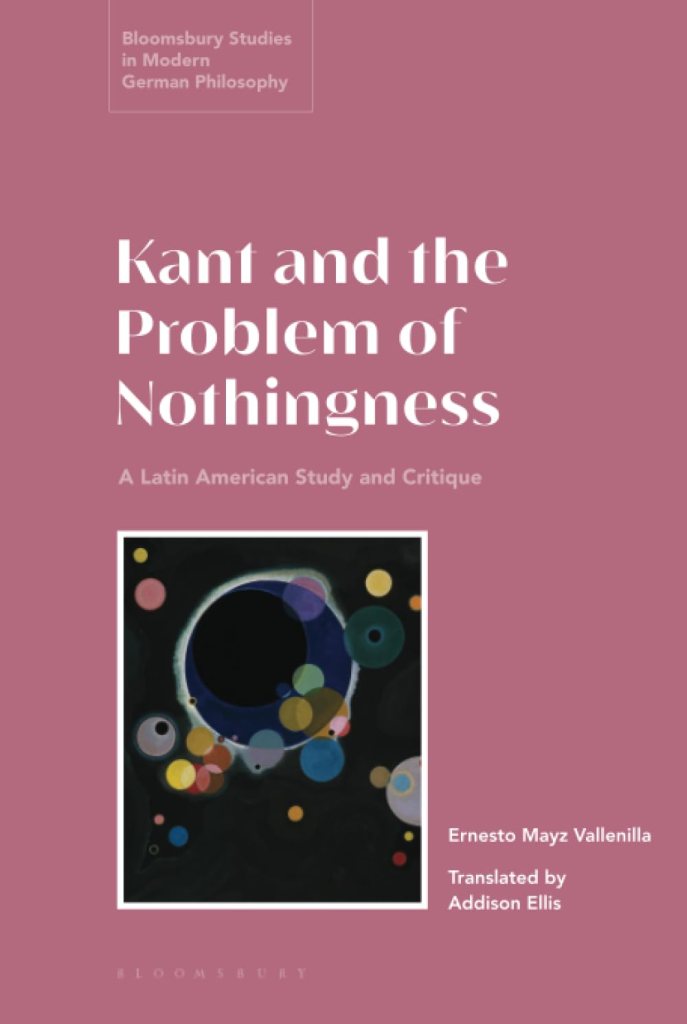
Ernesto Mayz Vallenilla’s Kant and the Problem of Nothingness, recently translated into English by Addison Ellis, marks a pivotal recovery of a neglected yet profoundly original philosophical voice from Latin America. Originally published in 1965, Mayz Vallenilla’s text undertakes a systematic investigation of the concept of nothing (nada) within the architecture of Kant’s Critique of Pure Reason, focusing especially on the Table of Nothings appended to the Transcendental Analytic’s Amphiboly chapter. Though briefly addressed by Kant and often disregarded by modern commentators, this Table is, according to Mayz Vallenilla, both methodologically essential and ontologically revelatory. It does not merely complete Kant’s architectonic; it exposes a hidden yet indispensable horizon of temporality that conditions the very intelligibility of metaphysical reflection.
The work aligns itself with and simultaneously critiques Heidegger’s radical rereading of Kant—most forcefully articulated in Kant and the Problem of Metaphysics—and thereby positions itself at the intersection of three traditions: classical German philosophy, 20th-century Continental hermeneutics, and a Latin American philosophical phenomenology that remains underacknowledged in the Anglophone world. That this text has now been rendered into English for the first time, sixty years after its initial publication, is not simply a matter of intellectual archaeology. It is a belated but necessary correction to a profound asymmetry in global philosophical discourse—an asymmetry that has historically excluded the Latin American contribution to Kantian and post-Kantian thought. Ellis’ translation, supplemented by a critical introduction and glossary, is meticulous in preserving Mayz Vallenilla’s terminological precision and phenomenological intent, and offers an indispensable resource for those seeking to understand how Kant’s system bears on the most fundamental question: the meaning and structure of nothingness.
Mayz Vallenilla’s approach begins by acknowledging the conceptual fragility of nothingness within language itself. All meaningful expression presupposes reference to some kind of being. To speak of “nothing” is already to posit it within a discursive framework saturated by ontological presuppositions. Language, in its ordinary function, elides the ontological difference by rendering Being and beings (or nothing and nothings) interchangeable. This compels a methodological reversal: the inquiry into nothingness must begin not with propositional assertions but with what language shows rather than says. In this way, Mayz Vallenilla follows the Heideggerian path of uncovering the phenomenon of nothingness via moods such as anxiety, where the world withdraws and the subject is confronted with its own finitude. Yet he does not rest with Heidegger’s account. Instead, he returns to Kant—not merely as a historical source, but as a philosopher whose categories and schemata reveal a hidden temporal logic that, once unearthed, allows for a radical rethinking of the concept of nothing itself.
Each of the four “nothings” in Kant’s table—ens rationis, nihil privativum, ens imaginarium, and nihil negativum—is treated by Mayz Vallenilla in a separate chapter, each of which constitutes a phenomenological excavation of that concept’s structure and implications. In the case of the ens rationis, Kant identifies a “concept without an object,” an abstraction that lacks any possible empirical referent, such as the noumenon. This is the epistemic limit-case of discursive reason, and Mayz Vallenilla argues that it cannot be dismissed as a mere conceptual placeholder. It reveals a deeper structure of cognition whereby the unity of apperception—the transcendental “I think”—is itself not timeless, as Kant sometimes implies, but temporal in a sui generis sense. Even the most abstract operation of the understanding, if it is to be understood as an act or function, presupposes temporality. The permanence and fixity Kant attributes to apperception are, on closer inspection, temporal determinations. Hence, ens rationis, although devoid of empirical objectivity, is disclosed through a temporal horizon that cannot be ontological in the classical sense. Mayz Vallenilla therefore uncovers a form of pure negativity that operates independently of empirical content but is still structured by time.
In analyzing the nihil privativum—a “concept of the absence of an object,” as in cold or darkness—Mayz Vallenilla confronts a Kantian paradox. Since all cognition requires sensation, and since privation is the absence of sensation, how can it be cognized at all? Kant seems to assert that total absence is not representable. Yet, through the phenomenology of deep sleep and Heideggerian anxiety, Mayz Vallenilla demonstrates that we do indeed experience nothingness as a phenomenon—not as a negation of something previously given, but as an original, self-revealing absence. In deep sleep, the subject is engulfed in a field devoid of sensory data, and yet time does not vanish. On the contrary, temporality is intensified in its abstraction from events. In such experiences, time is no longer the ontological succession of instants tied to perception and action. It becomes, instead, the horizon of the disappearance of presence—the pure temporality of nihilating experience.
The third concept, ens imaginarium, focuses on the forms of space and time as intuitions without objects. Kant describes these as “empty data” and insists that they are not appearances themselves, but conditions of the possibility of appearance. Mayz Vallenilla interrogates the paradoxical ontological status of such forms. They “exist” in a non-empirical mode; they are real, yet not beings. Kant’s characterization of them as “nothing” thus demands further analysis. What is the mode of existence of a form that is not actual but nonetheless operative in all acts of cognition? Mayz Vallenilla’s response is to push Kant’s theory of schematism to its limit. If space and time are formal conditions, then they too must be schematized. But schematism, as Kant defines it, operates only for the categories of being. What, then, is the schematism of nothingness? Mayz Vallenilla proposes an “anti-schematism” that would correspond to the anti-categories of the Table of Nothings. This leads him to posit a radical reconfiguration of temporality—not the time of physics or even the inner sense of empirical experience, but an originary temporality that is the condition of both being and nothingness. In this way, ens imaginarium becomes the key to disclosing a temporal structure that underlies even the purest abstraction. Time here is neither successive nor metric; it is ecstatic, horizonal, and pre-ontological.
The final category, nihil negativum, presents perhaps the most difficult problem: the nothing of contradiction. A two-sided rectilinear figure, for example, is logically impossible—not merely because it contradicts itself conceptually, but because its contradiction emerges through its attempted construction in space. That is, its impossibility is not merely logical but ontological. Mayz Vallenilla interprets this as a clue: the principle of contradiction is not only a law of thought but also a reflection of temporal form. When an object’s internal structure violates the schema of temporal presentation—when it posits incompatible determinations in a single instant—it ceases to be thinkable as an object. Thus, contradiction is not purely logical; it is temporally indexed. In this analysis, Mayz Vallenilla aligns with and extends Heidegger’s insight that time, not logic, is the primordial dimension of intelligibility. But he goes further, suggesting that this nihil negativum is not simply an epistemic failure. It is the point at which Reason, as pure negativity, discloses a “logos of nothingness.” This logos is not governed by the principle of identity but by the structural openness that allows for the appearance of impossibility itself. Reason, when it ceases to affirm, becomes a disclosive negativity—a temporal rupture that constitutes the very condition for the appearance of the impossible.
What emerges from Mayz Vallenilla’s inquiry is not a rejection of Kant but a reactivation of his critical project at its deepest level. He accepts Kant’s basic framework but insists that the Critique of Pure Reason contains within itself the seeds of a more radical philosophy—one in which the unity of cognition is rooted not in categories alone but in an originary temporality that enables both the appearance of being and the experience of its absence. Kant’s table of nothings, in this reading, is not a peripheral addendum but a suppressed center. It is the aperture through which the temporal structure of finitude can be seen—not as a deficiency, but as a philosophical resource.
To be sure, Mayz Vallenilla’s book is not without its challenges. His phenomenological method demands close attention, and his style—imbued with echoes of Ortega y Gasset and steeped in the idiom of post-Heideggerian metaphysics—may require effort from readers habituated to more analytic forms of Kant scholarship. Yet this effort is amply rewarded. For those willing to engage with its arguments, Kant and the Problem of Nothingness offers not only a reconstruction of a neglected Kantian motif but a transformative reorientation of critical philosophy itself. It shows how temporality, conceived not merely as the form of inner sense but as the horizon of all intelligibility, can ground an entire metaphysics of absence.
In recovering this text, Addison Ellis has not only restored a major Latin American philosophical voice to the global conversation; he has also provided Anglophone philosophy with an indispensable resource for reassessing its own assumptions. As Morganna Lambeth (California State University Fullerton) has emphasized in her review, Mayz Vallenilla’s phenomenological method often surpasses Heidegger’s own in clarity and coherence, especially by anchoring metaphysical claims in phenomenologically concrete experiences like sleep and anxiety, rather than abstract transcendental deductions. More than a historical recovery, then, this translation constitutes a philosophical intervention. It urges a reckoning with the unthought within Kant, the temporal within the logical, and the nothing within the very structure of reason. In so doing, it opens a path that is at once faithful to Kant’s legacy and radically transformative of it.
 Simon Gros
Leave a comment