
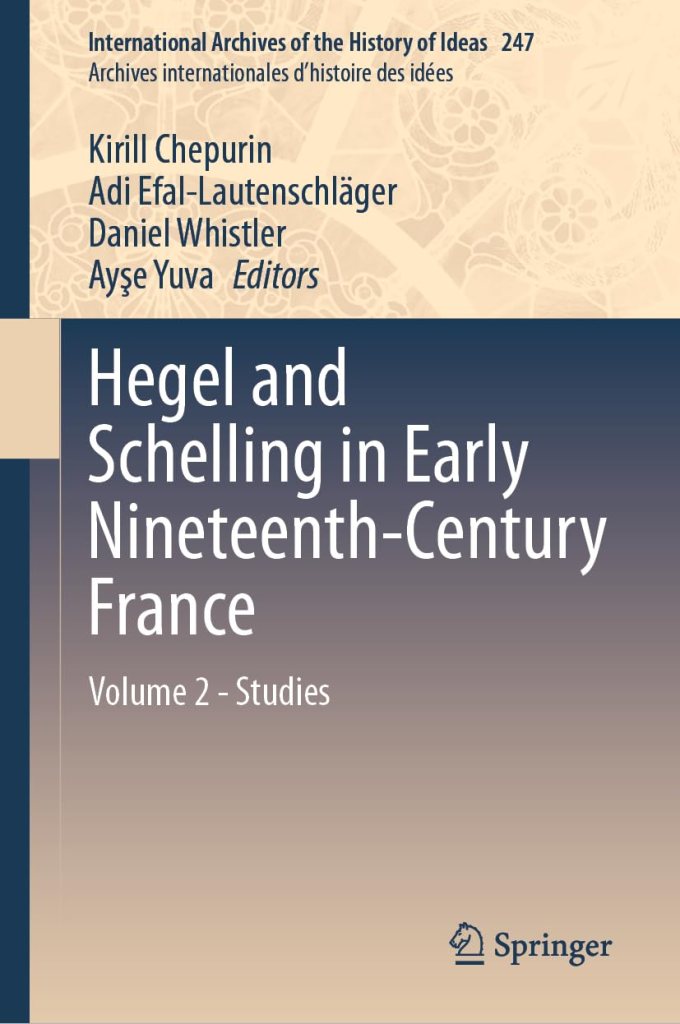
In these two volumes, drawn together under the common title Hegel and Schelling in Early Nineteenth-Century France, a rich panorama of philosophical exchange emerges, one that gently but decisively overturns many entrenched perspectives on the reception of German Idealism. From the outset, the books proclaim a sweeping project: they place before our eyes the overlooked arena of early nineteenth-century France, in which G.W.F. Hegel and F.W.J. Schelling were not only known but extensively debated, recast, and translated well before the canonical mid-twentieth-century landmarks of the “French Hegel,” so often associated with Jean Wahl and Alexandre Kojève. In drawing attention to a much earlier moment, stretching from 1801 to 1848, these volumes position themselves as indispensable companions for understanding how philosophical concepts, textual practices, and institutional frameworks moved and mutated across the Rhine. They dispel the longstanding myth that Hegelian or Schellingian influence upon French thought began suddenly, almost spontaneously, in the 1930s. With the utmost erudition, they delineate instead the pathways, channels, controversies, and revivals that gave form to a Franco-German intellectual space of decisive consequence for modern philosophy.
The first volume, subtitled Texts and Materials, opens a treasury of interpretative tools, primary sources, and historical reconstructions that offer a foundation for specialists and non-specialists alike. It restores access to eighteenth- and nineteenth-century French translations of Hegel’s and Schelling’s works, now largely forgotten and rarely consulted, while also providing excerpts of major philosophical writings of that era in English translation for the first time. Across its pages, one discovers an introduction to transnational reception history, a historiographic methodology that transcends the confining notion of purely national canons and instead emphasizes the ceaseless circulation of ideas between borders, journals, and educational institutions. This enables the reader to see how multiple frameworks of appropriation or rejection arose in nineteenth-century French circles: certain figures recast the German Idealist project in new terminologies, while others denounced it as a symptom of pantheism or political radicalism. The volume’s editors catalogue the original French editions and translations of the German Idealists; they also chart the many lesser-known but vital publications, cultural mechanisms, academic structures, and journals that transmitted Idealist ideas to an ever-growing French audience. By guiding us through a detailed chronology of key philosophical works and events and by presenting an extensive biographical register of protagonists, the volume maps a topography of ideas that defies the superficial assumption that Hegel or Schelling were minor presences in Restoration and July Monarchy France. Instead, one sees that the seeds of a broader European philosophy were being quietly planted and cultivated well before the twentieth century’s more famous expositors turned to Hegel’s logical architecture or to Schelling’s evolving metaphysics.
Whereas the first volume illuminates the textual and material bedrock, the second volume, subtitled Studies, gathers together a series of wide-ranging scholarly investigations by experts based in Europe, the United Kingdom, and North America. These investigations build upon the archival and documentary riches of the first volume, plumbing the deeper theoretical stakes of how German Idealism was received, contested, and metamorphosed in the French context. By reading these focused studies, the reader is exposed to the many intersections that French interpreters established between Idealist notions of reason, religion, art, and society on the one hand, and specific homegrown debates about the status of spirituality, the progress of history, and the possibility of collective moral advancement on the other. Such intersections, rarely illuminated in conventional histories of nineteenth-century thought, reveal that the apparently stable boundaries between “French philosophy” and “German philosophy” were anything but inviolable. Long before Hegel or Schelling became emblematic of dialectical or metaphysical grandeur in France, their theories had been sifted and rearranged by philosophers and journalists intent upon testing the speculative claims of the post-Kantian universe against French concerns with social perfectibility, religious sentiment, and the forms of academic instruction.
The second volume exposes the lively debates that swirled around these questions, from the translation debates sparked by the close textual analyses of Hegel’s Aesthetics or Schelling’s Naturphilosophie, to the suspicion of pantheism in the French Catholic press, to the enthralling but polarizing reading of Hegel among proto-socialist or radical circles such as those influenced by Saint-Simon or Leroux. A number of contributions here bring out the ferment around the notion of the “Absolute” and its potential to displace or reinforce Christian categories; others show how radical political figures, including Proudhon, absorbed Hegel’s contradictory logic of property and class but inverted it to advocate new social arrangements. The complexity of these paths exemplifies that the early French responses to German Idealism were neither systematically adoring nor systematically dismissive. Instead, the responses were ever in flux, shaped by intellectuals with distinct motivations, prejudices, and institutional allegiances.
Crucially, these two volumes put forward not only the major names—Cousin, Leroux, Proudhon, Quinet, Ravaisson, Renouvier, and Véra—but also the remarkably forgotten or “minor” figures who now come to stand at the heart of the story. Writers such as Barchou de Penhoën, Bénard, Lèbre, Lerminier, Pictet, and Willm inhabited borderlands, both geographically and intellectually, between established currents of French thought and the new wave of Idealist speculation emerging from Germany. This focus on minor or obscure authors, as demonstrated in the two-volume set, is one of the keys to understanding the complexities of transnational exchange. In many cases, it was precisely these lesser-known authors, often publishing in ephemeral journals or enjoying modest professorial posts, who became the actual conduits for the flow of Hegelian or Schellingian ideas across the Rhine. Their seemingly small initiatives—translating an essay here, critiquing a notion there—were the threads from which the larger variety of Franco-German philosophical culture was built. The editors persuasively argue that our conventional histories of nineteenth-century philosophy, obsessed with major French and German luminaries, have too often suppressed this complex phenomena of overlooked mediators and contexts. By attending to them, the volumes manage to circumvent the assumption that Hegel’s or Schelling’s significance can be measured purely by the handful of canonical readers in the subsequent century.
One sees, moreover, that the emphasis on transnational reception history is inseparable from a critique of nationalistic historiography. The editors stress that, in the early nineteenth century, philosophy’s institutional moorings in universities and learned societies became far more entangled with state interests, thereby deepening the sense that German philosophy and French philosophy were distinct pursuits with distinct missions. Yet the story recounted here shows how quickly such boundaries were undone by actual textual itineraries, personal voyages, academic appointments, bilingual periodicals, and correspondences. The shared impetus of both volumes is thus to reconstruct these intellectual itineraries—to trace the “mutation, contestation, and hybridization” that shaped Hegel’s and Schelling’s presence in France, and to exemplify, through vivid historical detail, the ways in which philosophical argumentation was itself transformed by the mechanisms that disseminated, translated, and sometimes distorted it. This documentation points to a near-constant process of rewriting, in which French commentators would revise Hegel’s or Schelling’s grand statements on logic or identity in order to accommodate local interests in moral life or spiritual introspection. As they were read, taught, and critiqued in journals, the German Idealists came to mean something new: a promise of unity between thinking and being, or a dangerous slide into pantheism, or even the theoretical legitimization of certain socialist ideas. The volumes thus refuse the notion that we may measure “influence” as a linear projection from center to periphery. Rather, these books depict reception as active re-creation, as a process of appropriation in which German texts were recast in the distinctive framework of French cultural and philosophical practices.
In the first volume, the reader encounters excerpted translations of once-influential works that had shaped the young Cousin’s or the young Leroux’s view of German philosophy. This is coupled with a general narrative describing how Hegel’s and Schelling’s philosophies found their fates in early nineteenth-century France, largely through the channels of publishing, the ephemeral journals and gazettes that abounded in the era, and the institutional structures that regulated philosophical instruction. Added to this, the book includes an analytical catalogue of all the contemporary French editions and translations of Hegel’s and Schelling’s principal texts, along with the major books and pamphlets that interrogated or adapted their legacy. By surveying these publications, it shows how, by the late 1830s and early 1840s, Hegel’s name, as well as Schelling’s, had attained sufficient intellectual resonance to be admired by some (who saw in them a logical or spiritual revolution) and condemned by others (who denounced them as irreligious or subversive).
The first volume’s introduction thus provides a historically and methodologically robust entry point into this “neglected field in the history of ideas.” The editors emphasize that the conventional story of French Hegelianism, beginning with mid-twentieth-century existential or phenomenological readings, is not wrong but is fatally incomplete if it overlooks the seeds sown in the first half of the nineteenth century. They equally underscore that the same is true of Schelling, whose influence was, for a time, entangled with Catholic spiritualist discourse in France, championed by thinkers like Ravaisson or Secrétan and then transmuted again when Schelling’s own late philosophy sought to critique Hegel’s purely logical approach. By portraying how French philosophers took up these concepts, transformed them, or even repudiated them, the volume illuminates the incessant rearrangement that characterizes philosophical transfer.
The second volume then builds upon the documentary bedrock with a series of studies that dissect the stakes of this reception with admirable depth and specificity. Each contribution, written by specialists in the history of ideas and the history of philosophy, situates German Idealism in the lived intellectual debates and institutional milieux of early nineteenth-century France. The volume shows that Cousin’s spiritualist eclecticism was not the only site of Hegelian or Schellingian influence, nor was Saint-Simonian speculation the only radical appropriation of “the German school.” Many authors—ranging from the self-exiled German poet and polemicist Heinrich Heine, to the Catholic publicist Lamennais, to the early translator Charles Bénard, to the lesser-known Barchou de Penhoën—each played distinct roles in shaping the significance of absolute idealism.
By detailing these multiplicities, the editors hope to demonstrate the impossibility of confining the history of philosophy within neat compartments called “German” or “French.” Instead, the volume underscores how philosophical endeavor, in that fervent age of Restoration and July Monarchy, was continually entangled with theological debates, literary expressions, political activism, and broader cultural transformations. Indeed, one repeated theme among the volume’s contributors is how the newly consolidated institution of the university itself served both as a vehicle for transnational dissemination—via planned visits to German academies or the appointment of correspondents beyond the border—and as an arena for critical confrontation, in which rival factions fought to define what a permissible and “correct” philosophy should be. This frequently drew in Hegel’s name as an example of pure rationalism or pantheistic danger, or Schelling’s as an emblem of near-mystical speculation about nature and freedom.
The volumes together also highlight the anxieties of some French observers confronted with Hegel’s dialectical method, reputedly so abstruse as to defy translation. Through the thoughtful presentation of archival finds—early renditions of Hegel’s terminology, partial translations in journals, the perplexing coinages that sought to capture the nuances of Geist or Begriff—one observes the real labor of forging a philosophical lexicon where no robust tradition existed. The question of whether Hegel’s logic could be rendered faithfully into elegant French was a constant theme in the 1830s and 1840s, generating parallel reflections on how German styles of reasoning might or might not take root in a country that prized clarity, distinctness, and rhetorical persuasiveness. At the same time, this anxiety itself became a motive for some French thinkers to assert their own superiority in matters of exactness and conceptual clarity. Thus, one sees how an apparently straightforward problem of translation gave rise to a subtle interplay of cultural claims and intellectual negotiations.
In restoring this complex story of exchange and influence, Hegel and Schelling in Early Nineteenth-Century France not only corrects a glaring omission in Anglophone scholarship regarding early nineteenth-century French thought, but also offers a new vantage point for reflecting on the history of modern philosophy itself. The volumes’ stress upon neglected authors clarifies how the German Idealists were actually read by contemporaries in France, rather than how later tradition constructed their memory. By foregrounding the porous border regions—especially the Swiss and Alsatian mediators, who were bilingual and could navigate between the German- and French-speaking worlds—the set shows that these figures, who have so often lingered in obscurity, were precisely those whose labor shaped intellectual life between nations. Such work points beyond a merely antiquarian interest; it implicitly calls for a revised understanding of German Idealism’s legacies, since the philosophical energies that shaped later French spiritualism, or that spurred certain forms of radical political thought, cannot be properly grasped without reference to this earlier chapter.
Throughout the two books, one senses the editors’ underlying commitment to a style of history of ideas that is simultaneously rigorous about conceptual distinctions and attentive to the actual mechanisms that cause ideas to move—journals, epistolary networks, lectures, personal travel, editorial endeavors, academic prizes, official or clandestine publishing, ephemeral societies, and cross-border friendships. This approach challenges any assumption that major philosophical systems, whether Hegel’s or Schelling’s, can be treated as self-contained cathedrals of thought. Instead, the volumes collectively advocate for an “impure” history of philosophy, recognizing how social, political, institutional, and linguistic determinants have always shaped conceptual evolution. In the France of 1801 to 1848, these determinants proved particularly powerful, since the domains of teaching, journalism, public intellectual controversy, and theological reflection all overlapped in ways that demanded a perpetual reconfiguration of German metaphysical claims.
Together, Hegel and Schelling in Early Nineteenth-Century France: Volume 1 – Texts and Materials and Hegel and Schelling in Early Nineteenth-Century France: Volume 2 – Studies affirm that the genealogies of Hegelianism and Schellingianism in France are more expansive than is traditionally recognized. One sees that debates about pantheism versus theism, about the role of nature in the logic of freedom, about the legitimacy of rational religion, and about the potential or impossibility of synthesizing all knowledge were already well developed when the first half of the nineteenth century drew to a close.
By 1848, these debates had encountered new fault lines, especially in the wake of the political revolutions that were pressing upon France and Europe. Consequently, readers may well find their standard frames of reference about the “German crisis of French thought,” typically dated to later decades, significantly reoriented. The two volumes are themselves a monument to the promise of studying philosophical transfers in their full dynamism. And they accomplish more than the reassembly of scattered translations or ephemeral pamphlets: they restore to contemporary Anglophone scholarship a vivid sense of that era’s excitement, perplexity, and creativity, thereby reopening a chapter of history that had long remained shuttered. In doing so, they enable us to reconceive how modern French thought might have been born not solely from domestic concerns, but also from a restless transnational impetus that compelled one generation of thinkers after another to turn their gaze beyond conventional boundaries, searching in foreign sources for the possibility of renewal.
Through these twin volumes, the editors—Kirill Chepurin, Adi Efal-Lautenschläger, Daniel Whistler, and Ayşe Yuva—offer a comprehensive resource of first-rate scholarship, reintroducing forgotten texts and authors, shining new light on canonical ones, and providing a marvelously thorough set of translations and analyses. They conclude by urging further inquiries beyond national narratives, beyond simplified genealogies, and beyond well-worn canons, so that one can appreciate how philosophical thought grows when confronted by the perpetual movement of concepts and people. In unveiling the dense variety of Hegel’s and Schelling’s reception in early nineteenth-century France, these volumes afford us a rare opportunity to witness the moment-by-moment formation of an intellectual tradition that will shape subsequent generations of European philosophy. The work thus stands as a definitive statement on what happens when two national cultures cross-fertilize in the domain of ideas, and in this it will prove invaluable for philosophers, historians, literary scholars, and all who value the subtle interplay of cultural, institutional, and conceptual transformations that molds the modern world.
 Simon Gros
Leave a comment