- Intro
- Ontology
- Illusion
- Metaphilosophy
- Disaster
- Destiny
- Censorship
- Failure of Internationalism
- Fragmentation of Ontology
- Of the Abyss & the Void
- Disgusting Sexuality
- End of a War
- Micropolitics of Borders
- Metaphysical Implied Corporeal Hypothesis
- Tutankamon, The Son-King
- Acumen & Evil
- Emerging Fields
- With Us, Capitalism is Genocide
- From Zizians to Zizekians
In the wake of my previous contemplations and explorations in In the Wake of Thought, where the stirring question of thought’s perpetual unfolding demanded ever deeper considerations of human agency and temporal unfolding, it becomes necessary now to gather the threads of ontology, history, and politics in a new tapestry titled Welt und Zeit (World & Time). The impetus for such an endeavor arises not only from the thirst for philosophical reflection but also from the rumblings of contemporary events, whose resonance can be felt in the silent corridors of global politics, and whose echoes reawaken the centuries-old aspiration for an end—an end to strife, an end to suffering, and an end to the illusions of finality. It is in the spirit of Kant’s vision of Eternal Peace that we stand again on the threshold of history, pondering the persistent question: Is there truly an “end” in sight, or does each pronouncement of finality merely open a new horizon of contingencies, illusions, and unforeseen complexities?
The notion of “The End,” so often called upon in the annals of philosophy, carries within it a nuanced variety of meanings. On one hand, it suggests a terminus or closure, an annihilation of what came before and a momentous leap into a new epoch or realm of possibility. On the other hand, the End can signify a telos, a purposeful culmination or the flourishing of the spirit under ideal conditions. Throughout the history of Western thought, from ancient eschatological predictions to the Hegelian idea of the end of history, the End has vexed philosophers as both promise and threat—promise in the sense of a final resolution to the unfolding dialectic of contradiction, threat in the sense that closure might dampen the impetus for growth, stifling the generative force of becoming. Within Welt und Zeit, I seek to carry forth the previous insights of In the Wake of Thought, combining reflections on the ontological dimension of endings with the raw immediacy of ongoing political events. We exist in a moment that demands we re-evaluate Kant’s aspiration for perpetual peace, examine its resonance with the illusions of the so-called golden 90’s, and confront the realities that persist as war once more appears, devastatingly, on the European continent—and beyond.
To speak of endings in today’s epoch is to confront a complex dynamics between historical memory and political aspiration. The global consciousness of the twentieth century was shaped by two catastrophic world wars, events that shattered illusions of Europe’s progressive destiny and forced humankind to grapple with the fragility of civilization. From the rubble of these conflicts, the intellectual atmosphere of the mid-to-late twentieth century offered a fragile hope: perhaps we were witnessing the final tide of large-scale, global violence, and perhaps the specter of nuclear annihilation would compel leaders to set aside their differences to preserve life itself. But the tragedy of the twentieth century was, in part, that hope for peace remained entangled with the specter of its own contradiction. The uneasy détente of the Cold War gave way, in 1989, to an era of seeming optimism—an era the popular media came to call the golden 90’s. The fall of the Berlin Wall signaled a universal sigh of relief in Europe; it kindled illusions of unification and a new dawn in which the international order would pivot toward dialogue and economic integration, thereby tempering the impetus for violent confrontation.
Yet the golden 90’s, upon closer inspection, were suffused with fault lines and contradictions hidden beneath the veneer of prosperity. It was a culmination of a post-metaphysical metaphysics of sorts. While certain regions experienced an influx of capital and the seductive wave of globalization, others were weighed down by the vestiges of colonial legacies and the unequal structures of economic exploitation. In the Balkans, the end of the Cold War gave rise not to immediate unity but to ethnic violence and a protracted tragedy that reminded us how ephemeral the illusions of final peace could be. Immanuel Kant’s ideal of Eternal Peace—rooted in the moral and rational capacity of humanity to form a federation of free states—appeared once again to hover in the distance as a noble, even if quixotic, horizon, prompting renewed philosophical debates about whether progress or historical cycles would have the final word in humanity’s story.
The notion of “The End of War” loomed large in public discourse throughout this period, propelled by a hopeful but perhaps naïve reading of developments in international relations. The integration of European nations into the European Union, the blossoming of new diplomatic frameworks, the expansion of market economies, and the belief that democracy might be universally desired all served to persuade some that large-scale interstate war might become an anachronism. From the perspective of liberal political theorists, the telos of history appeared to draw inexorably toward democratic governance, the rule of law, and the resolution of disputes through international fora. Yet, in Welt und Zeit, one must note that such optimism was precariously perched upon the complex interplay of power, both economic and military. The so-called golden 90’s masked ongoing tensions that simmered beneath the surface: regional conflicts in Africa, the Middle East, and parts of Asia; the unaddressed deep structural inequalities left by centuries of imperialism; and the ever-present possibility that great powers might once again pivot to militarism if circumstances shifted.
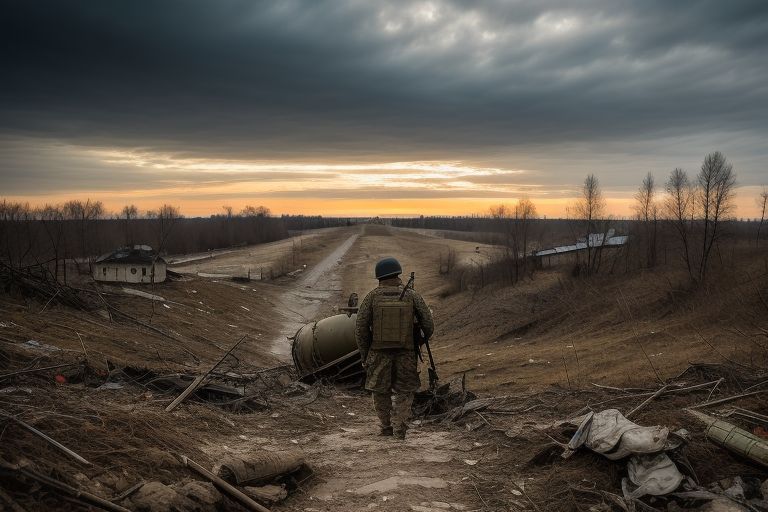
Indeed, as we gather here in the third anniversary of the War in Ukraine, the illusions of a final end to war appear shattered once more. The conflict that erupted in 2022 unleashed devastation, displacement, and a renewed sense of existential threat across Europe and much of the world. It has shown not just the fragility of peace, but also the philosophical necessity of re-evaluating what “the End” really entails. Is there truly a possibility of the End of War, of finalizing hostilities once and for all, or does each cessation simply mark a pause, a strategic recalibration until the next explosion of violence? Kant’s hope for Eternal Peace was predicated on the rational capacity of states and individuals to form lasting federative structures of mutual benefit. The historical record, and indeed the present moment, compels us to ask whether humanity’s capacity for reason will ever surpass the baser instincts that lead to conflict. Or, more in line with a certain dialectical perspective, does each new outbreak of war serve as the impetus for the next stage of moral and political evolution, thereby rendering violence ironically necessary for the forging of the new? Such speculation may appear cynical or paradoxical, yet the course of modern history suggests a tension between the impetus for progress through crisis and the suffering crisis inevitably engenders.
In the specter of the War in Ukraine, one sees once again the rallying of alliances, the intensification of rhetorical battles, and the mobilization of resources on a scale reminiscent of older, more harrowing chapters in Europe’s saga. On a deeper philosophical level, the conflict calls into question the nature of borders, sovereignty, and the illusions of stable national identity that have shaped the continent’s politics since the nineteenth century. Contemporary forms of nationalism, newly emboldened by the digital age’s echo chambers, breed suspicion and demonization. The complexity of modern warfare, with its potential nuclear dimension and the ever-evolving domain of cyber-warfare, extends the battleground into a conceptual space that touches every civilian with an internet connection. The notion of “the End” acquires an additional layer here: the sobering thought that nuclear or technological escalation could lead to a literal cataclysm. In this sobering sense, “the End” is no longer merely a philosophical speculation or the apex of an eschatological longing; it is an existential possibility that humankind might self-annihilate.
And yet, to speak of Welt und Zeit, we must hold open a dimension of hope. The philosophical reflection upon endings has often served as a galvanizing force for ethical and political transformation. In the tension between the destructiveness of war and the still-insistent yearning for peace, new political imaginaries are born. Kant’s dream of a federated world order—devoid of large-scale conflict, structured by reason and universal hospitality—remains, in some sense, an orienting ideal, even if we have rarely ventured close to realizing it. In the aftermath of each catastrophic conflict, the impetus to build new systems of collective security resurfaces with renewed urgency. Hence, the third anniversary of the War in Ukraine also marks an uneasy reflection on the tenuousness of these systems, the friction between the universal moral law and the particular interests of states, the tension between global norms and local realpolitik. Philosophically, this is not only a question of ethics or policy, but also of ontology: to what extent is the political domain reliant upon a shared sense of time and world that can be shattered by war? Does war distort our very experience of time, intensifying the present and making any future horizon of peace seem uncertain or unattainable? Does war transform the shared world into an estranged battlefield in which trust—the fundamental bedrock of the social—crumbles under the weight of suspicion?
In In the Wake of Thought, we traced how consciousness itself is shaped by the dynamics of self-reflection and the historical moment in which it is embedded. Following that thread into Welt und Zeit, we see how the present historical moment—defined by both the painful rupture of renewed conflict and the memory of a not-so-distant global optimism—shapes our reflections on the End. This tension sits at the heart of contemporary ontological questioning. Our being-in-the-world is inevitably finite, overshadowed by mortality and the fleeting nature of political orders; yet we remain driven, almost as though by a metaphysical compulsion, to conceive of an ultimate horizon wherein conflict yields to progess. This tension between the horizon of possibility and the limiting conditions of reality is precisely what animates the philosophical dimension of politics. It forces us to consider whether the longing for an absolute end of war is the impetus that ensures we never quite reach it—because in longing for it, we keep re-inventing the political solutions that tragically pave the way for new enmities.
Reflecting on the golden 90’s from the vantage point of the third anniversary of renewed war in Europe compels us to see how the illusions of finality—of having reached the “End of History”—can themselves generate complacency. A generation that believed conflict in Europe might be permanently relegated to the past found itself ill-prepared for the harsh realities of geopolitical tensions. Complacency, in this sense, is not merely a moral failing but an ontological disjunction: a gap between the world as we conceive it—stable, progressive, ever-improving—and the world as it unfolds—inherently unpredictable, shaped by emergent crises, and subject to the undertow of historical grievances. This disjunction resonates at the heart of Welt und Zeit, which seeks to illuminate how philosophical reflection can reconcile, or at least hold in tension, these conflicting accounts of reality. One may, in the spirit of existential phenomenology, suggest that our being is fundamentally thrown into a historical context where illusions of finality might well be the impetus toward building ephemeral structures of order, only for time to erode these structures and inaugurate a new cycle of conflict.
Today’s global politics, replete with populist surges, authoritarian revivals, and the fragility of liberal democratic structures, demonstrates that the question of war or peace cannot be divorced from the question of political will. If there is indeed to be an “End of War,” it will arrive neither solely through moral pronouncements nor through naïve hope in the inexorable march of progress. Rather, it would emerge through a concerted, global framework that addresses the root causes of conflict: economic inequality, resource competition, cultural antagonisms, and the manipulation of historical narratives. In the golden 90’s, the idealistic assumption was that integration into a system of liberal capitalism would ameliorate these root causes. However, the last three decades have revealed the structural weaknesses of such assumptions: integrative economic mechanisms cannot alone address the deep human need for recognition, identity, and communal belonging. Indeed, they can accentuate social stratifications and intensify resentments when the fruits of globalization are distributed unequally. War emerges, then, not merely from strategic calculation but from the deeper ontological realm of how people perceive their place in the world and in time—how communities define themselves in relation to the other, and how precarious or threatened that sense of identity may become in rapid socioeconomic transformations.
Thus, we circle back to Kant’s Eternal Peace, an ideal that demands institutions and values that transcend local interests. The War in Ukraine, marking its third year, is in many ways a microcosm of broader tensions that remain unresolved: the clash between spheres of influence, the contest of political systems, and the historical memory of empire. Yet, if we examine this conflict through an ontological lens, we see that war is never merely about territory or immediate interests; it also concerns the broader existential framework through which a community or nation understands its past, present, and future. As we observe alliances coalesce, sanctions proliferate, and public discourse polarize, we can trace the lineaments of an ontological crisis: how shall we conceive our global time, our shared timeline, if one segment of humanity denies the legitimacy or identity of another? Does the rift between conflicting parties represent a deeper rift in the collective sense of historical destiny? And, crucially, what does this imply for the possibility of any ultimate end, or even an extended cessation, of violence?
In confronting these questions, Welt und Zeit insists on the significance of thought as an active, transformative force. If we remain mere spectators to the global spectacle of politics, passively hoping that the moral arc of history will bend toward justice, we risk succumbing to the illusions of the golden 90’s all over again. Conversely, if we cynically accept that war is inevitable, we become complicit in perpetuating the status quo of conflict. The philosophical stance must be to maintain the tension: to recognize the persistent failures and illusions while refusing to abandon the horizon of peace. This tension is not an easy one to hold, for it demands that we inhabit a space of perpetual critique, questioning the structures of power and our own involvement in them, while also refusing the paralyzing cynicism that would declare all efforts at peace futile. In that sense, to speak of “the End” is as much a normative gesture as it is a descriptive one: it signals a call to act, to re-imagine the global order in a manner that might more robustly institutionalize the fragile gains that the golden 90’s seemed to promise, but never fully delivered.
Nevertheless, no reflection on war and peace can avoid the recognition of human mortality, the transient nature of states, and the cyclical character of historical developments. Philosophically, one might glean from existential phenomenology that endings—whether personal or collective—are the very impetus for forging meaning in the present. The dread of annihilation can be harnessed as a spur to build deeper solidarities, to question the moral basis of political orders, and to conceive more inclusive arrangements that could forestall the return of large-scale violence. Yet even as we cultivate this impetus, we must remain vigilant about the illusions of finality, for if the golden 90’s taught us anything, it is that the appearance of an end to history can be ephemeral, swiftly swept away by underlying structural contradictions that have been left unattended.
The present moment, with all its tumult—ranging from a global pandemic in the recent past to the existential threat of climate change—acts as an amplifier of this reflection on ends. War in Ukraine, social upheaval across continents, the intensification of autocratic tendencies, and the realignments of global power all suggest that the horizon of the future is both precarious and wide open. In many respects, we are living through a period akin to the dawn of the twentieth century, when the precarious balance of power unraveled into global conflict. Yet we are also heirs to the tragedies of that century and the subsequent leaps in consciousness that emerged in its aftermath. Here is where the question of “the End” resonates most deeply: does the accumulation of historical knowledge, the repeated invocation of “never again,” finally suffice to alter our course? Or does the cyclical nature of geopolitical rivalry blunt the transformative power of memory?
In answering such questions, Welt und Zeit must maintain the philosophical posture that actualizing an end to war is not an inevitability but a mission—a project that draws on the moral imagination, global institutional arrangements, and the philosophical awareness that each historical moment has the potential to shape the next. The impetus behind Kant’s Eternal Peace is not that peace is guaranteed, but that we are called to labor toward it. The impetus behind referencing the golden 90’s is not to eulogize an era of naive optimism, but to illuminate how ephemeral illusions of finality can be and how we might learn from that disappointment to forge deeper, more resilient structures. The impetus behind facing the War in Ukraine’s third anniversary is not to wallow in tragedy, but to confront the living reality that genuine peace remains elusive, and to remind ourselves that the philosophical notion of “the End” can either remain a vacuous abstraction or become a clarion call to reimagine the foundations of global politics.
Thus, this reflection unfolds a spectrum of possibility, from the darkest prospect of literal apocalypse—if nuclear escalation or uncontrolled conflict were to tip humanity into existential ruin—to the optimistic horizon of a re-invigorated international community addressing the real causes of strife. The concept of “End” is thereby twofold: it can be our doom or our ultimate aspiration for a final cessation of violence, and the difference between the two often hinges on political decisions shaped by moral and ontological awareness. To paraphrase the ethic behind In the Wake of Thought, our collective reflections do not occur in an empty realm of pure speculation; they emerge within the realm of lived experience and wield power to transform that experience. In other words, philosophical reflection is not a passive commentary on events but a potential catalyst for new modes of being in the world.
Perhaps what Welt und Zeit most urgently conveys is that talk of “the End” must always be accompanied by a deeper understanding of time as open-ended, dynamic, and perpetually susceptible to contingency. To declare an end—whether of history, war, or suffering—risks overlooking the perpetual process of becoming that defines both individual and collective life. Even if we were to achieve a lasting global peace, that state itself would be subject to erosion by time, requiring vigilance, dialogue, and renewal to maintain. The illusions of the golden 90’s stemmed in large part from a misunderstanding of time as something that could be halted at the moment of liberal triumph. Yet history continued, quietly weaving new contradictions and reanimating old conflicts. This recognition, far from dooming us to pessimism, affirms the existential duty to engage in the unending process of shaping a more just world. In so doing, we embody the essence of Kant’s moral imperative: act in such a way that your maxim could become a universal law. If we truly aspire to end war, we must be prepared to sustain the conditions of peace tirelessly, forging institutions that transcend local chauvinisms, educating new generations in the ethos of global citizenship, and acknowledging the moral equality of all.
Welt und Zeit is born from the impetus that unfolds an ontological reflection on endings in the face of present-day political fractures. The War in Ukraine’s grim anniversary forces us to confront that the End is neither guaranteed nor entirely elusive. It is both a horizon of desire—perpetual peace—and a menace—total destruction—lurking at the edges of possibility. The golden 90’s taught a lesson about the dangers of proclaiming an “end” too readily, while Kant’s schema reminds us that the pursuit of peace is an infinite task, one that demands a perpetually renewed commitment. The philosophical significance of this tension lies in its power to illuminate the foundations of our collective being: our shared world (Welt) and our shared time (Zeit). This space-time of co-existence is fragile, carved out by the interexchange of human understanding, moral aspiration, and the precarious balances of power. It is neither a given nor a static platform upon which we act; it is the ever-shifting field in which the drama of history unfolds. To speak of an end is always, in a sense, to ignore the fundamental flux of time. Yet, paradoxically, to renounce the possibility of any end to war or conflict is to abdicate the moral project of forging a more humane future.
Thus, if In the Wake of Thought introduced us to the inexorable interplay between cognition and existence, Welt und Zeit invites us to grapple with the living contradictions of global politics, the illusions that arise in historical junctures, and the unyielding desire for the End of War that pulses through humanity’s collective narrative. We stand on uncertain ground, seeking to cultivate a more cohesive, just, and peaceful order amidst realpolitik calculations and ideological polarizations. The philosophical impetus here is not to passively describe these conditions but to engage them, to let the notion of “the End” serve as an ethical impetus while recognizing that endings themselves are ephemeral, subject to the unstoppable flow of becoming that characterizes the human condition. Only through this delicate balance—attuned to our illusions, galvanized by our hopes—can we continue the age-old quest for lasting peace, guided by the ever-resonant echo of Kant’s call, striving with sober awareness to transform our precarious reality into a more enduring and humane communal life.
 Simon Gros
Leave a comment