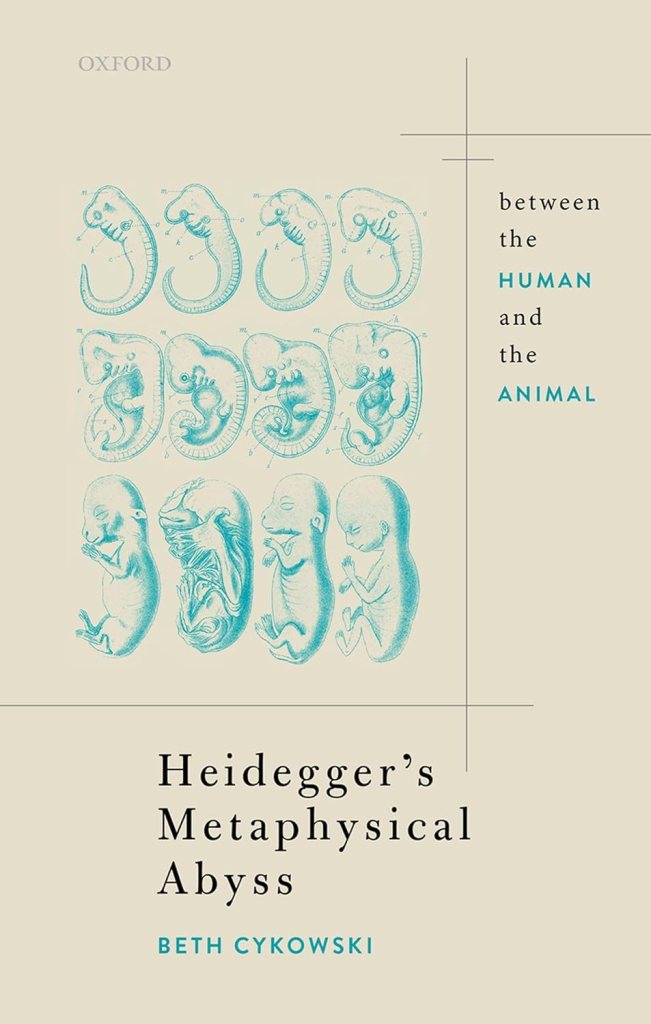
Elizabeth Cykowski’s Heidegger’s Metaphysical Abyss: Between the Human and the Animal offers a searching interrogation of how Martin Heidegger’s thought constructs, questions, and radicalises the distinction between human beings and non-human animals.
In a work that confronts both the subtle dilemmas of Heidegger’s argumentation and the received criticisms that depict him as forging an insurmountable gulf between human and animal life, Cykowski provides a richly textured analysis that at once clarifies Heidegger’s own project and overturns longstanding misinterpretations of his thesis on the distinction between the human as “world-forming” and the animal as “poor in world.” Though seemingly a stark dualism that has prompted impassioned critiques from Derrida, Krell, and numerous other commentators, this distinction, as Cykowski’s investigation reveals, does not simply reinstate outmoded metaphysical hierarchies or ignore ongoing developments in the life sciences. Instead, her close reading shows that Heidegger’s engagement with zoological and biological material in his 1929–30 lecture course The Fundamental Concepts of Metaphysics: World, Finitude, Solitude forms part of a grander and more startlingly nuanced philosophical undertaking—one that illuminates the mystery of how the human simultaneously belongs to and is set apart from the domains of nature and animality.
By focusing on how Heidegger situates his inquiry within a much older Greek understanding of physis as the entire prevailing realm of beings, Cykowski discloses the depth of Heidegger’s effort to reveal the metaphysical roots of our present-day conceptual schema, including the familiar distinctions between biology and anthropology, life and spirit, organisms and rational minds. In Cykowski’s account, Heidegger’s insistence that the animal is “poor in world” and that the human alone is “world-forming” cannot be reduced to a dogmatic exercise in cordoning off humanity in some exalted sphere. Rather, those bold theses bring to light a certain structural negativity, an unsettling rupture, that defines the human in its capacity to take issue with Being as such: the human does not simply live but exists, enacting a distinctive openness whereby it can disclose entities “as such,” rather than responding to them merely via drives or stimuli. Yet Cykowski stresses that Heidegger’s texts reveal something decidedly ambivalent about this openness, for it is purchased at the cost of a homesickness, a perpetual self-estrangement that paradoxically binds us more deeply to nature even as it seems to distance us from all other organisms. Heidegger’s analyses thus stage an “abyss” not in the simplistic sense of a fixed gulf that biology has to deny or confirm, but in the sense of an unfathomable difference, at once ontological and methodologically elusive, that appears wherever we reflect upon the question of how living beings relate to Being itself.
By drawing the reader step by step through the architecture of The Fundamental Concepts of Metaphysics, Cykowski reveals how Heidegger’s provocative claims arise within a larger attempt to expose the conceptual lineage by which Greek thought originally grasped the human as that peculiar being who stands within physis yet also brings physis to word. She considers Heidegger’s preoccupation with boredom as a fundamental attunement of the modern epoch, his intense dialogue with the biology of his time, and his critical appraisal of philosophical anthropology as it had developed in Scheler and others. Rather than passively dismissing Darwinian insights or the richly varied sociality evident in contemporary ethology, Heidegger weaves them into a genealogical critique of how “life” came to be locked in a conceptual separation from “spirit.” According to Cykowski’s interpretation, Heidegger’s texts aim to retrieve an even older perspective, traceable back to the Greeks, in which the human is conceived neither as a mere organism set alongside others nor as an otherworldly mind somehow parachuted into nature, but rather as the pivot where nature takes its most peculiar turn. It is precisely at this pivot, Heidegger contends, that the ancient categories of physis bifurcated into the modern split of life and the human, thereby concealing from us the mystery of our own animality and the ways in which we do, in fact, remain akin to non-human creatures.
Along the way, Cykowski demonstrates that the well-known objections—namely, that Heidegger’s theses consign the animal to a benumbed existence while exalting the human beyond biological continuity, that the “world-poor” ring of the animal entirely disregards the remarkable complexity of social and cognitive capabilities in higher species, and that Heidegger never properly acknowledges the bodily dimension of human Dasein—are not misplaced so much as they are incomplete. They fail to notice that Heidegger’s singular focus on the human’s special “taking issue with Being” arises from a wider metaphysical diagnosis of how the sciences themselves are embedded in a lineage of concepts about nature. Cykowski’s painstaking reading reorients the reader away from facile claims that Heidegger simply repudiates the possibility of animal language, communal life, death, or selfhood, and toward an appreciation of how Heidegger reconfigures “world” as the ultimate metaphysical battleground. The irreducibility of the “as-structure,” the all-important dimension in which things show up for us as something or other, is for Heidegger central to the human manner of being. Meanwhile, the animal, for all its organic complexity, is portrayed as bound to an encircling ring that does not allow the kind of self-reflexive “as” that defines world for us. Yet this is not a mere condemnation of animals, for Heidegger, in detailing their captivation by stimulus, simultaneously reveals the perplexing manner in which they inhabit their surroundings with a certainty and a wholeness that we, with our ruptured metaphysical attunement, perpetually lack.
In bringing such nuances to the fore, Cykowski elucidates a dimension of Heidegger’s work that is too often overlooked: the way his reflections on animality grow out of an ambition not so much to rank species on a hierarchical ladder but to challenge the conceptual prejudices by which we have inherited any such ordering to begin with. Heidegger’s aim, as Cykowski reconstructs it, is to force us to confront the paradoxes implicit in our inherited dualisms, such that we might retrieve a more essential way of thinking about physis, one that acknowledges how human existence arises in—and cannot be extricated from—an environment that sustains life in myriad forms. The guiding question becomes whether we can discover a philosophical comportment that neither collapses everything into a homogeneous biological continuum nor carves humanity away from all other beings. In that sense, Cykowski shows Heidegger steering a path that no conventional anthropology or biology can traverse: one that refuses to confine the question of the human–animal difference to the domain of empirical facts alone, even as he insists that empirical science unavoidably bears metaphysical commitments whose genealogies must be laid bare.
Throughout, Cykowski’s treatment testifies to how Heidegger’s own statements on animality can appear uncompromising and even contradictory—especially as he grows increasingly terse in later references to the “abyss” between the human and the animal—yet remain rooted in an unfinished task. There are moments in which Heidegger denies unequivocally that animals can speak, or that they can die in the sense that Dasein dies; there are moments when he denies them world altogether. But Cykowski’s analysis clarifies that Heidegger’s real intention is less to finalize a dogma than to expose the fraught boundary at which philosophical questioning about “life” demands a more primordial unpacking of how we, in our finite and solitary station, project meaning upon beings. By urging us to see that “the stone is worldless, the animal is poor in world, the human is world-forming,” Heidegger indeed sets forth a schematic difference, yet he does so precisely to awaken us to a deeper mystery: what does it mean that only in the human does physis fold back upon itself, seeking disclosure even as it continually withdraws into concealment?
Cykowski’s book insists that this core enigma has lost none of its pertinence for our own epoch. Far from betraying a relic of pre-Enlightenment ontology, Heidegger’s focus on world-poverty should prompt us to reexamine the assumptions built into molecular-genetic accounts of the human and the untested philosophical assumptions that linger beneath our evolutionary narratives. Overturning the standard caricature of Heidegger’s thesis, Cykowski situates him in dynamic conversation with the great debates of early twentieth-century biology—she notes how his engagement with the ideas of Jakob von Uexküll and the philosophical anthropologists of his day allowed him to explore a continuum of claims about the organic realm, while preserving a watchful eye on their hidden philosophical underpinnings. In so doing, she shows how Heidegger’s lectures in The Fundamental Concepts of Metaphysics serve as the privileged site where this tangle of scientific detail, classical metaphysics, ancient Greek etymology, and existential analysis is woven together. Against the charge that Heidegger is “oblivious to zoological data,” Cykowski reveals him as seizing upon biology’s findings as a crucial, if provisional, gateway to deeper ontological questioning—an approach that in turn demands we confront the metaphysics already dormant in any science of life.
If there is indeed an “abyss of essence” in Heidegger’s picture, Cykowski illustrates that it is one Heidegger wants us to explore as a metaphysical problem rather than to accept or reject outright, for it exposes the finitude that belongs to our own questioning. The deep unease with which we contemplate the possibility of bridging or denying the human–animal gap is itself symptomatic of a tacit inheritance from centuries of conceptual splits that do not allow us to think “life” and “spirit” together. In that sense, Heidegger’s reflections throw us back upon ourselves, urging us to consider anew what it means to be a being that discloses, articulates, and projects a world, yet remains embedded in the very processes—procreation, aging, death—that belong to organisms as such. The call is not to ignore or bury scientific discovery but to interrogate how science’s categories are tacitly shaped by metaphysical notions.
Accordingly, Heidegger’s Metaphysical Abyss: Between the Human and the Animal is seen as both a scrupulously researched commentary on one of Heidegger’s most confounding lecture courses and a far-reaching study that invites contemporary readers to revisit some of the most basic and under-theorised assumptions about our relationship to non-human beings. For Cykowski, Heidegger’s intention is to open, not to foreclose, possibilities for rethinking the status of the human in nature, and to do so by retrieving the vital impulses of ancient philosophy that once disclosed the human as a precarious, dangerously open site where physis might encounter itself. In that tension, we find not a comfortable hierarchy but a persistent question that Heidegger deems “abysmal,” one that resonates in his own words: “May we talk of a ‘higher’ and a ‘lower’ at all in the realm of what is essential? Is the essence of man higher than the essence of the animal? All this is questionable even as a question.” By revealing why Heidegger holds that such questioning can never reach a neat resolution, Cykowski’s work does more than merely defend Heidegger against his detractors; it shows how his challenging theses about poverty and formation, about logos and finitude, still offer a striking and inescapable provocation, calling us to reflect on life’s multiplicity without recourse to the dusty dualisms that have so long governed Western thought.
Elizabeth Cykowski’s study achieves a remarkable clarity and depth in excavating Heidegger’s intent, situating the 1929–30 lectures within a broader constellation of Heidegger’s writings, and explaining how Heidegger’s confrontation with life-science discourses reveals a more essential concern with the meaning of “world.” Her analysis compels us to see how the thesis that the human is uniquely world-forming—far from a simple anthropocentrism—provokes the troubling awareness that we do not own our world so much as we are compelled to wrest it from concealment, all the while never fully disentangling ourselves from the animality we share with the “encircling ring” of nature. It is a vision in which the dividing line between human and animal, though never erased, is not naively valorised but enigmatically sustained in a tension of concealment and disclosure, finitude and solitude. In following that thread, Cykowski not only clarifies difficult passages in Heidegger’s lecture course, she draws out the profound philosophical stakes that remain urgent for us today: how do we speak of life in a manner that does justice to our kinship with other living beings without reducing human existence to the merely biological? And how do we acknowledge the decisive difference that language and conceptual articulation introduce, while resisting the tired assumption that such difference translates into an unquestioned “superiority”? In this way, Cykowski’s rich and accessible yet philosophically rigorous text decisively transforms our understanding of Heidegger’s thinking on animality, establishing her work as indispensable reading for anyone who seeks to comprehend the broader reverberations of Heidegger’s engagement with the life sciences and the question of what it means to be human.
 Simon Gros
Leave a comment