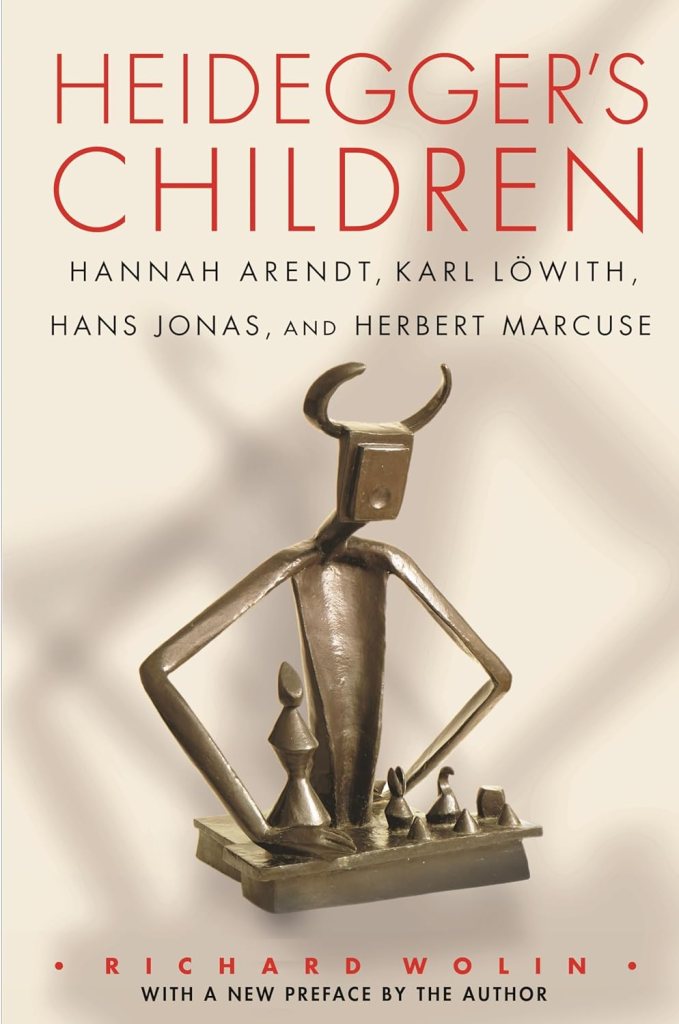
Richard Wolin’s Heidegger’s Children: Hannah Arendt, Karl Löwith, Hans Jonas, and Herbert Marcuse offers an intensely searching investigation of a painful paradox at the intersection of twentieth-century German philosophy, Jewish intellectual life, and the darkest political upheavals of modern Europe.
The book revolves around the unsettling spectacle of Martin Heidegger, an unmatched philosophical presence whose formidable genius remapped the terrain of Western thought in the wake of Being and Time. Yet Heidegger’s seductive classroom persona, so resonant for Germany’s keenest minds in the 1920s, stood in shocking contrast to his decision to join forces with National Socialism in 1933, a twist that was all the more jarring given the considerable number of Jewish students who had flocked to his lectures in the expectation of philosophical revelation. Unfolding with subtlety, rigor, and a wealth of documentation, this volume explores four among those Jewish disciples—Hannah Arendt, Karl Löwith, Hans Jonas, and Herbert Marcuse—who rose to become towering figures in twentieth-century letters yet carried with them, to widely divergent ends, the stamp of Heidegger’s method, manner, and existential impulse.
Wolin’s book begins by demonstrating the scale of Heidegger’s innovation as a thinker: the audacity of his “question of Being,” the extraordinary impact of Being and Time, and the distinctive way he integrated phenomenology, existential analysis, and a thunderous critique of modernity. Heidegger’s magnetism was by all accounts irresistible, and his lectures drew rapt throngs of students dissatisfied with the stale academic orthodoxies of neo-Kantianism and idealism. Many of those students saw in Heidegger’s philosophy a singular path toward a complete rethinking of human existence. Paradoxically, among that devout circle around Heidegger—those who delighted in his relentless dismantling of inherited concepts—there stood a remarkable number of assimilated Jews whose sense of identity was largely bound up in German Kultur and the dream of universal Bildung. Arendt, Löwith, Jonas, and Marcuse typified this group; all came from thoroughly acculturated backgrounds, many had little contact with traditional Judaism, and all approached Heidegger in the 1920s with an ardent conviction that German philosophical genius promised vistas of individual and collective emancipation.
In painstaking detail, Wolin conveys how Heidegger’s decision to join the Nazi Party on May 1, 1933, and to assume the rectorship at Freiburg University, stunned his Jewish disciples. Though almost none of them had previously suspected that the brilliant professor’s antidemocratic and anti-Enlightenment leanings would swerve so abruptly into open complicity with a regime bent on persecution and even extermination, in retrospect the turn felt less like a complete break than a dire actualization of themes latent in his radical critique of “inauthentic mass society” and his emphasis on resolute historical commitment. As Wolin makes plain, Heidegger not only affixed his name to letters with the salute “Heil Hitler!” and paid Party dues through 1945; he enforced the racial laws with pitiless administrative zeal, blocking Jewish students from completing dissertations and shunning his indebted mentor, Edmund Husserl. Even after the war, he never unequivocally recanted his allegiance. This ghastly record posed a bitter quandary for those who had eagerly followed him into the complexities of existential analysis. How could Germany’s greatest philosopher—and arguably modernity’s most trenchant critic of shallowness—disgrace himself through an alliance with a genocidal dictatorship? Why did these brilliantly gifted Jewish students fail to foresee the lethal reality beneath his rhetoric, and in the aftermath, how could they salvage what was crucial in his thought without succumbing to its treacherous political illusions?
The volume devotes particular attention to Hannah Arendt, who was Heidegger’s lover in her youth and who, in the years after the war, became one of the era’s most influential political theorists. Wolin shows how Arendt wrestled with her initial devastation in discovering her mentor’s and former paramour’s systematic involvement in the Nazi cause, only later to return to him in a complicated reconciliation that left indelible traces on her political existentialism. Outwardly, Arendt made her reputation by studying totalitarian regimes in The Origins of Totalitarianism, forging the “banality of evil” thesis in Eichmann in Jerusalem, and celebrating the spontaneous vigor of genuine political action. Yet always the ghost of Heidegger’s “existential radicalism” and his love for the Greek polis flickered in her own championing of ancient exemplars and her aversion to the flattening tendencies of “mass society.” Wolin highlights that her disillusion with the German intelligentsia—coming to a head when she recognized the widespread academic compliance with Hitler—pushed her to reclaim her Jewishness with a vehemence previously lacking in her assimilationist upbringing. Nonetheless, Arendt’s idiosyncratic stance in Eichmann in Jerusalem, including her controversial discussions of Jewish Councils and her striking declaration that Nazi crimes were perpetrated by “thoughtless” bureaucrats, can be seen as a functionalist interpretation that, ironically, reduces the specific German dimension of the Jewish catastrophe—perhaps mirroring her desire to absolve the philosophical domain from the “gutter-born” phenomena of political barbarity. By situating her existentialism within a broader critique of modernity, Wolin lays bare the tension between Arendt’s metaphysical debts to Heidegger and her attempt to craft a political philosophy upholding human plurality and civic freedom.
Wolin’s chapters on Karl Löwith, Hans Jonas, and Herbert Marcuse likewise illuminate the agonies of intellectual conscience, as each thinker carried forward central concepts learned from Heidegger—about finitude, crisis, authenticity—even while rejecting or transforming them in reaction to his misdeeds. Löwith, forced into exile, began a lifelong quest to reinterpret the Western tradition against the grim lessons of nihilism. Jonas, who fought with the British Army’s Jewish Brigade, survived the Holocaust with a new impetus to formulate an “ethics of responsibility,” eventually becoming the leading philosopher of technology and environmental ethics in Germany’s postwar landscape. The impetus for Jonas’s original reflections on Gnosticism and the modern sense of alienation was partly the fruit of Heidegger’s own existential theology, yet Jonas discovered in it a philosophical impetus that turned squarely against the destructive momentum of modern technological mastery. Marcuse, the outlier in many respects, developed a heterodox Marxism, crossing Freudian ideas of repression with a utopian longing for liberated society. Nonetheless, Marcuse, having studied under Heidegger in the late 1920s, never quite relinquished his admiration for his teacher’s brilliance, writing plaintive letters after 1945 in hopes that Heidegger would repudiate Nazi atrocities. The silence or evasions Marcuse encountered only reinforced his conviction that a purely existential critique of modern reason needed to be fused with emancipatory socio-political insights that Heidegger had either scorned or missed altogether.
Part of the fascination of “Heidegger’s Children” lies in the subtle portrait it offers of the “anxiety of influence” embedded within these disciples, as they fought, each in a personal way, to philosophize with—and yet decisively against—the fatherly presence of a teacher who had betrayed them, not merely as Jews, but also as believers in the emancipatory promise of thought. There is, Wolin suggests, something of a tragic family drama at work here, a philosophical Oedipal drama in which these students—Arendt, Löwith, Jonas, Marcuse—strove to preserve what was most luminous in Heidegger’s phenomenological and existential method, while ensuring that the glaring moral blindness and susceptibility to totalitarian illusions would never resurface in their own endeavors. Wolin’s narrative is unflinching: it shows how, in many cases, the same existential radicalism that drew them to Heidegger also blinded them to the political ramifications of his romantic anti-liberalism. And in each figure’s postwar revaluation of the German cultural inheritance, one sees how the calamity of Nazism and the Holocaust reshaped their relationship to Heidegger’s call for a “destruction” of Western metaphysics. The question looms: was it merely personal misjudgment, or had Heidegger’s early fundamental ontology always contained a dangerously illiberal seed?
Throughout the book, Wolin combines rich historical analysis with critical commentary on how philosophers construct genealogies of thought. He traces the post-1945 “Heidegger controversies”—the revelations of Heidegger’s 1933–34 speeches, the disquieting evidence from newly published correspondence and lecture courses, and the subsequent attempts by both sympathizers and detractors to decide whether Heidegger’s Nazi allegiance was incidental or essential. The picture that emerges is more disturbing with every new archival discovery. Passages in Heidegger’s so-called Black Notebooks confirm not only the racial bigotry his Jewish students suspected but also reflect a residual denial that the Holocaust demanded singular condemnation. In certain disconcerting lines, Heidegger even depicts the extermination of the Jews as a form of collective “self-annihilation,” thus trivializing the unprecedented crime as a byproduct of modern technology. Wolin addresses such claims directly, concluding that Heidegger’s metaphysical contortions served to obscure the moral and political accountability that an authentic philosophical conscience would be obligated to confront. If anything, this posthumous material brings into stark relief the moral gulf that separated Heidegger from his brilliant disciples, each of whom, after the horrors of the Third Reich, recognized the impossibility of conflating philosophical daring with existential megalomania.
In its effect, Heidegger’s Children thus becomes more than a straightforward piece of intellectual history; it is a nuanced moral meditation on the relationship between ideas and the destructive politics they can sanction. Readers interested in modern thought, the political legacy of twentieth-century Europe, and the deeper crises of existential meaning will find that Wolin’s examination bristles with interpretive challenges. He draws on an array of archival sources, includes references to Arendt’s private letters and diaries, reconstructs Löwith’s written recollections of Rome in 1936, discusses Marcuse’s experiences with the Frankfurt School and the American New Left, and details Jonas’s reflections on ethics and the environment that shaped debates in German postwar philosophy. The interplay among these four thinkers—whose lives braided together Jewish identity, bitter exile, renewed assimilation, and the fervent hope that a purified modernity could still be salvaged—underscores the truth that the failures of a venerated mentor can neither be willed away nor simply accepted. They must be grappled with in full consciousness, no matter the pain of shattered loyalties and the wreckage of illusions.
Critical reactions collected in the book’s editorial discussions show how Wolin’s approach has been described as provocative, erudite, and, in some eyes, polemical. His claim that an “inner truth” of Heidegger’s philosophy facilitated a Nazi affiliation has met a range of responses, with some praising his boldness in unmasking the philosopher’s political illusions and others insisting that Heidegger’s metaphysical project can be salvaged from its author’s personal entanglements. Yet as multiple reviewers noted, Wolin’s historiographic approach sets a useful standard for those who would continue to engage or appropriate Heidegger: one must do so with open-eyed historical awareness and moral caution. Wolin’s powerful commentary, particularly his investigations of how Hans Jonas’s concept of “responsibility” and Marcuse’s concept of “the Great Refusal” were shaped in critical dialogue with Heidegger’s earlier transformations of classical ontology, illuminates the unending tension between genuine philosophical innovation and the catastrophes unleashed by totalitarian politics.
The horrifying question that reverberates throughout the text—how could a genius so attuned to the question of Being have aligned himself with a movement that declared its goal to eradicate an entire people?—cannot, in Wolin’s analysis, be softened into mere contingencies of biography or ephemeral misjudgments. Instead, the path leads to an unsettling reflection on the complicities of radical ideas when severed from any grounding in moral and political judgment. As an examination of that vexing interplay between a titan of thought and the Jewish disciples who struggled to extricate themselves from his looming intellectual shadow, “Heidegger’s Children” excels in clarity, honesty, and philosophical depth. It portrays Germany’s “brightest young intellects,” who, before 1933, might have been forgiven for expecting in Heidegger a new dawn in philosophical inquiry, only to face exile and cultural rupture when they found that dawn turned to darkness.
In the end, Wolin insists that understanding the response of Arendt, Löwith, Jonas, and Marcuse discloses fundamental truths about the fragile boundaries between creative theoretical ambition and existential disillusionment. It also exposes the precarious juncture between politics and ideas: the very domain in which radical conceptual breakthroughs can shadow forth radical deeds, whether emancipatory or destructive. As many readers have acknowledged, the book’s import extends to ongoing debates about modernity itself, the lure of mystifying narratives of national destiny, and the philosopher’s duty to clarify rather than obscure moral accountability. Above all, Wolin’s presentation of these four “Heideggerians” compels us to confront how personal devotion to a philosophical master may degenerate into a self-deception that refuses to see the seeds of ethical catastrophe. By shining so searching a light on these paradoxes, “Heidegger’s Children” stands as both an indispensable study of a critical dimension of twentieth-century thought and a cautionary tale of how swiftly brilliance can descend into moral disaster. Wolin’s thorough archival research, his critiques of “ontological fascism,” and his painstaking reconstruction of the many ways Arendt, Löwith, Jonas, and Marcuse carried Heidegger’s existential impetus into the sphere of their own writing combine in a narrative that is at once profoundly philosophical, historically gripping, and unafraid to judge harshly where harsh judgment is deserved. If, as readers, we emerge both enriched and unsettled, it is because “Heidegger’s Children” keeps alive the irreducible tension between the greatness of a thinker’s accomplishment and the gravity of his betrayal—and the brilliant but haunted legacies left to those who once lovingly called him Master.
 Simon Gros
Leave a comment