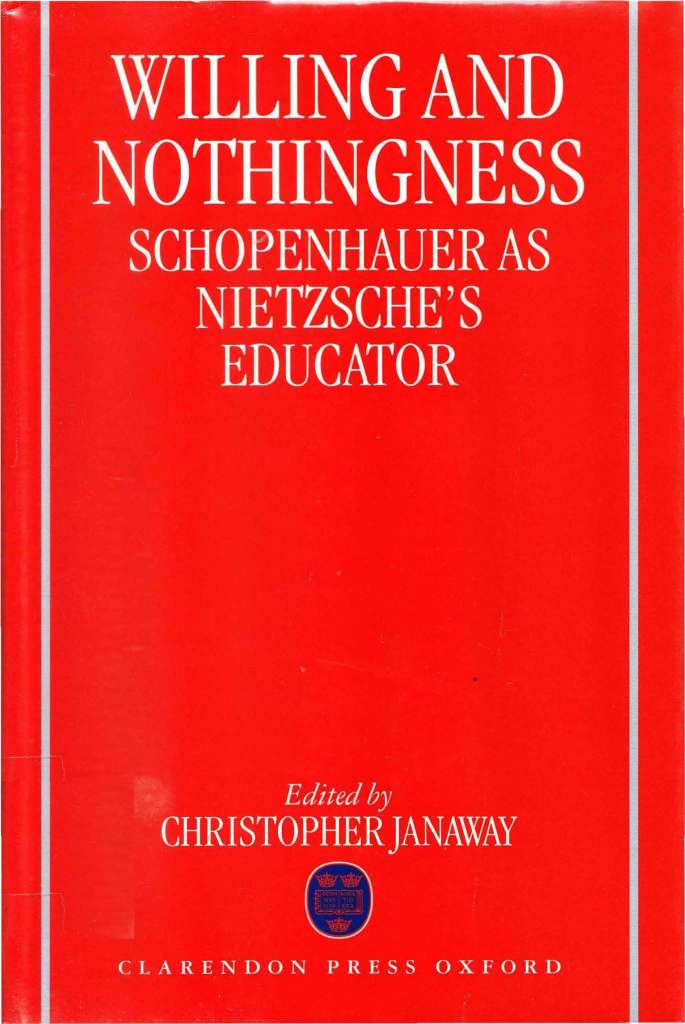
Willing and Nothingness: Schopenhauer as Nietzsche’s Educator plunges into the heart of Friedrich Nietzsche’s philosophical development by situating it against the background of Arthur Schopenhauer’s towering influence. The volume unfolds as a study of the tensions, continuities, and convoluted transformations generated when Nietzsche, that restless spirit of modern European thought, confronts Schopenhauer’s austere metaphysical vision of the will, suffering, and redemption. Both philosophers, each possessed of a sweeping narrative about existence and each driven by the urgency of philosophical reflection upon life’s suffering and greatness, stand in an unexpectedly close and paradoxical relationship: Schopenhauer as the system behind Nietzsche’s anti-system, as the educator that Nietzsche must simultaneously embrace and overcome, as the Ghost that can never be exorcised from the Hamlet of Nietzsche’s metaphysical drama. This book goes into the subtle exchanges of admiration and rejection, of discipleship and apostasy, that gives structure to Nietzsche’s philosophical journey from his first, fascinated reading of The World as Will and Representation in the mid-1860s to the final delirious pronouncements of his last lucid years.
From the earliest moment that the young Nietzsche discovered Schopenhauer, he was struck by the latter’s withering assessment of human existence, by his insistence that suffering pervades life as its primary truth, and by his revelation that freedom from this incessant torment can emerge only when the will-to-life in the individual reverses and denies itself. Schopenhauer built a grand metaphysics in which the will is that universal essence prior to and underlying all appearances, never satiable, ceaselessly striving, blind to rational purpose, and giving birth to a realm in which existence itself is questionable, a realm pervaded by conflict, self-assertion, and despair. He concluded that non-existence would have been preferable and that deliverance from the agonies of life is granted only to those who have recognized the underlying futility of all volitions and so turn against the will, sinking into a state of genuine will-lessness.
Five years after Schopenhauer’s death, Nietzsche opened The World as Will and Representation and felt a new philosophical world press in upon him. What he found in Schopenhauer was the unflinching negativity that treats life as inherently lacking a positive meaning or redemption, the constant pushing and restless dissatisfaction of the world-will, and the bleak promise that only ascetic denial of one’s will could win one ultimate salvation. At first, Nietzsche embraced Schopenhauer’s radical metaphysics and his savage honesty about life’s torment; in his earliest writings, Nietzsche openly calls him a demi-god and master, citing Schopenhauer’s incisive treatises on the futility of worldly striving, on the illusions of the mind, on the subjugation of knowledge to the will, and on the transcendence offered by aesthetic experience. Yet the later Nietzsche, having grown steadily more distrustful of life-denial, excoriates Schopenhauer for poisoning Europe with a philosophically sharpened form of decadent asceticism, for turning existence into an object of condemnation, and for saying no to the dynamic powers that alone can affirm the grandeur of being.
In Willing and Nothingness we find a series of essays by eight leading scholars, all converging upon the problem of how Nietzsche’s thought negotiates its dependency upon and revolt against Schopenhauer’s ideas. Each contributor reveals a distinct facet of this relationship, together illuminating the evolving ways Nietzsche engaged Schopenhauerian pessimism, tragic art, moral psychology, religion and atheism, truth, knowledge, and the practice of philosophy itself. Some essays take a chronological approach, tracing the development of Nietzsche’s views as he passes from the early euphoria of The Birth of Tragedy, in which Schopenhauerian metaphysics underwrites a conception of Dionysian suffering and Apollonian image-making, into the complex pages of Human, All Too Human, Daybreak, and The Gay Science, where Nietzsche begins to replace metaphysical illusions with a resolute philosophical empiricism that owes an unspoken debt to the same Schopenhauer who had once declared that all knowledge in service to the will must be transcended if one would apprehend the eternal Ideas. Other essays enter the territory of moral philosophy directly, examining the moral emphasis on compassion that Schopenhauer painstakingly established, and Nietzsche’s subsequent counter-claim that pity debilitates and robs us of our strength. Yet even where Nietzsche attacks pity or Mitleid as the symptom of a more general moral sickness, his genealogical method unearths psychological and physiological dimensions of moral life that resonate with Schopenhauer’s insistence that the intellect never stands free of the underlying drives, the deeper essence known to us most intimately in the direct feeling of our own volitional nature.
A powerful leitmotif saturating this book’s discussions is the presence of Schopenhauer’s dogmatic condemnation of life as fundamentally worthless, and the spiritual or ascetic solution found in the denial of the will. Under Schopenhauer’s metaphysical scheme, each individuated phenomenon is but an instrument by which the blind will objectifies itself, so all individuals are condemned to strive under illusions, without a final satisfaction or aim. Nietzsche, for his part, is haunted by this pessimism and its ascetic remedy. He confronts it through the lens of his more robust naturalism, developing the notion that Schopenhauer’s self-denial attests a decadence or resignation in the philosopher’s physiology and a refusal to greet the intensities of life with the resounding yes that marks the Dionysian moment. But as the essays emphasize, Nietzsche’s assault on Schopenhauer’s moral conclusions is never a simple rejection; behind the fierce scorn for denial hides the paradoxical admiration of one who still calls Schopenhauer the last great German philosopher, the final personality in Germany of any truly European consequence, the last to sense that the question of life’s value is genuine and inescapable. And so we see that the genealogical dimension of Nietzsche’s critique of Schopenhauer, the reading that discerns the deep drives that shaped Schopenhauer’s condemnation of existence, is itself a craft that owes a methodological impetus to Schopenhauer’s own idea that the intellect is only the instrument of deeper inclinations in the will, that behind every structure of reason lurk pressing needs of organic striving or suffering.
Willing and Nothingness highlights this persistent dialogue within Nietzsche’s texts, where the image of Schopenhauer is sometimes the mentor, sometimes the foil, sometimes the cultural exemplar, sometimes the metaphysical scapegoat. The book traces Nietzsche’s repeated invocations of Schopenhauer’s name and doctrines, from the compositional rhetoric of The Birth of Tragedy, with its overt quotations from Schopenhauer’s arguments on music as direct copy of the will, to the Untimely Meditation entitled “Schopenhauer as Educator,” where Nietzsche extols the heroic moral persona of Schopenhauer, the solitary fighter for truth, yet quietly modifies the meaning of that truth, rendering Schopenhauer’s moral stance into a symbol for cultural renewal.
Another dimension that emerges from these pages concerns Nietzsche’s ambivalent stance toward Schopenhauer’s brand of determinism and character fixity. In Schopenhauer’s moral psychology, all character is inalterable and is simply the empirical expression of an intelligible essence. Nietzsche likewise insists that people’s moral frameworks and entire mode of life are grounded in fundamental drives and psycho-physiological conditions. But whereas Schopenhauer equates this situation with guilt, suffering, and the ascetic ideal of resignation, Nietzsche reinterprets it as an impetus to self-creation, to self-overcoming, or to the sort of transformation he symbolically associates with the Übermensch. In that sense, Willing and Nothingness demonstrates that even where Nietzsche’s trajectory leads him far from Schopenhauer’s official teachings, he often travels along routes that Schopenhauer initially surveyed, so that the younger philosopher’s alleged “originality” frequently amounts to an intensification or inversion of Schopenhauerian points.
Throughout this work, we see the persistent presence of Schopenhauer’s moral explanation, shaped by the tension of Mitleid and affirmation or denial of the will, re-emerging whenever Nietzsche addresses the problem of pity, asceticism, or the moral significance of existence. The contributors illuminate how Nietzsche’s effort to ground moral phenomena in naturalistic drives and genealogical lineages is a radical extension of Schopenhauer’s claim that the intellect’s illusions mask deeper volitional truths. They reveal how Nietzsche’s genealogical method, which denies the objectivity of moral claims in favor of psychophysiological genealogies of moral values, remains quietly reliant on the Schopenhauerian idea that all knowledge is a product of affects and interests, that the body’s natural functions color every cognitive stance.
Yet at the final hour, Nietzsche’s moral worldview stands at the opposite pole from Schopenhauer’s counsel to deny the will. Indeed, one essay details the manifold references to Schopenhauer’s “antinaturalness” in Nietzsche’s text, culminating in Nietzsche’s sarcastic portrayal of Schopenhauer as a decadent soothsayer in Thus Spoke Zarathustra, who seduces the soul with the longing for nothingness. The spiritual conflict is brought to light with maximal intensity: how can one find redemption? For Schopenhauer, it lies in the saintly acceptance of universal guilt, the radical self-abnegation that ends the illusions of willing. For Nietzsche, it lies in the artistic, heroic, or sovereign soul that says yes to life and is capable of transfiguring its own sufferings into higher forms of self-affirmation. Willing and Nothingness clarifies how the friction between these two extremes is not simply a matter of straightforward disagreement, but an ongoing and deeply personal drama in Nietzsche’s work, a drama replete with echoes and returns to the Schopenhauerian vantage. The volume discloses that whenever Nietzsche condemns pity, ascetic ideals, or moral interpretation itself, he re-stages the moment in which Schopenhauer beckoned him to interpret existence as something whose non-existence would be preferable. If Schopenhauer’s unconditional condemnation of the world is ultimately what Nietzsche refuses, the shadow of that condemnation continues to shape all the forms of self-interpretation that run through Nietzsche’s philosophy.
The multi-faceted essays here also supply a painstaking chronology of Nietzsche’s changing references to Schopenhauer from the time when Nietzsche was an acolyte at the feet of “the master,” through the years after The Birth of Tragedy, when the first critiques of Schopenhauer’s pity-oriented morality appear in Human, All Too Human, Daybreak, and beyond. Readers discover in these pages how Nietzsche’s overt hostility to Schopenhauer surfaces in a hundred published references, culminating in the rhetorical flourish of calling him a decadent. Yet the same hostility co-exists with Nietzsche’s frequent admiration that Schopenhauer was among the last truly great European intellects to have confronted the terror and horror of life squarely and fearlessly. The authors highlight passages from Nietzsche’s unpublished notebooks, in which Schopenhauer’s presence is equally unstoppable, shaping the unceasing drama of Nietzsche’s attempts to define himself as a moral-psychological diagnostician rather than a metaphysical life-denier. These essays collectively unveil the full narrative of Nietzsche’s appropriation of Schopenhauer’s moral categories, his inversion of them, his genealogical recoding of the ascetic ideal as an “ideal of decadence,” and his ultimate assimilation of Schopenhauer’s method into a new philosophical vantage that attempts to cherish life for its creative possibilities and to interpret morality itself as one more phenomenon subject to the will’s underlying impetus.
The result is not so much a simple story of betrayal and revolt as it is a subtle demonstration that Nietzsche did not merely deviate from Schopenhauer’s moral and metaphysical system, but engaged it at the level of method, psychological insight, rhetorical flair, and existential vantage. Willing and Nothingness: Schopenhauer as Nietzsche’s Educator thereby contributes a rare comprehensiveness to our understanding of Nietzsche’s moral philosophy, by showing the layered ways in which Nietzsche’s moral psychology, his genealogical approach to values, his concept of life as a multiplicity of conflicting drives, his condemnation of Christian-like pity, and his call for affirmation all stand as responses—both rebellious and indebted—to the commanding teacher whom Nietzsche once revered as the greatest philosophical genius of the previous millennium. This volume, through dense, lively, and wide-ranging scholarly engagement, culminates in the recognition that Schopenhauer remains the hidden specter animating Nietzsche’s moral and metaphysical reflections. And in the final analysis, such recognition allows us to glimpse how even an “antipode” can be one’s most powerful educator, forging a new and unforeseen path for philosophy by virtue of a dramatic confrontation with the darkest vision of willing and nothingness.
 Simon Gros
Leave a comment