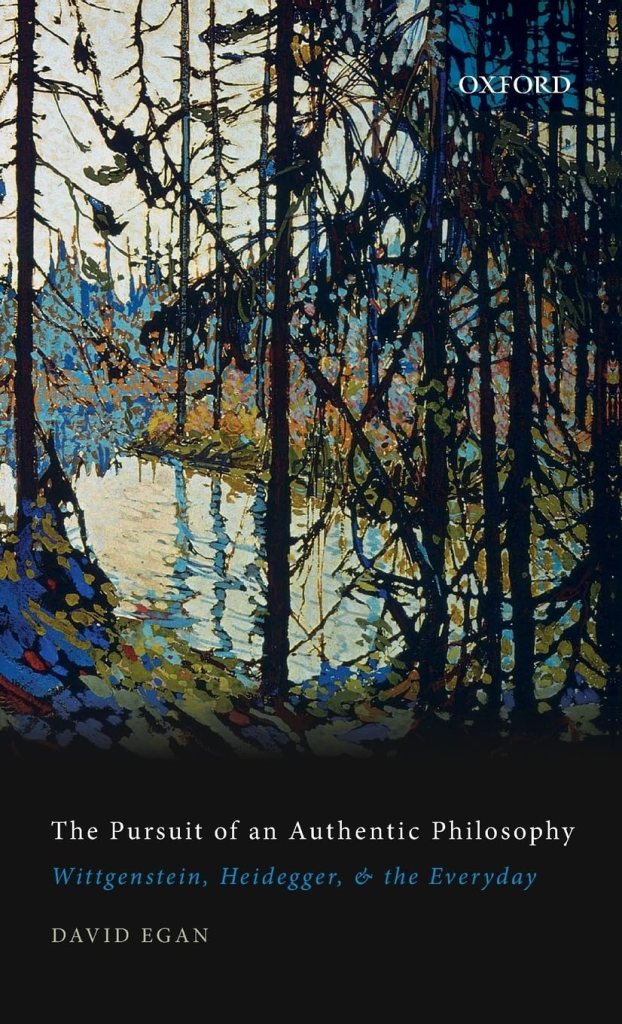
David Egan’s The Pursuit of an Authentic Philosophy: Wittgenstein, Heidegger, and the Everyday is an erudite and multifaceted analysis that combines the ostensibly disparate strands of Wittgenstein’s crisp, aphoristic examinations of language with Heidegger’s profound and complex analyses of being. At first glance, the works of these two titanic figures seem to inhabit entirely different philosophical ecosystems—the terse, often elliptical remarks of Wittgenstein, steeped in the clarity of everyday language-games, stand in stark contrast to Heidegger’s dense, sometimes mythopoetic disquisitions on Dasein and the unfolding of being-in-the-world. Yet, as Egan persuasively argues, both thinkers are united by a deep-seated concern for the authenticity of existence and the recovery of the ordinary as the locus of our most fundamental understanding. In this work, authenticity is not a matter of mere stylistic expression or detached theoretical postulation; rather, it is the very ground upon which philosophy must be reoriented, a call to recognize that the presuppositions of our thought—whether manifested in the rules governing language or in the primordial disclosure of our everyday engagement with things—are themselves the starting points for any genuine philosophical inquiry.
Egan’s investigation unravels the dynamics of authenticity and inauthenticity, revealing how both Wittgenstein’s and Heidegger’s methodologies are committed to recovering a kind of pre-reflective knowledge that underpins our everyday practices. Where Heidegger interrogates the concealed nature of being through the method of formal indication—a stylistic and conceptual manoeuvre that uses familiar terms in provocative, often unsettling ways to disrupt conventional thought—Wittgenstein pursues a therapeutic dismantling of philosophical confusions by exposing the limits inherent in our standard modes of assertion. For Heidegger, the everyday is not simply a backdrop to abstract theorizing but a site where the structures of existence reveal themselves in the lived, dynamic interplay of care, readiness-to-hand, and the ever-present possibility of inauthenticity. Similarly, Wittgenstein’s focus on the ordinary contours of language challenges the presumption that philosophical problems can be resolved by transcending the mundane; instead, it is through a careful attention to how we actually use our words in the ebb and flow of life that the true nature of meaning—and, by extension, truth—can be discerned.
At the basis of Egan’s exacting study is a reappraisal of the traditional problematic that has long pitted realism against idealism. Both Heidegger’s phenomenological ontology and Wittgenstein’s language-games invite us to question the entrenched assumption that there exists an external, mind-independent realm of facts or objects that our thoughts must accurately mirror. Heidegger’s critique of the realist impulse—exemplified in his insistence that our engagement with the world is always already mediated by our own existential mode, and that any attempt to extricate our experience from this situatedness results in a pernicious form of inauthenticity—finds a resonant echo in Wittgenstein’s skepticism about the possibility of speaking about propositions in any manner that exceeds their practical, rule-governed uses. In both cases, the attempt to posit a detached perspective from which to assess the truth of our assertions is shown to be a conceptual misstep, one that overlooks the fundamentally embedded character of all our thought and language.
Egan’s work is remarkable not only for its textual analyses—which illuminate passages ranging from Heidegger’s meditations on the “ontological difference” and the dialectic of care to Wittgenstein’s disarming examinations of the bivalence of propositions and the inherent limits of grammatical expression—but also for its broader philosophical ambition. The book challenges the reader to reconsider what it means to do philosophy in the first place, suggesting that authentic philosophical practice must eschew any pretension to a detached, metaphysical vantage point. Instead, both Wittgenstein and Heidegger are portrayed as engaging in a form of self-critical inquiry, one that holds up a mirror to the very conditions of possibility for thought and experience. In this light, the act of philosophical reflection becomes inseparable from the everyday; it is not a matter of constructing ever more elaborate theories about the nature of reality, but of recognizing and reclaiming the pre-theoretical, lived structures that underwrite all such theorizing.
A particularly striking aspect of Egan’s analysis is his treatment of the concept of truth. In Heidegger’s account, truth is recast not as a static correspondence between mind and world but as a process of revealing and concealing—a notion captured in the Greek concept of aletheia. Heidegger’s provocative claim that even Newton’s celebrated laws of motion were not “true” until they were disclosed by Newton himself serves as a dramatic illustration of his dependency claim, wherein the truth of any statement is inextricably linked to the existential and historical context of Dasein’s engagement with the world. In juxtaposition, Wittgenstein’s insistence that the rules governing our use of the terms “true” and “false” are not to be understood as metaphysical certainties but as expressions of our language-games underscores a similar deflationary move: the search for an objective, external standard of truth is revealed to be misguided when it neglects the embedded, pragmatic contexts in which our assertions gain their meaning.
Throughout this rigorous and reflective work, Egan does not shy away from the tensions and paradoxes that arise when one attempts to articulate the nature of authenticity. He critically examines Heidegger’s stylistic innovations—such as the use of scare quotes, neologisms, and the ambiguous forms of formal indication—and reflects on their double-edged capacity to both illuminate and obscure the very issues they aim to resolve. By drawing careful parallels and noting subtle divergences between the two philosophers, Egan shows that while Heidegger’s approach may verge on a kind of ontological idealism by suggesting that being itself is contingent upon the disclosure by Dasein, Wittgenstein’s method remains steadfastly grounded in the ordinary practices of human life, offering instead a way to dissolve philosophical quandaries by exposing the confusions that arise when language is misapplied. In doing so, Egan not only defuses the longstanding debates over the nature of philosophical truth but also proposes a more integrated vision of philosophy—one that is as much about the way we live and speak as it is about abstract metaphysical commitments.
In its merger of rigorous textual exegesis, historical context, and original philosophical reflection, The Pursuit of an Authentic Philosophy is a monumental contribution to contemporary thought. It invites scholars and students alike to confront the enduring challenge of overcoming the “sideways perspective”—the seductive yet ultimately illusory aspiration to step outside of one’s own situatedness in order to capture a supposedly objective truth. Instead, Egan contends that authenticity lies in a return to the very ground of our being, in an unflinching acknowledgment of the ways in which our ordinary encounters with the world imbue our language, thought, and life with meaning. By retracing the steps of both Wittgenstein and Heidegger, the book lays bare the intricacies of a philosophical method that privileges the recovery of what is already known—albeit in a manner that is ever open to questioning and redefinition—over the construction of new, detached doctrines.
In this impressively argued work, David Egan thus not only bridges the apparent gulf between two of the most influential figures of 20th-century philosophy but also offers a compelling reorientation of the philosophical enterprise itself. His exploration of authenticity, with its careful balance between the rigorous deconstruction of established thought and a hopeful reengagement with the everyday, presents a vision of philosophy that is at once challenging and profoundly human. For anyone committed to understanding the deeper dimensions of truth, language, and existence, Egan’s book is an indispensable guide—a call to rediscover the wonder and significance of our most immediate, lived experience in the very act of thinking itself.
 Simon Gros
Leave a comment