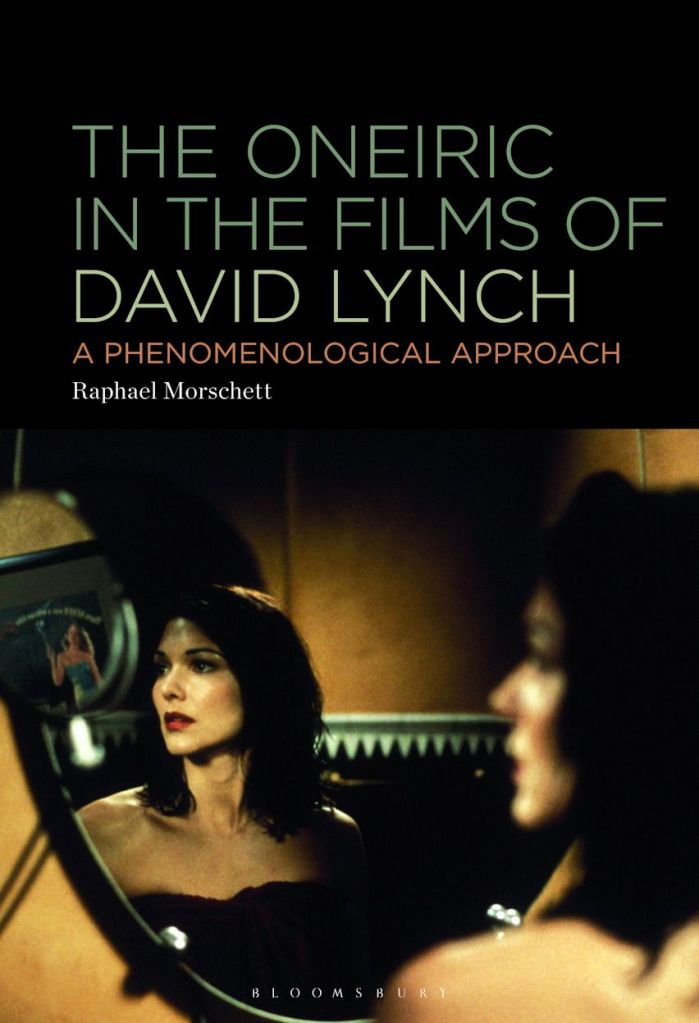
The Oneiric in the Films of David Lynch: A Phenomenological Approach by Raphael Morschett is an ambitious, erudite, and rigorously detailed analysis of the unique dreamlike matrix that underpins the cinematic oeuvre of David Lynch, an auteur whose work has long been synonymous with the enigmatic and the surreal.
In this study, Morschett makes a systematic, book-length exploration that reconfigures conventional film criticism by interrogating not merely the narrative structures or stylistic flourishes of Lynch’s films but by going into the very experiential and phenomenological foundations of what it means to encounter the dream in the medium of film. Drawing upon the philosophical insights of phenomenologists such as Maurice Merleau-Ponty and building on the conceptual resources of Vivian Sobchak’s understanding of embodied perception, the book probes the ways in which Lynch’s cinematic language deconstructs and rearticulates the boundaries between waking reality and the realm of dreams. It is not enough, argues Morschett, to describe Lynch’s work as simply “dreamlike” in a generic sense; instead, the text proposes a precise, layered analysis of the oneiric as it manifests through a dual dynamic of pre-reflective sensory immersion and reflective medial self-awareness.
Morschett’s inquiry is as much an ontological meditation as it is a methodological treatise. His approach acknowledges that the film experience is inherently a dialogue between the film as an active, “viewing subject” and the embodied spectator, whose sensory and affective capacities are both challenged and expanded by Lynch’s idiosyncratic aesthetic. This dialogue is explored through an examination of the interplay between the materiality of image and sound and the emergent, almost ineffable phenomenology of dreaming. Throughout the study, Lynch’s filmic universe—from the experimental, almost proto-cinematic incipience of his early short films to the sprawling, intertextual labyrinths of Twin Peaks and Mulholland Drive—is shown to be a dynamic arena in which the sensory-perceptual and the reflective-medial dimensions of experience are in constant tension and reciprocal reinforcement. The book situates these cinematic moments within a broader discourse that spans neurophenomenology and psychoanalytic theory, suggesting that the visceral reactions elicited by Lynch’s images—echoing phenomena such as the activation of mirror and canonical neurons—are not merely aesthetic effects but constitute an experiential modality that bridges the gap between subjective dreaming and the intersubjective act of film viewing.
The basis of Morschett’s argument is the claim that over the course of a fifty-year creative trajectory, Lynch has not only harnessed the formal devices of cinema to evoke the surreal textures of the dream but has, in doing so, crafted a unique “cinematic aesthetics of the oneiric.” This aesthetic is articulated through what Morschett identifies as four interrelated dimensions: the direct experience of marked dreams as depicted in the films; sequences that are intrinsically “dreamlike” in their material presentation; the mimetic recreation of nocturnal dream phenomena as experienced in the waking state; and finally, the self-reflexive conceptualization of dreaming that emerges as a commentary on both the art of cinema and the nature of human consciousness. These dimensions are not presented as isolated phenomena but as facets of a complex, dialectical relationship between perception and expression, where the act of seeing is as much an act of self-reflection as it is of sensory reception.
The book resists the temptation to reduce Lynch’s work to a mere repository of surreal imagery or to subsume its enigmatic qualities under a reductive psychoanalytic interpretation. Instead, Morschett emphasizes that the oneiric quality of Lynch’s films is not an accident or a mere stylistic flourish; it is a deliberate and multifaceted exploration of the conditions under which experience itself is constituted. By adopting a phenomenological stance, the study highlights how Lynch’s cinematic language reveals the pre-reflective intensity of sensory experience—how images and sounds coalesce to form a dynamic field of meaning that is at once immediate and elusive, tangible yet perpetually deferred. In this respect, the work is a philosophical inquiry into the nature of consciousness, suggesting that film—by virtue of its capacity to enact a double movement of perceptual engagement and mediatized reflection—offers a unique window into the very structure of human experience, where the dream is not merely an escape from reality but a mode of existence that interrogates the limits of knowledge, identity, and temporality.
Morschett’s analysis is characterized by its attention to detail and its willingness to traverse the often uncharted territory between aesthetics and ontology. He shows how the formal innovations in films like Eraserhead and the narrative ambiguities of Lost Highway and Twin Peaks are not merely exercises in visual trickery but are intimately connected to a broader philosophical project of destabilizing the conventional hierarchies between subject and object, between the seen and the unseen. In doing so, he challenges the dominant paradigms of film theory that tend to privilege a detached, objective reading of the cinematic image, arguing instead for an approach that fully integrates the subjective, embodied act of viewing into the process of interpretation. This insistence on the inseparability of film and viewer echoes the insights of earlier phenomenologists who posited that all acts of perception are inherently intersubjective, imbued with both an element of participation and a capacity for self-reflection.
Moreover, the study illuminates the meta-cinematic dimension of Lynch’s work by revealing how his films often call attention to their own materiality and constructedness. This self-reflexivity is not presented as a mere postmodern gimmick but as an essential aspect of the oneiric experience—a way of mirroring the inner workings of consciousness itself, where the boundaries between reality and illusion, between waking life and dreams, are continuously renegotiated. In scenes where time appears to fold upon itself, or where the diegetic world fractures into multiple, conflicting layers, Lynch is seen as engaging in a kind of philosophical meditation on the nature of existence and perception. His films evoke a paradoxical simultaneity: they immerse the viewer in a sensory landscape that is as immediate and affectively charged as a dream, while at the same time inviting a reflective contemplation of the very act of dreaming, of the impossibility of capturing experience in fixed categories or absolute narratives.
In its dense and all-encompassing treatment, The Oneiric in the Films of David Lynch displays the power of cinema to function as a medium of both expression and introspection. It is an invitation to reexamine the familiar territory of film criticism through the lens of phenomenology, to consider not only what appears on the screen but how it appears to us, how it resonates with the hidden, often ineffable dimensions of our own sensory and emotional life. Morschett’s work is as much an exploration of David Lynch’s idiosyncratic aesthetic as it is a broader philosophical treatise on the nature of film, the processes of perception, and the interplay between the conscious and the unconscious. By bringing together insights from neuroscience, psychoanalysis, and the rich tradition of existential phenomenology, the book offers a panoramic vision of the cinematic dream—a vision in which the oneiric is not merely a mode of representation but a dynamic, constitutive force that shapes our experience of time, space, and identity.
This book is essential reading for scholars and cinephiles alike, those who wish to grapple with the profound mysteries of film and the enigma of human consciousness. It challenges the reader to look beyond the surface of the images and to engage with the latent structures of perception that inform our understanding of both art and life. In its relentless interrogation of the dreamlike and its unflinching examination of the interplay between sensory immediacy and reflective self-consciousness, Raphael Morschett’s study ultimately affirms that the power of David Lynch’s cinema lies in its ability to awaken us to the possibility that, in every act of seeing, we are simultaneously re-enacting the primordial, ineffable experience of dreaming.
 Simon Gros
Leave a comment