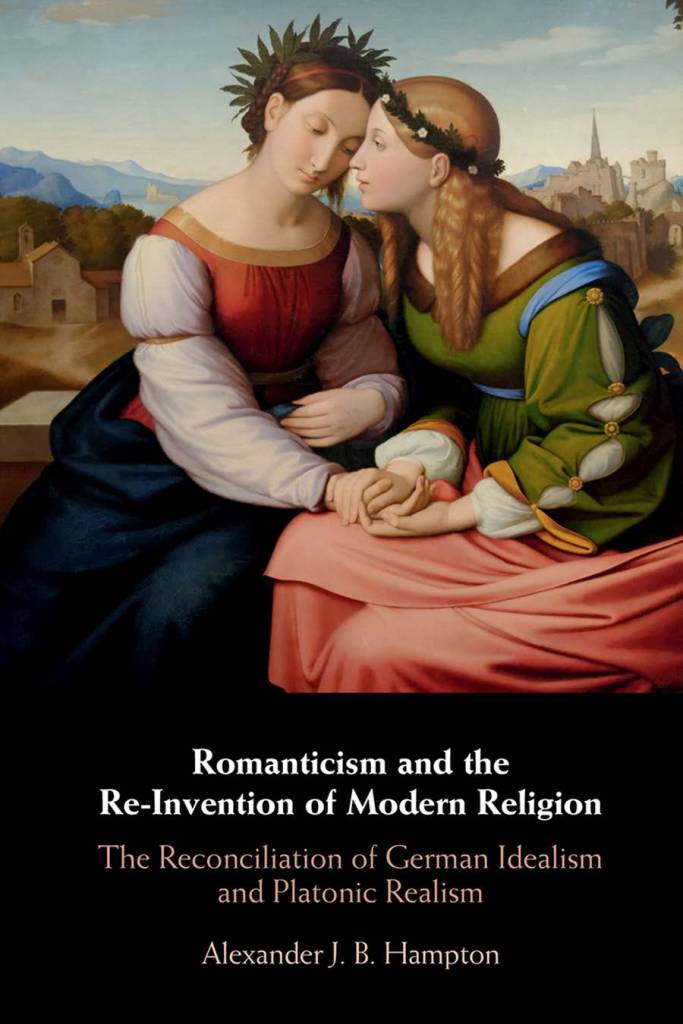
Romanticism and the Re-Invention of Modern Religion: The Reconciliation of German Idealism and Platonic Realism is an analysis of a moment in intellectual history when the forces of modernity, with their insistence on immanence and the rigorous demands of critical reason, collided with an enduring, though often obscured, tradition of transcendent realism rooted in both German Idealism and the ancient Platonic heritage.
In this monumental work, Alexander J. B. Hampton traces the genealogy of modern religious thought, revealing how the debates and dilemmas that animated figures such as Jacobi, Herder, and Moritz not only challenged the secularizing impulses of Kantian and Fichtean philosophy but also generated a fertile countercurrent that re-enchanted the modern world with the language of the divine. Hampton’s study is distinguished by its insistence that the modern crisis of religion—often caricatured as the inevitable consequence of Enlightenment rationalism and scientific naturalism—is in fact an opportunity for a radical re-invention of religious language, one that is simultaneously grounded in the objectivity of Platonic realism and imbued with the subjective dynamism of Romantic idealism.
Hampton argues that the traditional conception of the transcendent as an abstract, external absolute, estranged from the immanent order of human experience, is inadequate to capture the full spectrum of modern religious sensibility. Instead, he demonstrates how Romantic thinkers sought to dissolve the rigid boundaries imposed by secular modernity by rearticulating a vision of the divine that emerges not solely through apodictic demonstration but through the participatory, aesthetic, and mythopoetic engagement of the human subject with the world. Drawing on the dialectical interplay between the henological principle, which emphasizes a primordial unity from which multiplicity emanates, and the psychological principle, which locates the divine within the dynamic life-force or soul permeating all of nature, Hampton shows how the re-invention of modern religion is deeply rooted in the Platonic concepts of methexis and poesis. These notions, which originally explained the relationship between the eternal ideas and their sensible manifestations, are reinterpreted by the Romantics as expressions of a participatory metaphysics where every individual act of artistic creation becomes an act of divine revelation, a mode of accessing a transcendent truth that remains ever beyond the strictures of rational explanation.
In a landscape where Spinoza’s radical immanence and Fichte’s transcendental subjectivity appeared to offer competing blueprints for the foundation of an absolute, Hampton contends that it is precisely the reconciliation of these seemingly antagonistic positions—through a return to the timeless insights of Plato—that illuminates the true nature of Romantic religion. The book goes into how Jacobi’s vehement critique of an immanent, mechanistic conception of the divine, which he argued inevitably led to nihilism and the dissolution of individual freedom, set the stage for a rearticulation of religious belief that is both epistemologically humble and existentially robust. At the same time, Herder’s innovative revision of Spinoza’s doctrine, which sought to restore a dynamic, forceful understanding of nature as a self-revealing, creative totality, demonstrates how the spirit of transcendence may be rediscovered not in an abstract metaphysical postulate but in the lived, mutable expressions of history, art, and myth. Moritz, whose aesthetic writings further articulate the notion that art is the process by which the absolute becomes manifest in a “disinterested” yet participatory imitation of nature, contributes to this grand synthesis by showing that true aesthetic experience can bridge the chasm between the subjective act of creation and the objective structure of the cosmos.
The book presents an analysis into the unique task assumed by the Romantic poet—a vocation defined not merely by the production of art but by the responsibility to articulate a new, participatory language for transcendence in an age characterized by immanence.
This project is a response to the dramatic reordering of knowledge that modernity imposed. In earlier epochs, meaning and truth were understood as secured by the transcendent, the supernatural realm from which all reality derived its purpose and order. With the modern project of establishing an immanent absolute—exemplified in the philosophies of Spinoza and Fichte—human understanding came to be grounded in the natural order and the structure of experience itself. Yet, as the limits of this modern immanence became apparent through the critiques mounted by figures such as Jacobi, Herder, and Moritz, a deep philosophical and aesthetic yearning emerged: the need to restore a sense of the transcendent that is not alienated from human life but intimately woven into its very fabric.
Hölderlin’s early exploration of the “Dichterberuf” (the poet’s vocation) encapsulates this yearning. He portrays the Romantic poet as one who must not only reflect the world but, through the creative act of poetic expression, reintroduce the presence of the divine into a disenchanted age. In his novel Hyperion, for example, the figure of the young revolutionary poet embodies the conflict between the forces of immanent domination—where individuals are reduced either to domineering “lords over nature” or to its submissive “servants”—and the aspiration to reclaim an absolute, participatory relation to the divine. Novalis’s often-quoted lament, “We seek everywhere the absolute, and always find only things,” encapsulates this tragic misalignment: in the modern condition, the absolute, or the ultimate ground of being, has been effaced into a series of mere phenomena. The Romantic response, then, is to seek a restoration—a “rising higher than reason”—by rearticulating the transcendent in aesthetic terms that do not reduce God to an abstract postulate but rather reveal the living, immanent participation of the divine in all reality.
This transformative task is achieved, in part, by turning to the ancient tradition of Platonism. For the Romantics, Plato’s thought offers not a relic of an obsolete metaphysics but a vibrant model of liberation from the limitations of both Enlightenment rationalism and the reductive immanence of modern philosophy. Two interrelated Platonic concepts are especially significant here: methexis and poesis. Methexis, the idea of participation, expresses how the sensible world derives its being by partaking in the intelligible forms or ideas. Every object, every phenomenon, is what it is because it participates in a higher, transcendent ideal—for example, all beautiful things are beautiful by virtue of participating in the Form of Beauty. In this way, methexis provides a structural bridge between the many and the one, between contingency and the absolute.
Complementing methexis is the concept of poesis—the creative act of making. In Platonic thought, poesis does not merely mimic or copy nature; it is an active, generative process by which the artist or poet brings forth a new expression of the eternal into the finite realm. Unlike the mere imitation criticized in the Republic, true poesis reclaims the creative power inherent in the divine order. It is through the act of artistic creation that the individual, by engaging in a process that is both imitative and inventive, can participate in the higher order of things and thus serve as a mediator between human finitude and the transcendent absolute.
The Romantic poet, drawing on these Platonic principles, is thus called to a dual challenge. On the one hand, he must acknowledge the modern legacy—wherein the immanent has been privileged over the transcendent—and the associated risks of alienation, determinism, and the reduction of the divine to a mere principle of morality or a regulative idea. On the other hand, he is tasked with reasserting a vision of the absolute that is both immediate and participatory—a vision in which every aspect of the world, from nature’s laws to the vicissitudes of human history, is suffused with the living presence of the divine. The poet’s language becomes, in this context, a form of “transcendent realism”: a mode of expression that restores the sacred through the aesthetic, bridging the gap between the subjective and the objective, the immanent and the transcendent.
In the works of Schlegel, Hölderlin, and Novalis, this dialectical movement is rendered with remarkable force. Their writings reveal a deep dissatisfaction with both the excessive abstraction of Kantian critical philosophy and the sterility of a purely rational immanence as presented by Spinoza and Fichte. Instead, they propose an alternative that embraces the fullness of experience while simultaneously opening up a space for the ineffable, for that which lies beyond the reach of discursive reason. Their poetry, far from being a mere by-product of artistic impulse, is a deliberate attempt to recapture the lost intimacy between the human soul and the divine—a call for a reinvention of religious experience in terms that speak directly to the conditions of modern life.
Thus, the vocation of the Romantic poet is not one of idle aesthetic indulgence but of profound cultural and metaphysical renewal. Through his creative act, the poet enacts a “salto mortale” against the totalizing demands of rational explanation—a leap that embraces the mystery and the fullness of being. In his work, the dichotomy between lordship and servitude is dissolved; instead, all of creation is invited into a participatory dialogue, where the divine does not hover as a remote, abstract deity but lives immanently within the very act of creative expression. In this way, Romantic religion, as articulated by the poet’s vocation, offers a model for a new spirituality—one that reclaims transcendence without repudiating the richness of the immanent world.
This study explores how the Romantic poet’s vocation is a response to the modern crisis of meaning—a crisis born from the fragmentation of transcendence into mere immanence. By drawing on the deep well of Platonic thought, particularly the concepts of methexis and poesis, the Romantics forge a new language in which art becomes the medium through which the absolute is both revealed and participated in. It is a language that reconciles the historical and the eternal, the subjective and the objective, offering a pathway back to a unity of being that had long been obscured by the imperatives of modern rationality. The vocation of the Romantic poet, therefore, is to re-enchant the world—to restore to every facet of human life the promise of the transcendent, so that, as Hölderlin poignantly reminds us, even though “we come too late,” there remains the possibility of reviving that sacred dialogue between the self and the infinite.
Hampton’s work is not merely an historical reconstruction but a vigorous philosophical intervention that challenges prevailing narratives of secular modernity. By unearthing the latent power of Romantic thought to reframe the modern religious experience, he illuminates how the crisis of modernity—its alienation, its disenchantment, and its overreliance on rationalism—can be transcended through a re-engagement with the perennial, participatory dialogue between the human and the divine. His analysis reveals that modern religion, far from being an obsolete remnant of a pre-modern world, is in fact undergoing a profound transformation that calls for a synthesis of critical reason and aesthetic intuition, a reconciliation of the objective and the subjective, the immanent and the transcendent.
In a work of staggering erudition and philosophical depth, Hampton analyses the interplay of ideas that have defined German intellectual history since Kant, showing how Romanticism emerged as a creative force determined to reclaim the ineffable dimensions of religious experience from the clutches of reductive, secular modernity. His narrative is rich with allusions to the geometric rigor of Spinoza, the radical subjectivity of Fichte, and the mythopoetic grandeur of Platonic thought—a triumvirate of influences that converge in the writings of the early Romantics, whose poetic vocation becomes the crucible for a re-envisioned, re-enchanted modern religiosity. This book thus stands as a testament to the enduring possibility of a modern faith that is not shackled by the dichotomies of old, but that is instead capable of reconciling the highest ideals of rational inquiry with the immeasurable depths of mystical experience.
As Hampton unfolds his argument in multifaceted prose, he invites the reader into a world where the boundaries between philosophy, theology, and art dissolve, revealing a continuum of thought that is as much about the limits of human cognition as it is about the infinite possibilities of divine revelation. The book challenges us to reconsider the modern religious landscape not as a barren field of secular rationalism but as a dynamic arena where the legacy of German Idealism and Platonic Realism continues to inspire a re-invention of the sacred—a reinvention that is as radical as it is necessary for understanding the modern condition. In doing so, Romanticism and the Re-Invention of Modern Religion offers a compelling and ultimately transformative vision of modernity, one in which the yearning for transcendence is re-cast in the language of art, myth, and the inexhaustible, participatory beauty of existence, reaffirming the eternal human quest to find a place of belonging in an ever-changing world.
 Simon Gros
Leave a comment