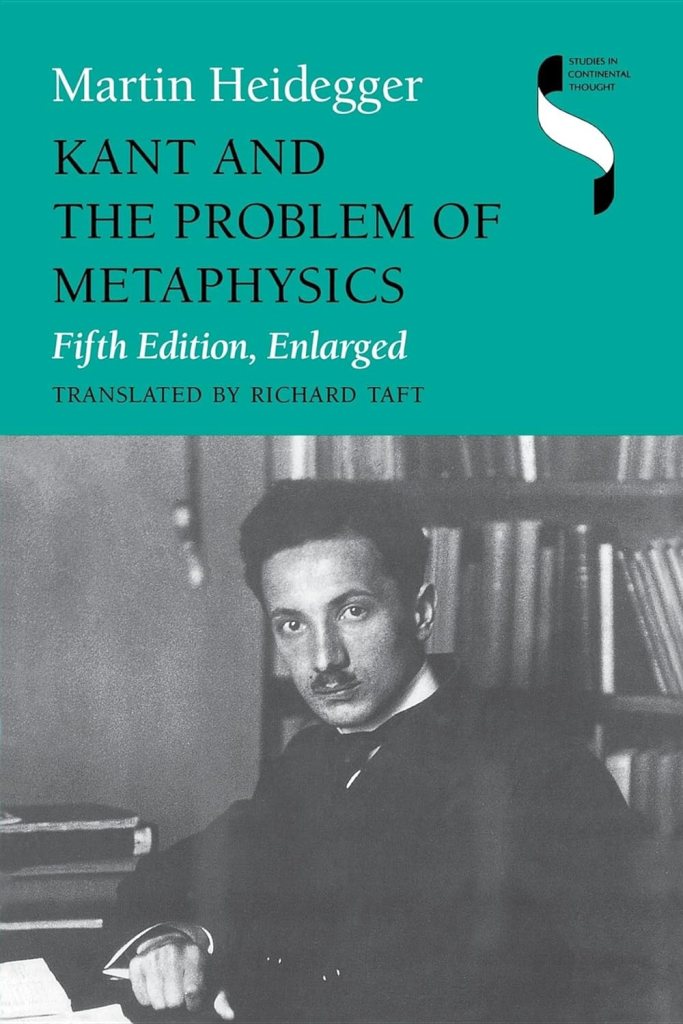
Martin Heidegger’s Kant and the Problem of Metaphysics is a forceful excursion into the fundamental principles of Immanuel Kant’s Critique of Pure Reason, yet it is also a resolute turning point within Heidegger’s own philosophical journey after the publication of Being and Time.
First appearing in 1929 and later forming volume 3 of Heidegger’s Gesamtausgabe, this treatise—the “Kantbuch,” as Heidegger sometimes names it—seeks to lay bare the inner dynamic of Kant’s thought regarding the possibility of metaphysics, while also offering a profound reorientation to the tradition of Western metaphysics itself. Its significance reverberates not only through twentieth-century Kant scholarship but also through the unfolding trajectory of Heidegger’s own project, especially in regard to the Destruktion of the metaphysical tradition. It has ignited persistent debate since its first edition, generating commentary and critique from contemporary thinkers such as Ernst Cassirer and Rudolf Odebrecht, and inspiring elaborations in subsequent philosophical undertakings far beyond its initial reception. Over time, the work has been revised, enlarged, and supplemented—particularly in its fifth edition, which includes not only Heidegger’s marginal notations from his personal copy but also four new appendices that record his subsequent reflections and his polemical exchanges with Cassirer. Indeed, it offers both a historical record of Heidegger’s earliest attempts to rethink ontology through Kant and an enduring statement of how he intended to engage the question of Being in the wake of Being and Time.
In Kant and the Problem of Metaphysics, Heidegger seeks to show that Kant’s Critique of Pure Reason does not merely supply an epistemological assessment of our cognitive faculties in the modern sense but rather, in its innermost momentum, aims at laying the ground for something broader and more original: what Heidegger calls a fundamental ontology, or a metaphysics that is itself rooted in the finite human condition. Heidegger’s reading pivots on the conviction that finite human knowing demands a prior disclosure of the very possibility of knowledge—an unveiling of how sensibility, understanding, and imagination conjoin to allow beings to appear as such. The major point of departure within the Kantbook is that if we consider Kant’s “Copernican Revolution” precisely, we discover that it is not simply an advance in “theory of knowledge” but rather a radical rethinking of metaphysics insofar as it requires a critique of pure reason to illuminate the transcendental framework that makes possible our finite relation to objects.
In particular, Heidegger accentuates the centrality of the Schematism chapter of the Critique of Pure Reason, where Kant grapples with the mysterious function that allows pure concepts to connect with sensible intuitions. Heidegger discerns in Kant’s discussion of the schemata—those transcendental determinations of time that mediate between the intellect and the senses—a profound clue concerning the finite human being’s mode of encountering objects. Much attention is thus paid to the power of imagination as the formative center wherein time, as a universal pure intuition, and the pure concepts of the understanding become originally unified. By interpreting the schematism as this intrinsically temporalizing condition, Heidegger reinterprets Kant’s fundamental move away from classical onto-theological metaphysics, in which an infinite intellect or a purely objective standpoint was presumed, toward a thoroughly finite constitution of reason.
Throughout the text, Heidegger’s insistence is that Kant’s problem of metaphysics—a problem that concerns how we can have synthetic knowledge of the highest principles—cannot be dismissed as a question of empty formal logic or a mere representation of “objects” in the sense of an external reality. On the contrary, Heidegger argues that the “inner possibility” of metaphysics is identical with how finite human reason transcends itself toward beings as such. In his presentation, “transcendence” names the human capacity to hold oneself open to what is encountered, so that the being can show itself. Kant’s a priori forms—space, time, and the categories—are disclosed not merely as abstract elements but as conditions that reveal how finite Dasein (human existence) is constituted in its directedness toward beings. He reads Kant’s passages on the transcendental power of imagination as the focal point where finite reason’s receptivity (sensibility) and spontaneity (understanding) coalesce. It is here, at the juncture of imagination, that we apprehend how time is not merely one subjective form among others but the universal pure intuition granting unity to the disparate forms of finite knowing. Hence, the “Kantbook” makes the bold claim that Kant’s first Critique, when interpreted in this way, offers an initial pathway for what Heidegger calls the “destruction of the metaphysical tradition,” signifying a retrieval of what was implicitly transformative in the Kantian project, while exposing the historical oversights that Kant himself partly sustained by remaining wedded to certain dogmatic assumptions.
Yet for all its interpretive ingenuity, Heidegger’s approach has been met with skepticism and outright rejection by many Kant scholars, who accuse him of distorting the genuine meaning of the Critique of Pure Reason. Ernst Cassirer famously rejected Heidegger’s account in their debates at Davos in 1929, objecting that the unilateral emphasis on the schematism and time neglected the rational ideal at the heart of Kant’s system. Michael Inwood later suggests that Heidegger himself abandoned some of the positions that characterize the Kantbook in his subsequent engagements with Kant. Nevertheless, the book’s challenging thesis—that time, imagination, and finite reason hold the key to metaphysics—continues to fascinate philosophers. The frequent charge that Heidegger “violently” interprets Kant does not lessen the abiding fruitfulness of Heidegger’s arguments for anyone seeking to rethink the relationship between ontology and transcendental philosophy.
Heidegger himself was never fully satisfied with his accomplishment here and repeatedly revised the text, clarifying that he had realized the interpretation might be an “over-interpretation,” or one that accentuated aspects of the Critique out of proportion to Kant’s own explicit statements. In the later editions—particularly in the fourth (1973) and fifth (1997) ones—he added prefaces and marginal notes that illuminate his ongoing struggle over what he took to be Kant’s hesitant but promising quest for a “fundamental ontology.” The final, fifth edition, as published in German in 1991 and now reflected in the English translation by Richard Taft, incorporates these marginal notes from Heidegger’s personal copy, thereby offering a more comprehensive glimpse into how Heidegger was still wrestling with, refining, or recasting his original claims. Alongside these annotations are four new appendices that bear critical historical value: Heidegger’s notes on the book post-publication, his review of Cassirer’s Philosophy of Symbolic Forms (focusing on mythical thought), his direct response to Cassirer’s and Odebrecht’s criticisms, and a remarkable textual fragment on the history of the Philosophical Chair at the university since 1866. Taken together, they expand the interpretive horizon for readers who wish to trace the exact movement of Heidegger’s thought from Being and Time through this daring confrontation with Kant, and they shed light on the controversies surrounding the so-called “Davos Disputation,” during which Heidegger unveiled his interpretation of Kant in conversation with Cassirer.
The expanded fifth edition thus shows the legacy of this pivotal work. It is not simply an academic text on Kant, nor merely a supplement to Being and Time, but a reorientation of Kant’s critical project from out of Heidegger’s fundamental question of Being. It invites scholars to grapple with the meaning of “transcendental logic” and “transcendental aesthetic” by acknowledging the existential-temporal structure that Heidegger identifies as the true source of a priori knowledge. In the original text, Heidegger integrates his argument with the tradition’s classical concerns—namely, how metaphysica generalis (ontology) undergirds metaphysica specialis (knowledge of God, freedom, and immortality)—only to insist that the latter must remain inaccessible unless the former is properly established as a finitude-based transcendence. The systematic categories, i.e., quantity, quality, relation, and modality, are recast not as a final classification of all beings but as the indices of our temporal, finite mode of engaging with whatever is. Once reconfigured through the lens of time, categories become the pivots that allow the understanding to project the horizon within which beings may appear, including those elusive questions of cosmology, psychology, and theology.
The style of the book is demanding, for Heidegger’s reading enacts a “destruction” of the comfortable notion that Kant’s Critique offers simply an epistemological grounding for modern science. Readers are confronted with dense passages that hinge on the exhanges among “pure intuition,” “transcendental schematism,” “transcendental apperception,” and “productive imagination.” Through a series of steps, Heidegger contends that the finitude of our knowledge—our inability to produce or bring forth the being itself—necessitates a distinctive mode of “transcendence” wherein time functions as the universal form allowing phenomena to manifest themselves. This yields the well-known (and frequently contested) claim that the transcendental power of imagination is the “common root” of sensibility and understanding. In Heidegger’s words, Kant was on the verge of recognizing that imagination is neither a mere psychological intermediary nor a formal logical faculty but the very pivot where pure intuitions and pure concepts unite to open the realm of possible objects. Although Kant himself, in Heidegger’s telling, recoiled from fully developing this insight—shying away from exploring imagination’s ontological primacy in favor of a more conventional conception of reason—Heidegger credits him with a decisive intimation that time (rather than an abstraction of reason) is at the heart of metaphysics.
The newly added materials in the fifth edition reinforce how central the Cassirer–Heidegger confrontation was in shaping the “Kantbook.” Immediately after the Davos Lectures, Heidegger wrote Kant and the Problem of Metaphysics, and these lectures themselves, along with the subsequent disputation, are archived in the appendices. They show how Cassirer, deeply rooted in the Neo-Kantian legacy, found Heidegger’s radical emphasis on time incongruous with the classical interpretation, which tended to highlight Kant’s emphasis on the spontaneity of the understanding and the formation of objective knowledge. The Davos transcripts reveal that while Cassirer defended the continuity of Kant’s moral and logical foundations and insisted on the universal structures of objectivity, Heidegger pressed for the existential-temporal dimension that he believed Kant’s schematism gestured toward but never fully unfolded. The gap between these two readings, so clearly manifested at Davos, remained unresolved, leading Cassirer to dismiss Heidegger’s interpretation as far too “existential,” whereas Heidegger claimed that Cassirer’s position lacked the depth and originality that truly confronted the finitude of reason.
In the post-publication reflections that also appear in the expanded edition, Heidegger shows increasing awareness of how his argument in the Kantbook could be misread or was perhaps overdrawn in specific details. Yet he never abandons the core thesis: that Kant’s quest for the conditions of the possibility of experience implies the question of Being, once we fully acknowledge that reason is never infinite or self-sufficient but always oriented by time and circumscribed by the “human Dasein” that discloses objects. For Heidegger, the genuine thrust of the Critique of Pure Reason lies not in mere epistemological certitudes but in unveiling the fundamental manner in which being matters to a finite knower. This is why the text remains “a treatise on method,” not in the sense of a methodological guide to scientific knowledge but in the sense of disclosing how finite existence must necessarily project the ground by which beings can appear.
In this vein, the book’s textual expansions—Heidegger’s unpublished notes, the newly included review of Cassirer’s Philosophy of Symbolic Forms, his response to the criticisms of Odebrecht and Cassirer, and the short essay “On the History of the Philosophical Chair since 1866”—elucidate both the provenance of Heidegger’s interpretive choices and the context in which his philosophical project was both contested and refined. Readers who wish to appreciate the interplay of Heidegger’s commentary on the schematism and his broader philosophical commitments will find these supplementary sections indispensable, since they unveil the aims of a philosopher who sees in Kant’s “transcendental turn” a partial yet essential impetus for rethinking the entire history of metaphysics. The controversies that erupted, especially those driven by Cassirer, show how divergent the pathways from Kant can become when one highlights transcendental logic and rational universality on the one hand or finite temporality and imagination on the other.
Furthermore, the new edition preserves the longstanding marginal notations Heidegger himself entered into his copy of the book, revealing the gradual refinements, hesitations, and rediscoveries he underwent in later decades. These annotations are especially pertinent for those examining whether Heidegger’s post-Being and Time attempts at fundamental ontology abandoned or continued the “Kantian” trajectory. They testify to the enduring resonance of the “Kantbook” in shaping the destiny of Heidegger’s entire oeuvre, as well as how the “Kantbook,” in turn, was illuminated by his subsequent explorations into Hölderlin, Nietzsche, and the pre-Socratics.
Throughout the decades, commentators have debated whether Heidegger’s interpretation is faithful to Kant’s letter or whether it transcends and partially reconstructs it to fit Heidegger’s existential concerns. Critics of Heidegger’s approach have sometimes maintained that he downplays Kant’s commitment to moral autonomy, universalized reason, and the objectivity of cognition, reworking the Critique of Pure Reason into a treatise on finitude and temporality. In response, readers sympathetic to Heidegger contend that he exposes dimensions of Kant’s text that remain otherwise latent and that his brand of “violence” against the text is both clarifying and productive. One may thus see how the “Kantbook” continues to drive philosophical reflection on the interplay of ontology, finitude, and transcendental method. Even as Heidegger warns against overestimating the scope of Kant’s system, he credits Kant with having identified the phenomenon of time-bound, imaginative synthesis as a crucial pivot within the entire project of metaphysics.
No less important, Kant and the Problem of Metaphysics exerts its influence as a guide for those concerned with the deeper question that animates Being and Time, namely the question of the meaning of Being. Already in Being and Time, Heidegger makes reference to Kant as a precursor who had intuited, yet not explicitly pursued, the finite-temporal structure that undergirds human understanding of Being as such. Thus, this monograph is not so much a separate “commentary on Kant” but an integral element of Heidegger’s attempt to retrieve and radicalize the Kantian question in service of his own existential ontology. Indeed, its dedication to Max Scheler, with whom Heidegger had important, though sometimes fraught, philosophical connections, further highlights its transitional place in Heidegger’s intellectual biography. The entire 1920s had seen Heidegger immerse himself in Kant, culminating in Being and Time’s repeated yet fragmentary evocations of the Critique. The “Kantbook” can thus be read as a stepping stone: the place where Heidegger expands those references into a systematic confrontation with the first Critique, all the while transforming Kant’s approach into a more radical line of inquiry about Dasein and time.
Readers, then, who engage with Kant and the Problem of Metaphysics in its newly expanded form will encounter an astonishing matrix of ideas. They will see the conceptual architecture of pure intuition and the pure concepts of the understanding weighed and measured in the crucible of time and the power of imagination. They will discover how crucial the “transcendental schematism” is in reconfiguring the relationship of finitude and objectivity. They will find in the appended notes, reviews, and disputation texts a living record of the heated debates in the late 1920s that shaped both Neo-Kantianism and the nascent paths of existential philosophy. And they will sense the tension between the historian of philosophy, who must honor textual fidelity, and the existential analyst, who seeks to push Kant’s hidden impetus into new and daring territory. All the while, Heidegger’s reading underscores that metaphysics, far from being a superfluous or antiquated discipline, arises from the most intrinsic demands of finite human reason—that it is bound to the question: how must we be so that the being can appear to us as being?
Because the book demands such sustained attention, even the earliest English translators grappled with the complexities of rendering Heidegger’s specialized usage of Kant’s technical terms into an idiom consistent with emerging conventions in English-speaking Heidegger studies. James S. Churchill’s original 1962 translation of Kant and the Problem of Metaphysics, though pioneering, has frequently been criticized as awkward and occasionally misleading, in large part because it predated most of the major translations of Heidegger’s works and lacked the specialized lexicon that later congealed. Richard Taft’s translation, with its attentiveness to the revised German editions, clarifies numerous ambiguities and ensures that contemporary readers can navigate the textual labyrinth with more precision. The addition of Heidegger’s marginal notations and the newly discovered appendices makes this version the authoritative resource for those who wish to appreciate the kaleidoscopic interplay of Kant, Heidegger, Cassirer, and the broader tradition. The complete reading experience illuminates how, with every passing decade, Heidegger still considered this early experiment vital to his own dialogues with ancient Greek philosophy, modern science, and post-Kantian thought.
Hence, Kant and the Problem of Metaphysics is aptly regarded as one of Heidegger’s most significant and, from a scholarly perspective, most challenging works. It redefines the meaning of metaphysics by shifting the center of gravity from any notion of reason’s absolute power to a deeper acknowledgment of reason’s temporality and finitude. It likewise reanimates the old Scholastic division between Metaphysica Generalis (ontology) and Metaphysica Specialis (theology, cosmology, psychology) by insisting that the latter cannot be tackled without first rethinking, in finite terms, the problem of Being that underlies any claim to know a totality of reality. Consequently, while Kant’s Critique of Pure Reason might seem an unlikely basis for an existential ontology, Heidegger boldly insists that Kant already ventured down that path, only to take flight from its final implications. In exposing those implications, Heidegger draws the Kantian project into a field of interpretive tension that remains urgent in contemporary debates over the nature and limits of human reason. One may even say that the “Kantbook” sketches out a new vantage on critical philosophy, one no longer tethered to purely logical constraints but immersed in the dynamic exhanges among time, imagination, and the Being-question.
The significance of the five editions culminating in the fifth, enlarged edition is thus considerable. Readers discover how the text’s lively reception history includes Heidegger’s own self-criticism and an unwavering sense that the book, while overshadowed by Being and Time, stands on its own as an indispensable essay in the modern confrontation with Kant. It is a text that has haunted nearly a century of philosophy, and for many of Heidegger’s readers, it is the place where he puts Kant into motion for the sake of an altogether different future for metaphysics. Even if the interpretation shows tensions or perhaps reaches contradictory ends, its conceptual boldness continues to spark new readings of Kant’s Critique, fuelling ongoing discussions about the relationship between finite human reason and the possibility of knowing anything at all, let alone the meaning of Being itself. In that sense, Kant and the Problem of Metaphysics is never merely a historical commentary, but rather a decisive and highly original statement that rethinks the domain in which reason takes shape.
It is in these many layers—historical, philological, systematic, existential—that the work endures in philosophical discourse. Scholars of Kant, historians of Continental thought, and students of Heidegger will find it essential, for it opens up a vantage point on how the Critique can be made to speak to problems that Kant did not explicitly isolate, yet which may lie latent in the very question of how finite beings can approach what truly is. Thus, Kant and the Problem of Metaphysics belongs not only on the shelves of those exploring the arc of Heidegger’s career but also among the key texts that define modern engagements with the Kantian enterprise. Even its overtly difficult passages, the ones that display its “violence of interpretation,” point to the unresolved tension in Kant himself, where the union of sensibility and understanding, under the aegis of time, marks a wondrous horizon that remains open to fresh investigation. By the book’s conclusion, the reader is compelled to wonder whether Kant’s philosophy, restored to this primal context of the human relation to Being, might yet offer perspectives that surpass even what Heidegger gleaned. That enduring possibility is part of what makes “Kant and the Problem of Metaphysics” a singular work, forever shaping the question of whether metaphysics, in its old or new forms, can and should be made intelligible from the standpoint of our finitude.
 Simon Gros
Leave a comment