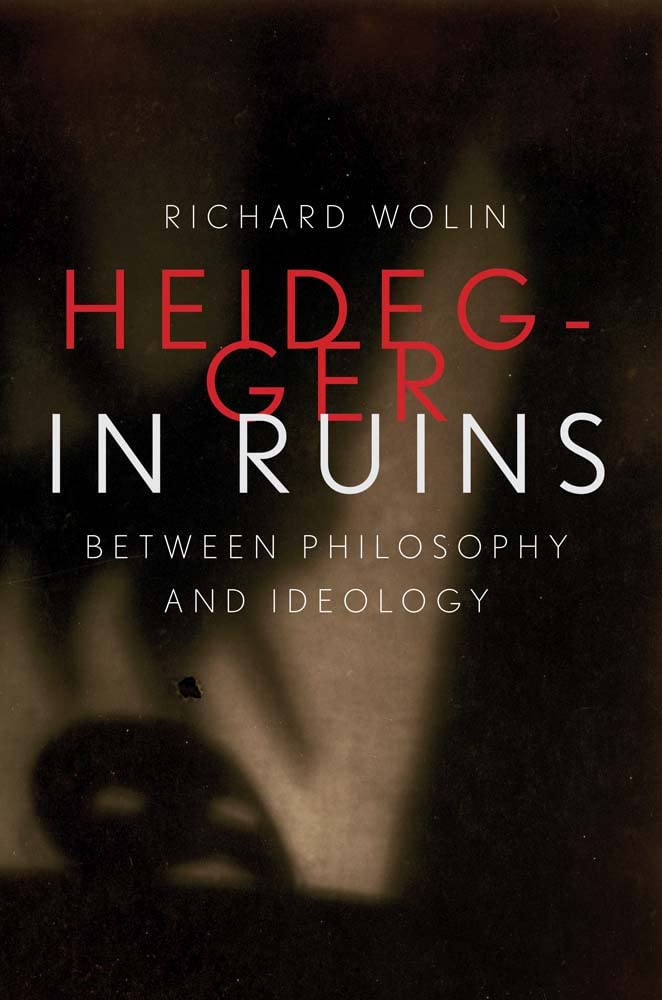
Heidegger in Ruins: Between Philosophy and Ideology is a formidable reappraisal that confronts, with unflinching rigor and extraordinary erudition, the profound and inextricable entanglement between Martin Heidegger’s philosophical corpus and his radical political commitments. In a work that traverses the complex intersections of existential ontology and völkisch ideology, Richard Wolin painstakingly demonstrates that the great philosophical edifice once hailed as a paragon of innovative thought is, in fact, constructed of bricks steeped in the corrosive admixture of National Socialist fervour and a conservative revolutionary worldview. Wolin’s inquiry goes deep into the historical, literary, and cultural matrix of twentieth-century Germany, exposing how Heidegger’s notorious Black Notebooks and his public interventions—far from being peripheral aberrations—reveal an enduring metaphysical commitment that cannot be extricated from a politics imbued with anti-Semitic and racialized undertones.
In Wolin’s evidence-laden narrative is the contention that Heidegger’s method of indirect writing, his deliberate rewording of texts, and his strategic manipulation of philosophical vocabulary were not mere stylistic idiosyncrasies but deliberate, even if tacit, vehicles for enshrining an ideology that celebrated the “inner truth” of a mythic people. Rather than representing a divergence between his philosophical pursuits and his political predilections—a duality that many of his defenders have long attempted to maintain—Heidegger’s thought emerges as a singular, if deeply problematic, synthesis in which the lofty questions of Being, truth, and destiny are inexorably combined with an agenda that sought to elevate race and national character above the universal claims of reason and humanism.
Wolin’s work is at once a historical reconstruction and a trenchant philosophical critique. It surveys the multifarious ways in which Heidegger’s engagement with the themes of technological domination, the decline of Western metaphysics, and the “end of philosophy” were repurposed as a metapolitical framework—a framework in which the destiny of the individual and the fate of the people were subordinated to an unyielding, almost mystical conception of historical renewal. The book argues persuasively that Heidegger’s postwar pronouncements and his involvement with the expellees’ discourse on Heimat, Boden, and rootlessness are not signs of a reformed or dispassionate intellectual retreat but rather the continuation of a problematic allegiance to an idea of the “people” that is inseparable from his earlier, overt sympathies with National Socialism.
Throughout this erudite examination, Wolin challenges the comforting myth of a radical break between Heidegger’s philosophical insights and his political misadventures. Instead, he reveals how the language of philosophy, far from being an abstract realm of disinterested contemplation, became a terrain over which ideological battles were waged and where the ontological was perennially suffused with the language of race, nation, and destiny. Heidegger’s exaltation of primordial rootedness, his recourse to metaphors drawn from agrarian life, and his incessant invocation of an authentic, premodern connection to the earth are all read as extensions of a völkisch romanticism—a romanticism that reanimates a racialized notion of “the people” and provides a metaphysical camouflage for an inherently exclusionary and, ultimately, destructive politics.
In its sweeping scope, Heidegger in Ruins also ventures into the contemporary resonance of Heidegger’s thought by examining its reception among the New Right and other political movements that continue to mine his writings for ideological validation. Wolin’s narrative underscores that the legacy of Heidegger’s philosophy is not a relic of an isolated historical moment but a living, if corrosive, influence that persists in modern debates about the nature of truth, the role of technology, and the possibility of genuine political renewal. The book’s insistence on interrogating the inseparability of philosophical inquiry and political ideology is a stark repudiation of attempts to sanitize or compartmentalize Heidegger’s thought, insisting instead on a critical reckoning with the full implications of his commitment to an “inner truth” that is as much about exclusion and domination as it is about existential profundity.
In a final, uncompromising meditation on the nature of philosophical legacy, Wolin invokes the metaphor of ruins not just to denote the collapse of an intellectual edifice but to signal the potential for the fragments of thought—each inscribed with the ambivalence of genius and ideological blindness—to be reassembled in ways that confront, rather than obscure, the deep moral and political ramifications of Heidegger’s work. His book, in this sense, is both a historical document and a philosophical intervention, urging contemporary readers and scholars to recognize that the value of philosophy is not found in an abstract separation from historical contingencies but in the rigorous, sometimes painful, scrutiny of the ideas that have shaped—and continue to shape—the destinies of peoples and nations.
Heidegger in Ruins: Between Philosophy and Ideology is a demonstration of the need for intellectual honesty in the face of charismatic yet pernicious ideas. It is an invitation to explore the depths of a thought that, while capable of sublime insight, is irrevocably stained by its entanglement with one of history’s most catastrophic political movements. Wolin’s multifaceted analysis challenges us to reconsider what it means for philosophy to be “in ruins” and to recognize that the remnants of a once-celebrated intellectual tradition may yet serve as both a warning and a resource for rethinking the relationship between thought and power in our own age.
 Simon Gros
Leave a comment