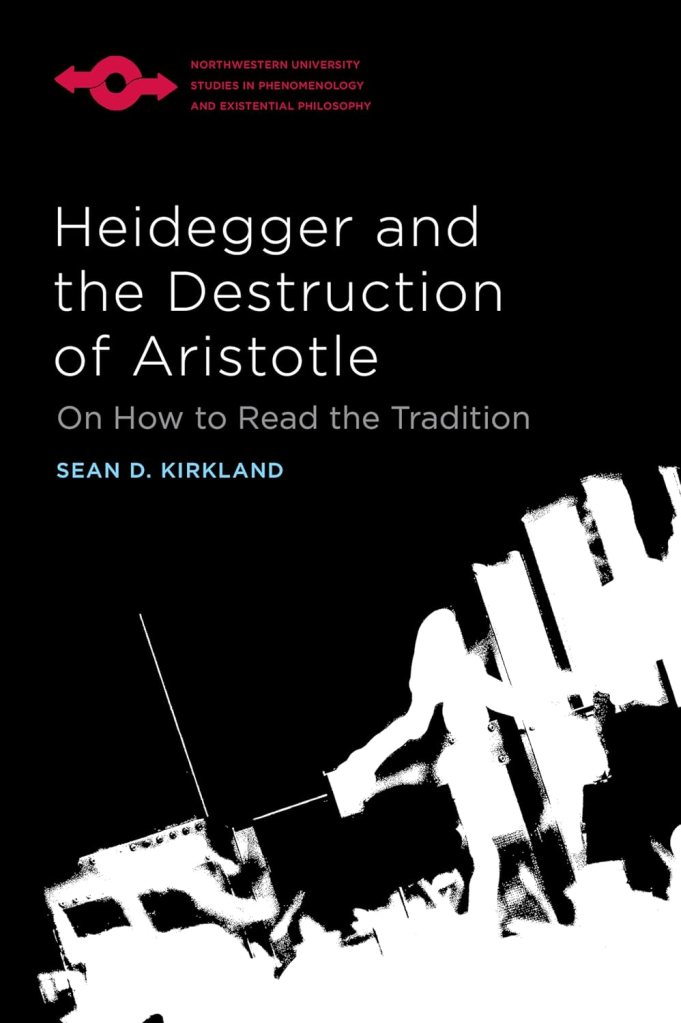
Heidegger and the Destruction of Aristotle: On How to Read the Tradition is an extended exploration of Heidegger’s method of “destruction” as applied to the reception and interpretation of Aristotle’s philosophy. In these passages, Kirkland outlines how Heidegger’s approach is neither a mere repetition nor a total rejection of the inherited metaphysical tradition. Instead, it is a dynamic, dialectical method that both disassembles traditional concepts and simultaneously appropriates their deeper, often unarticulated origins. This method is meant to reveal the “ground” or the “Boden” from which these concepts—especially central ones like ousia (substance or being‑ness)—emerge, and in doing so, it points to what is beyond the strict confines of what is given in our ordinary experience.
In the basis of Heidegger’s project is the observation that Western philosophy, since the time of the ancient Greeks, has tended to reduce the question of Being to an identification with the presence of beings. For Aristotle, this reduction takes a particularly systematic form in his treatment of concepts. In the traditional reading, Aristotle is often seen as offering a finished system in which ousia is identified primarily with the concrete, individual entities (like a particular horse or human) and with the universal qualities they share. However, Heidegger insists that such an interpretation misses an essential dimension: before any concept is fully formed, there is a primordial questioning—a “krisis” or rupture—in which Being itself is experienced in its hidden, withdrawn quality. This initial encounter with Being is not something that can be captured entirely by the later metaphysical formulations. Instead, it persists as an excess, a remainder that escapes the full articulation of the concept.
Heidegger’s “destruction” (or de‑construction, in a sense, though he is careful not to reduce his project to a mere negation) operates on several levels. First, it involves a shift in attention from the static, polished definitions that have come down through the tradition to the concrete, lived experience that originally prompted the formulation of those concepts. This means that rather than taking for granted the established meanings of terms such as “substance” or “essence,” the destructive reader must inquire into the “originary experiences”—the very moments when beings first appeared and elicited philosophical questioning.
Second, Heidegger directs our attention to the language and terminology that Aristotle employs. One must ask whether the terms are “imposed” on the phenomena from an inherited framework or whether they arise organically from the experience itself. For example, when Aristotle speaks of ousia, he is not simply cataloguing properties of individual things but is also, perhaps inadvertently, gesturing toward an unspoken source of being—a kind of ground that remains concealed even as it underwrites the intelligibility of what appears.
A third step in the method is to scrutinize the way in which intelligibility is achieved. That is, destructive reading asks: In what way does the text “make intelligible” its subject matter? And what aspects of that intelligibility might actually betray a deeper lack—a failure to capture the fullness of Being? This is where the method reveals its ambivalence. On one hand, it can be seen as a kind of “original repetition,” whereby the interpreter not only repeats the ancient questioning of Being but does so in a way that actively transforms one’s present understanding. On the other hand, it is also a process of critical distancing, where one must “de‑construct” or dismantle the received, traditional formulations in order to expose their historical and conceptual limitations.
The discussion also highlights Heidegger’s broader project in relation to phenomenology. Whereas Husserl’s reduction seeks to suspend the “natural attitude” in order to get at the structures of consciousness, Heidegger’s reduction is ontological: it aims to lead the thinker from the immediate appearances of beings back to the more elusive question of Being. This movement is not simply a matter of bracketing off the world; it is an active re‑engagement with the pre‑philosophical experience of phenomena—what the Greeks, including Aristotle, experienced as the raw openness of Being. In doing so, Heidegger insists that philosophy must be “critical science”—a mode of inquiry that does not merely accumulate facts or systematically deduce propositions about beings, but rather questions the very ground on which our understanding of being is founded.
This critical orientation is what allows Heidegger to challenge the “dogma” that Aristotle, by virtue of his systematic approach, is simply the master builder of an already finished metaphysical edifice. Instead, Heidegger reads Aristotle as an active, questioning thinker whose dialectical method—rooted in the practice of endoxa and the flux of everyday experience—reveals that even the most basic concepts are inherently provisional and open to further questioning. For Aristotle, the concept of ousia is not a static category but rather a dynamic interplay between form and matter, between what is explicitly present and that which withdraws itself beyond immediate capture. Heidegger’s task is to “destroy” the received formulation of ousia—not in the sense of obliterating it, but in the sense of unpacking and reactivating its unspoken potential.
The work explains that Heidegger’s destructive method is a twofold process of construction and de‑construction. It first involves an immersion into the historical and experiential context of Aristotle’s thought—a “participation” in the original questioning of Being—and then a critical de‑construction of the subsequent metaphysical accretions that have obscured the original, lived encounter with Being. The ultimate goal of this method is to open up a new space for philosophical thinking, one that does not reduce Being merely to the sum total of present beings but instead recognizes its inherent excess, its withdrawn and enigmatic nature. This, in turn, is seen as essential not only for re‑reading Aristotle but for renewing our entire philosophical outlook in the contemporary world.
Thus, Heidegger’s approach—as laid out in these courses and lectures from the 1920s—invites us to listen anew to the ancient texts, to “hear” what is not immediately there, and to engage with our tradition in a way that both appropriates and transforms it. This is not a simple act of rejection or nostalgic repetition but a radical re‑engagement with the origins of philosophical inquiry, aimed at liberating thought from the constraints of a metaphysics of presence and opening it to a more original and profound understanding of Being.
 Simon Gros
Leave a comment