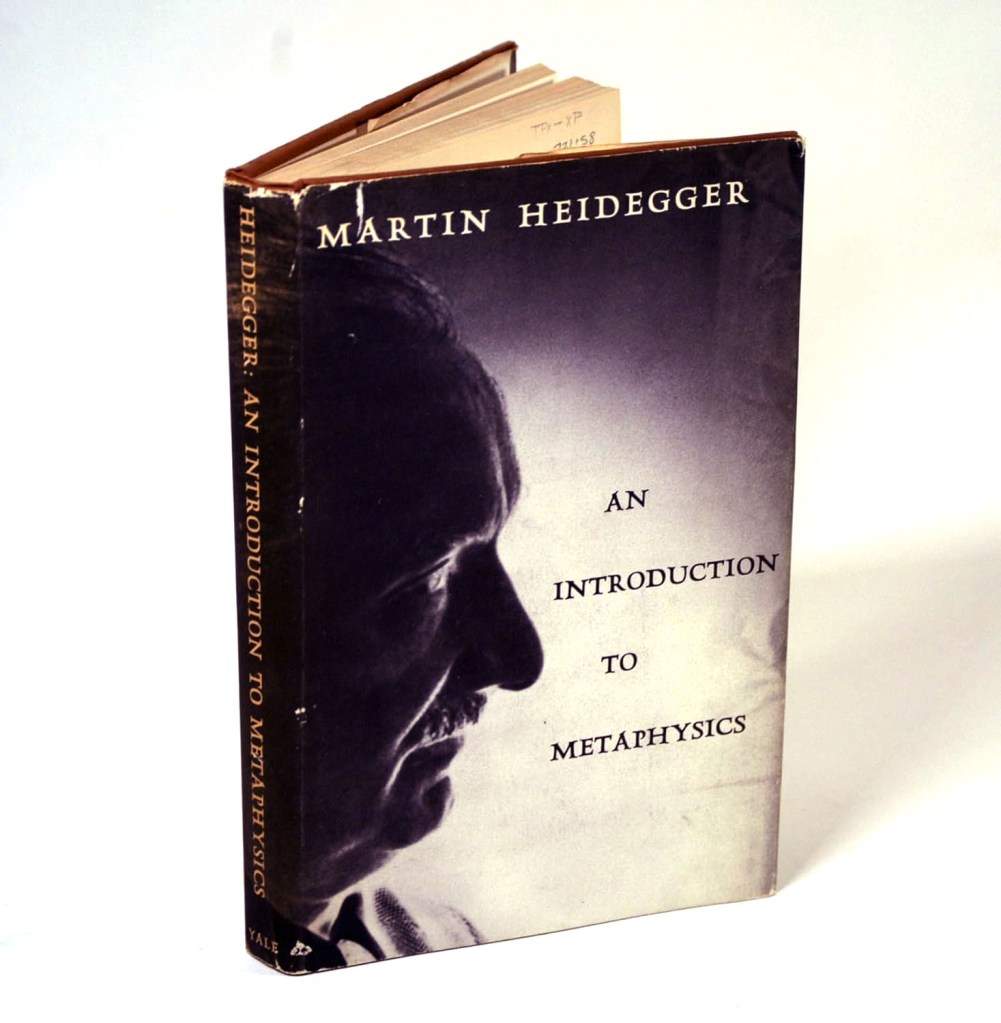
In An Introduction to Metaphysics, Martin Heidegger presents a formidable and unrelenting analysis of the very conditions of existence, inviting the reader into a difficulty of thought where the primordial question—“Why are there beings at all instead of nothing?”—resonates as the central enigma that has haunted Western philosophy since its inception. This work, delivered as a series of lectures at the University of Freiburg in the summer of 1935, unfolds as both a historical document and a transcendental meditation on the nature of Being, challenging entrenched assumptions and the conventional metaphysical categories that have long dominated our understanding of reality. Heidegger’s text is not a mere academic exercise but a passionate summons to reawaken our sense of wonder at the mystery of existence, urging us to recognize that the most fundamental questions of our lives are inextricably bound to the ways in which we encounter and interpret the world around us.
At the heart of this inquiry lies a deep engagement with the legacy of Greek thought, whose language and poetic sensibility serve as the original medium for grasping the phenomenon of Being. Heidegger’s exploration is anchored in the delicate interplay between what he terms das Seiende—beings or that which is—and das Sein, the expansive, nonentity-like character of Being that enables all beings to reveal themselves as such. He interrogates the etymological and grammatical roots of these terms, demonstrating that traditional metaphysics has often reduced the fluid, dynamic process of emergence, becoming, and fading into rigid, static categories that obscure rather than illuminate the true nature of existence. In this regard, the work is both a return to and a radical revision of ancient preoccupations: it calls for a recuperation of the Greek sense of phusis, of nature as an unfolding, emergent presence that resists complete capture by analytical concepts or scientific objectification. The result is a reorientation of our understanding, one that privileges an event-like coming-to-be—a “happening” of Being—that defies the neat binaries of presence versus absence, being versus nothing.
Combined with these ontological investigations is a trenchant critique of the historical trajectory of Western thought, a trajectory that has, according to Heidegger, gradually forgotten the original, transformative encounter with Being. The lectures trace a long history of philosophical misinterpretation, beginning with the subtle distortions introduced by Platonic and later scholastic dichotomies, which positioned Being in opposition to becoming, and thereby relegated the poetic, experiential encounter with existence to the margins of rational inquiry. Heidegger’s treatment is not content with cataloguing this tradition; rather, he employs it as a foil against which the possibility of a more authentic, primordial engagement with the world can be illuminated. In doing so, he not only challenges the entrenched prejudices of academic metaphysics but also calls into question the very language, logic, and conventional practices through which we have come to think about truth and meaning.
This philosophical enterprise is set against the charged political and cultural backdrop of the 1930s—a time marked by the rise of National Socialism and a pervasive crisis in modernity. Heidegger’s own political engagement, exemplified by his tenure as rector and his ambiguous, often contradictory remarks on the nature of the revolutionary moment, casts a long and complex shadow over the text. The lectures grapple with the notion that historical events—political upheavals, technological advances, and cultural transformations—are not mere contingencies but are deeply interconnected with the unfolding of Being itself. In his meditations on the nature of violence, the dynamics of power, and the role of language in shaping our collective destiny, Heidegger suggests that the encounter with Being is as much a historical phenomenon as it is an ontological one. The work, therefore, emerges as a space of dialectical tension, where the sublime aspirations of a new, authentic community intersect with the stark realities of political violence and ideological excess, inviting the reader to consider not only what it means to be but also what it means to be collectively responsible for the unfolding of history.
The significance of the new translation of An Introduction to Metaphysics cannot be overstated. Carefully revised and expanded, this edition renders Heidegger’s notoriously idiosyncratic and challenging prose into a form that remains faithful to its original complexity while offering greater clarity and accessibility to contemporary readers. Extensive scholarly apparatus—including comprehensive notes, a detailed German-English glossary, and a translator’s introduction that situates the lectures within the broader context of Heidegger’s oeuvre—allows the modern reader to penetrate the layers of meaning embedded in the text. Each carefully rendered passage and every nuanced play on words serve to highlight the multifaceted nature of Heidegger’s inquiry, ensuring that the reader is invited to engage with the original dynamism of the language rather than simply receiving a static, one-dimensional interpretation. The translation thus becomes an indispensable companion to the text, offering insight into the linguistic and philosophical transformations that lie at the heart of Heidegger’s thought.
Heidegger’s philosophical exploration in this work is marked by a rare density and precision, qualities that are at once both demanding and exhilarating. The book exemplifies the idea that philosophy must, at its best, be an exercise in reawakening our most fundamental capacities for wonder and critical reflection. By interrogating the very possibility of understanding—as well as the ways in which language, tradition, and historical circumstance conspire to shape our experience—Heidegger dismantles the comfortable certainties of everyday life and reveals the profound mystery that lies beneath the surface of all things. The work challenges us to reconsider the role of human existence (or Dasein, as he refrains from reducing it to a mere biological or anthropological category) as inherently bound up with the event of Being, a process that continuously unfolds and redefines itself through the interplay of presence and absence, temporality and finitude.
The stylistic and linguistic innovations of An Introduction to Metaphysics are as integral to its meaning as the philosophical insights it conveys. Heidegger’s deliberate use of neologisms, his careful attention to the etymological roots of key concepts, and his intricate wordplay invite the reader into a kind of linguistic meditation that mirrors the ontological meditation at the core of the work. By resisting the temptation to reduce language to its conventional referents, he demonstrates that words themselves can be sites of profound revelation—a means by which the hidden dynamics of Being may be partially disclosed. In this way, the text not only challenges our preconceptions about what it means to think and to speak but also compels us to appreciate the inherent musicality and transformative potential of language itself.
The political dimension of the lectures is rendered with an ambiguous intensity that has sparked sustained debate among scholars and readers alike. While certain passages hint at an endorsement of the revolutionary potential of National Socialism—evoking the possibility of an authentic, historically grounded communal destiny—other sections offer a scathing critique of the superficial and ultimately destructive tendencies inherent in any movement that reduces human existence to mere ideology or technological domination. Heidegger’s reflections on the nature of violence, power, and the sway of historical forces suggest that the encounter with Being is an event that defies easy categorization, one that can engender both creative renewal and catastrophic rupture. In his meditations on the interplay between the elemental forces of nature and the constructed totalities of human society, he ultimately implies that the true “inner truth” of any historical movement must be discerned not in its overt political manifestations but in its capacity to reveal the deeper, often unsettling, dynamics of existence.
In its relentless interrogation of traditional metaphysics, An Introduction to Metaphysics is both a culmination of Heidegger’s early thought and a harbinger of the radical rethinking that would later come to characterize his mature philosophy. The text pushes beyond the limitations of a static, ahistorical conception of Being, advocating instead for a dynamic, historically contingent understanding that recognizes the transformative power of the encounter between human existence and the unfolding of reality. Here, the question of Being is not to be answered by invoking timeless absolutes or transcendent principles but is to be experienced as an event—a moment of profound revelation in which the ordinary is rendered extraordinary and the familiar becomes imbued with the possibility of endless reinterpretation.
Ultimately, Heidegger’s work is an invitation to step beyond the narrow confines of conventional metaphysics and to embrace a mode of thinking that is both radical and reflective—a mode that is attuned to the nuances of language, the flux of historical forces, and the profound mystery of what it means to exist. In this text, the interplay of thought, language, and history is rendered in a manner that is as poetic as it is incisive, urging each reader to confront the challenge of reawakening a deeper awareness of Being in the midst of a world that too often seems dominated by the calculable and the superficial. The transformative potential of this encounter lies not in the acquisition of ready-made answers but in the courageous willingness to question the very foundations of our most cherished assumptions, to listen anew to the silent call of the primordial, and to rediscover the power of authentic, reflective existence.
An Introduction to Metaphysics endures as a work of unparalleled philosophical richness, a text that continues to provoke, inspire, and unsettle with its relentless interrogation of the mysteries that lie at the heart of existence. It is a work that demands from its readers not passive consumption but active, thoughtful engagement—a rigorous and often painful process of unlearning the comfortable certainties of everyday thought in order to rediscover the raw, unmediated experience of Being. In its synthesis of ancient wisdom and modern critique, its intricate fusion of language and thought, and its unyielding challenge to both political and metaphysical orthodoxy, Heidegger’s text remains an indispensable guide for anyone seeking to confront the profound questions of human existence and to reclaim a sense of wonder in a world that is ever teetering on the brink between revelation and oblivion.
 Simon Gros
Leave a comment