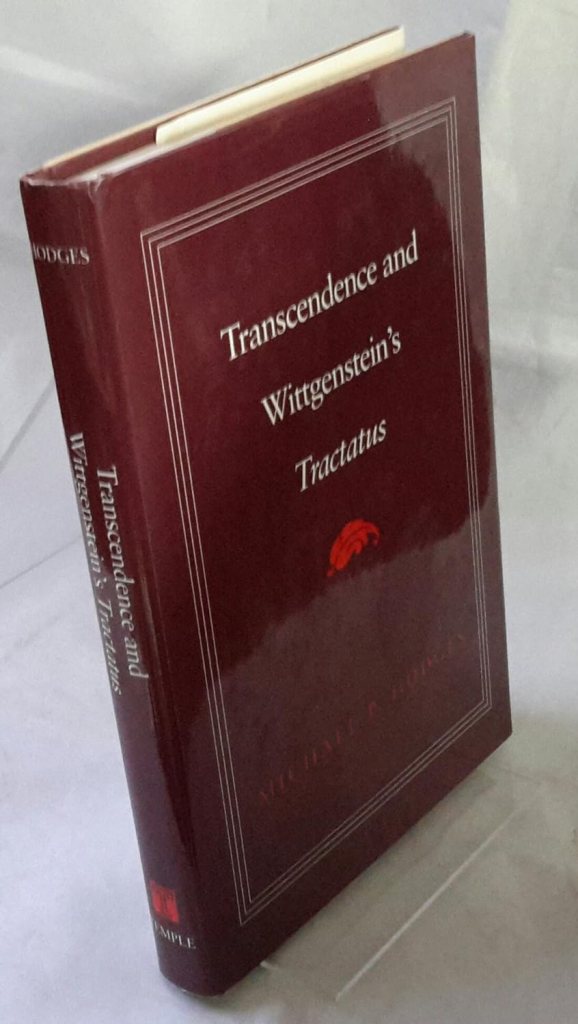
In this towering reflection on the very foundations of human thought, language, and the ethical life, the reader is drawn into an inquiry that challenges not only the boundaries of what can be expressed but also the very limits of the representational order itself. This work emerges as both a rigorous exegesis and a transformative re-imagination of Wittgenstein’s seminal insights—a synthesis of logical atomism, transcendental critique, and an ethical vision that refuses to be contained by the superficial confines of empirical representation. It is an opus that unfolds with a relentless precision, inviting its audience to confront the paradox that lies at the heart of all philosophical discourse: that the totality of human experience, with all its ineffable values and unutterable meanings, is at once circumscribed by and yet exceeds the very language by which it is given form.
The book navigates the treacherous terrain between what can be said and what must, by necessity, remain unsayable—a terrain where the clarity of logical structure collides with the opaque depths of ethical and aesthetic transcendence. With a style that is both unyielding and poetic, the author reconstructs the interplay between the discrete, atomic propositions that serve as the building blocks of the factual world and the broader, often paradoxical, horizons of the metaphysical subject. In so doing, the work not only reaffirms the intimate connection between language and the world but also exposes the fissures and tensions that arise when we attempt to articulate the inarticulable—a pursuit that ultimately reveals the silent, yet indomitable, presences of moral and existential significance.
At its core, this text is a journey into the heart of representation itself, where the logical form of a proposition is shown to be inseparable from the structure of reality it seeks to mirror. The narrative unfolds in a manner that offers an analysis so detailed that every nuance of meaning is rendered visible against the backdrop of a world that is defined as the totality of facts. Here, language is not merely a passive medium for the transmission of information, it is an active, dynamic force that delineates the very possibility of thought. The author persuasively argues that the limits of our language are not arbitrary but are, in fact, the precise contours of the world as it is experienced and understood, thereby establishing a critical link between the cognitive apparatus of representation and the transcendent domain of ethical commitment.
Yet, as the analysis proceeds, the reader is compelled to confront the stark realization that any attempt to encapsulate the essence of the ethical or the sublime within the rigid framework of propositional language is destined to falter. The work challenges the modern inclination to reduce all value to mere empirical contingency by insisting that the realm of the unsayable—the sphere in which true ethical significance resides—remains forever beyond the reach of definitive description. In this light, the text advances the notion that what truly matters in human life is precisely that which defies expression, that which is manifested only indirectly through the very structure of our linguistic practices and the tacit assumptions that undergird them. It is a call to recognize that the most fundamental aspects of our existence are not facts to be catalogued but conditions to be intuited from the silence that follows the limits of our discourse.
Drawing upon a merger of logical rigor and metaphysical depth, the book illuminates the essential ambiguity that permeates the nature of the self. It distinguishes, with exquisite subtlety, between the empirical subject—an individual self ensconced in the flux of everyday experience—and the metaphysical subject, an abstract yet indispensable locus from which all representation is made possible. This duality, the book contends, is not a mere theoretical abstraction but the very condition for the possibility of a world imbued with meaning. By positing that the metaphysical subject exists as the limit of the world rather than as one among its many constituents, the work offers a radical reorientation of our understanding of subjectivity, one that dissolves the seductive allure of solipsism while simultaneously affirming the transcendental character of ethical and aesthetic values.
In a daring move that blurs the boundaries between philosophy and art, the book insists that the full spectrum of human life—its joys, its sorrows, its moral dilemmas, and its transcendent aspirations—can be apprehended only by acknowledging the inherent tension between the expressible and the ineffable. Every proposition, it is argued, carries within it the seed of its own transcendence; each statement, in delineating the contours of a possible state of affairs, also gestures toward the realm of those facts that can never be fully captured in words. This insight is presented not as a limitation but as the very source of our intellectual and existential freedom, a freedom that permits us to glimpse the sublime even as we are bound by the strictures of our linguistic constructions.
The work offers a relentless critique of the modern worldview—a critique that is as much about the limitations of scientific explanation as it is about the dangers of reducing the ethical dimension to a mere by-product of empirical observation. It challenges the prevailing assumption that the world, as given by the totality of observable facts, is all that there is to reality. Instead, it posits that the ultimate significance of life lies in that mysterious interstice between the said and the unsaid, between the realm of measurable phenomena and the domain of the transcendent. In doing so, the work evokes a vision of philosophy that is at once both humble and heroic, a vision in which the act of philosophical inquiry is understood not merely as a technical exercise in logical analysis but as a profound engagement with the deepest questions of human existence.
The narrative unfolds with a deliberate cadence that mirrors the slow, inexorable unfolding of truth itself, urging the reader to relinquish the comfortable certainties of everyday language in favor of a more expansive, if disquieting, vision of the world. It is a work that demands both intellectual rigor and a willingness to embrace the ineffable—a willingness to confront the mystery that lies at the heart of all being, a mystery that, while it may ultimately defy complete articulation, nonetheless infuses our lives with an enduring sense of wonder and purpose. In its relentless pursuit of clarity, the book reveals that true understanding lies not in the accumulation of discrete propositions but in the capacity to apprehend the totality of what can be represented, and in doing so, to recognize that the very act of representation is itself an act of transcendence.
This work is a monumental contribution to contemporary philosophy, an essay that reconfigures our most fundamental assumptions about language, logic, and the ethical life. It is a book that refuses to be neatly categorized, for it exists at the intersection of rigorous analytical inquiry and the deepest existential questioning, a place where the limitations of our words are transformed into the very conditions of our possibility. By boldly affirming that the world is not merely a collection of facts but a horizon of meaning that can only be fully grasped through a recognition of its inherent unsayability, the text offers a vision of philosophy that is as liberating as it is demanding—a vision that, in its insistence on the indispensable role of transcendence, ultimately points toward a more authentic and profound engagement with the mystery of existence.
 Simon Gros
Leave a comment