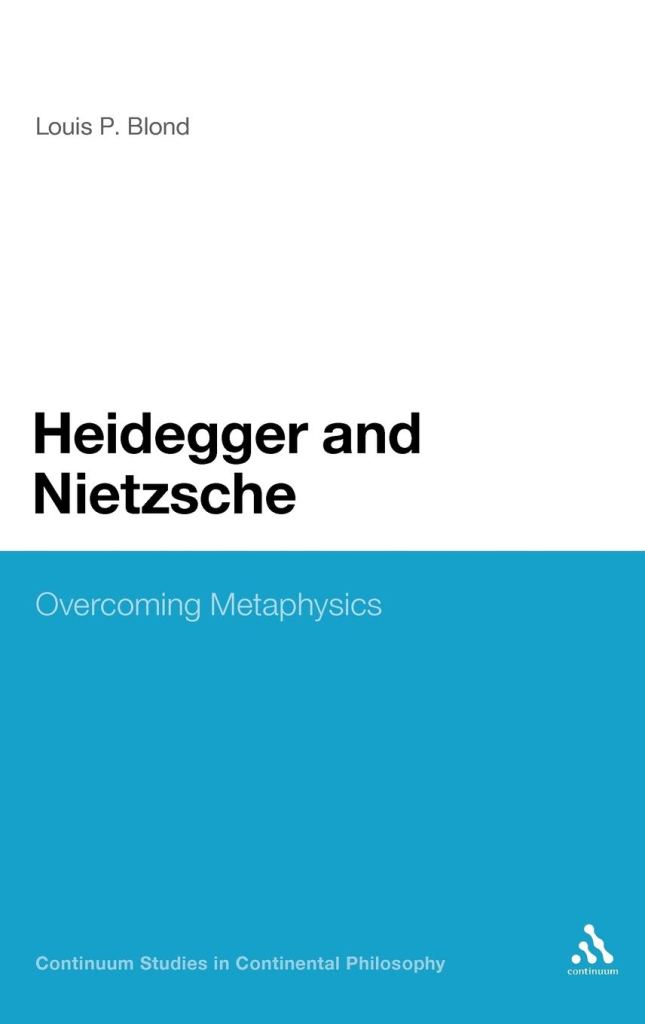
In this formidable and exquisitely rigorous exploration, Louis P. Blond offers a penetrating reappraisal of the twin challenges posed by Heidegger and Nietzsche to the long-entrenched tradition of Western metaphysics. The work unfolds as an inquiry into the very conditions under which beings emerge into presence and, by extension, how the nothing—a concept traditionally relegated to mere negation—acquires a positive, even formative, role in the ontological constitution of reality. Drawing upon an expansive historical panorama that spans from the critical innovations of Kant and Leibniz through the dialectics of Hegel and Schelling to the radical revaluations of Nietzsche, Blond’s study dissects the principle of sufficient reason as it has been inherited and transformed within metaphysical discourse. He exposes the inadequacies of an account that seeks to ground the multiplicity of phenomena solely in a causal chain or in the unyielding logic of presence, arguing instead for an approach that situates the emergence of beings within a dynamic exchange of transcendence and nihilation.
It’s an interrogation of the ontological distinction between being and beings—a distinction that, for Heidegger, is not merely a formal demarcation but a lived, experiential condition of Dasein itself. Blond traces how Heidegger’s reconfiguration of this primordial split not only undermines the traditional metaphysical reliance on a self-grounding subject and its orderly categorization of entities but also discloses an alternative horizon where the nothing is re-envisioned as an active, creative force. In this reading, the nothing is no longer the passive background of negation; rather, it performs a radical “nihilating” function that both withdraws and simultaneously unveils the horizon of being. It is this paradoxical operation—the capacity to both repel and to disclose—that enables a transition beyond the confines of a metaphysics obsessed with static presence and immutable categories. By foregrounding the role of anxiety (Angst) as the experiential locus at which the nothing is encountered, Blond elucidates how Dasein is compelled to confront the sheer contingency of its own existence, thereby opening up the possibility for an authentic reorientation toward an understanding of being that escapes the reductive confines of traditional subject–object logic.
Blond’s treatment is marked by an extraordinary conceptual nuance, as he combined detailed analyses of the schematism in Kant’s transcendental deduction with a critique of the neo-Kantian project that sought to dissolve the tension between pure sensibility and formal logic. In his narrative, the power of the imagination is not merely a mediating faculty but the root of synthesis—a necessary precondition for the unification of the manifold of appearances into a coherent field of experience. This very synthesis, however, is reinterpreted as an ontological operation that must be understood in terms of transcendence: a process by which finite existence reaches beyond the immediate givenness of beings to apprehend the fundamental ground from which their possibility arises. Here, the principle of sufficient reason—traditionally deployed to account for every effect by a corresponding cause—is destabilized. Blond shows that when this principle is applied without critical reflection, it inadvertently reinscribes the very metaphysical totality it purports to overcome, ultimately reducing the richness of being to a series of self-evident, yet ultimately hollow, causal determinations.
The book’s narrative advances by scrutinizing the dialectical tension between immanence and transcendence, a tension that has haunted philosophical thought from its earliest articulations. In confronting the legacy of Leibniz, whose principle of sufficient reason once promised a complete rational explanation for the order of the world, Blond demonstrates how Heidegger’s rearticulation of this principle eschews a purely causal account in favor of one that recognizes the necessity of an origin which is itself not a being but rather the condition for the possibility of beings. In this way, the search for ground is transformed from a quest for an ultimate substance or self-causing cause into a phenomenological investigation of the very structures that render the world intelligible. The analysis is carried out with a remarkable balance between historical fidelity and innovative theoretical insight, as Blond carefully presents the lineage of ideas while simultaneously proposing a reconfiguration that lays the groundwork for a post-metaphysical thinking.
Interlaced throughout this formidable study is a critical engagement with the legacy of Nietzsche, whose own deconstructive impulse serves as both a foil and a complement to Heidegger’s critique. Blond argues that while Nietzsche’s diagnosis of nihilism and his provocative revaluation of values have often been read as a triumphant liberation from the burdens of metaphysics, such interpretations risk overlooking the complex ways in which Nietzsche’s thought itself is enmeshed in the very structures that Heidegger seeks to dismantle. By carefully mapping the contours of Nietzsche’s “will to power” and its implicit reliance on a metaphysical valorization of presence and determination, Blond reveals the paradox that Nietzsche’s own project of overcoming is always already haunted by a residual metaphysics—a residue that Heidegger’s radical questioning of being and nothingness endeavors to expunge.
In its sweeping scope and formidable intellectual ambition, Heidegger and Nietzsche: Overcoming Metaphysics is both a rigorous historical study and a provocative reimagining of the very possibility of philosophical thought. It is an invitation to reconsider the foundations of Western philosophy by interrogating the limits of reason, the nature of transcendence, and the role of nothingness in the unfolding of existence. With an erudition that is as uncompromising as it is subtle, Louis P. Blond challenges the reader to move beyond the comfortable certainties of established metaphysical categories and to engage instead with a mode of thinking that is at once radical, existential, and deeply attuned to the perennial mysteries of being. In doing so, the book not only offers a fresh perspective on the legacies of Heidegger and Nietzsche but also lays the groundwork for a new philosophical horizon—one in which the search for ground is recast as an ongoing, dynamic process of self-overcoming, a leap into the very heart of existence where being and nothingness, together, herald the possibility of authentic freedom.
 Simon Gros
Leave a comment