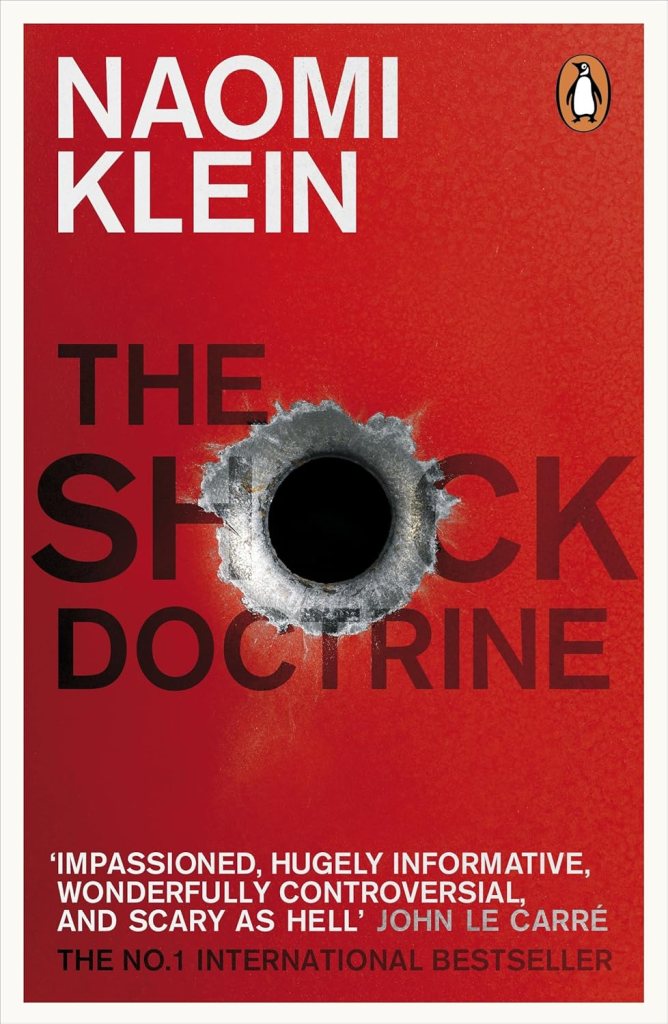
In an era where chaos reigns and disasters unfold with alarming frequency, Naomi Klein’s seminal work, The Shock Doctrine: The Rise of Disaster Capitalism, emerged as an unsettling exploration of how power is wielded amidst turmoil. Heralded by luminaries such as John le Carré, who described it as “impassioned, hugely informative, wonderfully controversial, and scary as hell,” this book delves deep into the dark corridors of global politics and economics, unmasking the shadowy figures who thrive on catastrophe to reshape societies in their favour. Klein chronicled the emergence of what she terms “disaster capitalism,” a ruthless strategy employed by a cadre of elites who exploit crises—be they natural disasters, economic meltdowns, or political upheavals—to impose neoliberal policies that dismantle social safety nets, privatize public assets, and entrench corporate power.
At the heart of Klein’s narrative lies the chilling revelation of the “shock doctors,” a term she uses to describe the strategists and policymakers who engineer and capitalize on shocks to implement radical economic transformations. From the military junta in Chile under Augusto Pinochet, where the Chicago Boys swiftly overhauled the economy in the aftermath of a violent coup, to the exploitation of the 2004 tsunami in Southeast Asia, Klein demonstrates a consistent pattern: the deliberate use of chaos as a pretext to advance a free-market agenda that serves the interests of a privileged few at the expense of the many. Through painstaking research and compelling storytelling, she exposes the complex of connections between governments, corporations, and think tanks that orchestrate these manoeuvres, revealing a global playbook designed to crush dissent, redistribute wealth, and consolidate power under the guise of necessity and reform.
Klein’s analysis is not merely a historical account but a philosophical inquiry into the nature of power and its capacity to corrupt and distort societies. She interrogates the ethical implications of using fear and uncertainty as tools for economic and political gain, challenging readers to consider the moral cost of progress when it is achieved through coercion and manipulation. Her exploration extends beyond mere economics, touching upon the very fabric of democracy, human rights, and social justice, questioning whether true freedom can exist in a system where power is concentrated in the hands of those who exploit disasters for their own ends.
The reception of The Shock Doctrine underscores its impact and relevance. Acclaimed by thinkers like John Berger, who calls it “packed with thinking dynamite” and essential reading, and recognized by institutions such as Metro Books of the Year for its unparalleled insight, Klein’s work resonates across diverse audiences. John Gray of The Guardian lauded it as one of the few books that illuminate the complexities of the contemporary world, while The Independent praised it for its incisive anger and factual rigor, surpassing even her own earlier influential work, No Logo. These endorsements reflect the book’s capacity to provoke thought, inspire debate, and challenge entrenched paradigms, establishing it as a cornerstone in the discourse on globalization and economic policy.
A particularly poignant segment of the book examines the brutal coup in Chile in 1973, where Pinochet and his allies seized power amidst orchestrated chaos, implementing the Chicago Boys’ radical economic reforms with ruthless efficiency. Klein recounts the harrowing details of the military’s oppression, the economic devastation wrought by sudden privatizations and deregulations, and the deep human suffering that ensued. This case study serves as a microcosm of the broader phenomenon Klein describes, illustrating how disaster capitalism not only reshapes economies but also devastates lives, leaving a legacy of inequality and social disintegration. The philosophical underpinnings of this strategy—where suffering is commodified and exploited—invite readers to ponder the fundamental values of our global society and the ethical boundaries of economic experimentation.
Klein’s work is a call to awareness and action, urging individuals and communities to recognize and resist the insidious tactics of disaster capitalism. By uncovering the mechanisms through which crises are manipulated to serve vested interests, she empowers readers to advocate for more equitable and resilient systems that prioritize human well-being over corporate profits. The Shock Doctrine shows the power of investigative journalism and intellectual courage, offering a lens through which to understand the interplay of power, economics, and morality in shaping our world. It is a dense, richly detailed, and philosophically charged narrative that challenges us to rethink the very foundations of progress and to strive for a future where disasters do not become opportunities for the few to impose their will upon the many.
 Simon Gros
Leave a comment