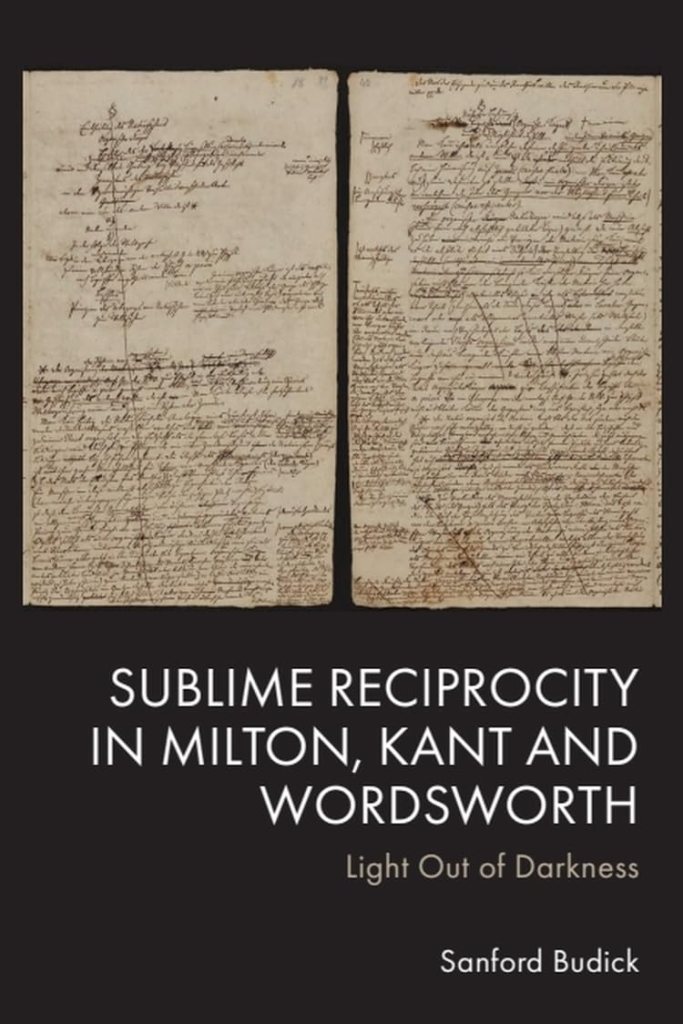
Light Out of Darkness by Sanford Budick offers an exploration of the themes of reciprocity and the sublime, tracking their manifestation in the works of John Milton, Immanuel Kant, and William Wordsworth. Budick examines how these thinkers and poets interact with and build upon each other’s ideas to illuminate a deeply philosophical understanding of existence, light, and being. At the heart of the study is a detailed look at Milton’s Paradise Lost, where the reciprocal forces within “Light Ethereal” — the first of things — shape a cosmic vision of co-existent being. This Miltonic reciprocity, encapsulated in the communication of light and darkness, is not merely a poetic device but a dynamic force through which the world itself is animated and the sublime experienced. In Paradise Lost, light and darkness exist in a perpetual interplay, an exchange that is far from a mere opposition but rather an intricate, reciprocal relation that sustains the universe and defines the experience of self-consciousness.
Kant, in his Opus postumum, recognized and articulated the philosophical underpinnings of this Miltonic reciprocity, situating the reciprocal forces of light as part of the foundational unity of being. His engagement with Milton’s poetry is not just an intellectual curiosity but a deep, philosophical interpretation that transforms our understanding of Paradise Lost. Kant’s concepts of reciprocal forces, particularly those relating to light and first matter, align with Milton’s poetic vision, giving new meaning to the relationship between subject and object, perception and reality. For Kant, the experience of light and the movement of forces within it are not just metaphysical abstractions but necessary components of human consciousness, framing a world where all beings are linked in a web of reciprocal interactions.
Wordsworth, building upon Kant’s insights, further developed the notion of reciprocal forces within his own poetry, most notably in The Prelude. Wordsworth’s engagement with Milton and Kant deepens our understanding of the sublime as an act of reciprocal expression, where the mind participates in the unfolding of being. In his poetry, particularly in his meditations on nature and the human condition, Wordsworth explores how reciprocal light — the forces that animate nature and human consciousness — shapes the experience of the sublime. Wordsworth’s poetic language enacts the reciprocal relations that Milton and Kant theorized, tracing a path of illumination that moves from the darkness of ignorance to the light of understanding, offering a transformative experience for both the poet and the reader.
The study’s central argument is that poetry, in the works of Milton, Kant, and Wordsworth, serves as a medium for the expression of the reciprocal forces of the universe. These poets do not merely represent philosophical ideas; they actively participate in the creation of meaning by embodying the dynamic, reciprocal forces that constitute existence. Budick argues that through their poetics, they enact a philosophy of co-existent being, where the sublime emerges from the interplay of light and darkness, self and other, subject and object. In this way, poetry becomes a way of understanding and participating in the reciprocal dynamics that define the world and the human condition.
The basis of this reciprocal poetics is the recognition that light and darkness, far from being opposites, are part of a single, unified process. Milton’s Paradise Lost offers a vision of a cosmos where light and darkness, in their reciprocal exchange, give birth to creation itself. Kant’s philosophy of the sublime, particularly in relation to Milton’s work, expands upon this by showing how the experience of the sublime is an encounter with the forces of attraction and repulsion that define the material world. Wordsworth, in turn, brings this philosophical and poetic tradition to a new level, embodying the reciprocal dynamics in his verse and transforming them into a personal, lived experience.
Budick’s study reveals the revolutionary implications of this shared poetics. It shows how Milton, Kant, and Wordsworth, each in their own way, offer a vision of poetry as an active, reciprocal process that engages with the forces that constitute existence. Their works suggest that human consciousness is not isolated or self-contained but is part of a larger, dynamic interplay of forces that are expressed through language and art. Through the reciprocal acts of poetic expression, the poet and the reader alike participate in the unfolding of light, in the experience of co-existent being, and in the sublime.
In tracing the development of this idea from Milton to Kant and Wordsworth, Light Out of Darkness not only illuminates the philosophical depths of their works but also offers a new understanding of the role of poetry in the human quest for meaning. Budick’s work thus represents a significant contribution to both literary and philosophical scholarship, offering a new way of thinking about the relationship between poetry, philosophy, and the sublime.
 Simon Gros
Leave a comment