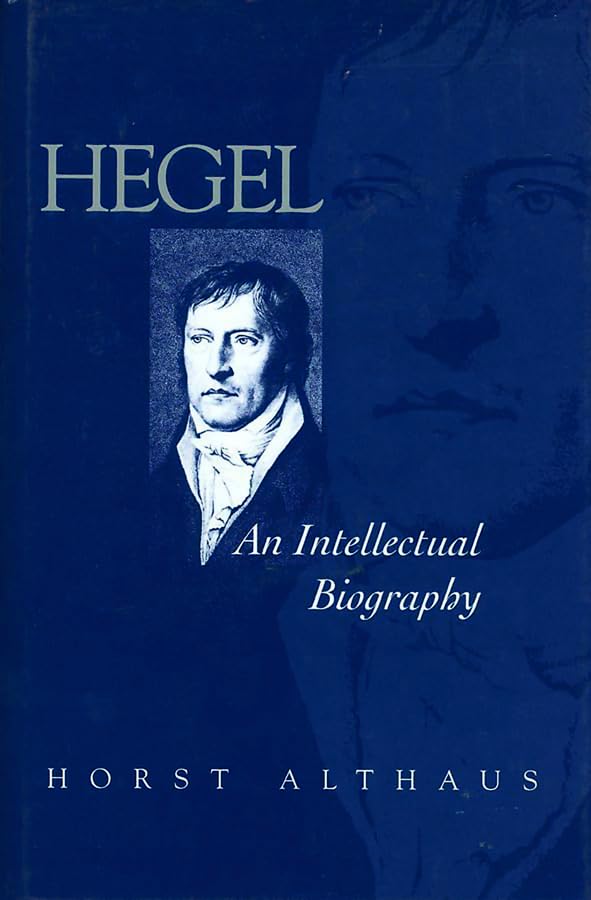
Horst Althaus’ Hegel: An Intellectual Biography, as translated by Michael Tarsh, explores the life and evolving thought of Georg Wilhelm Friedrich Hegel, offering a comprehensive and deeply detailed intellectual history that for a long time served as the definitive biographical work on the enigmatic philosopher. Unlike the sporadic and often outdated accounts from the nineteenth century, Althaus’s work navigates both Hegel’s philosophical maturation and the socio-political context that shaped his ideas, providing modern readers with a clearer understanding of Hegel’s life as an integral part of his intellectual journey. Althaus transcends the typical biographical narrative by including the socio-cultural fabric of Germany during Hegel’s lifetime with the subtle transformations in Hegel’s thinking, portraying him as a thinker in constant dialogue with both his contemporaries and the political landscape of his era.
Hegel’s journey begins with his early theological studies at Tübingen, where his unpublished critiques of established religious doctrines hinted at a radical departure from orthodoxy, yet remained cloaked within the boundaries of his clerical education. Althaus describes Hegel as an intellectual insurgent even in his early writings, aligning himself more with the rationalism of the Enlightenment than the conservative theology espoused by his instructors. Hegel’s immersion in this theological environment catalyzed his later philosophical orientation toward questions of religion, ethics, and human nature, framing him as a critic of religious ‘positivity’—a theme that, according to Althaus, serves as a backdrop to his later dialectical method. His theological investigations, particularly during his years as a tutor in Berne and later in Frankfurt, reflect a deep commitment to reconstructing the historical Jesus as a moral philosopher rather than a divine miracle-worker. Through this lens, Hegel diverges significantly from traditional dogma, pursuing a secularized view of Christianity that aligns closely with Kantian rationality. Althaus brings to life the theological concerns that Hegel wrestled with, concerns that gradually laid the foundation for his later philosophical frameworks.
Hegel’s years in Jena mark a pivotal shift, a period during which he engaged intensely with Friedrich Schelling, a collaborator and competitor. Althaus chronicles Hegel’s struggle for intellectual independence, describing this period as a philosophical apprenticeship that led him toward his own unique articulation of dialectics. Althaus’s portrayal of Hegel’s relationship with Schelling—at once collaborative and competitive—reveals the complex interplay of ideas that eventually distinguished Hegel’s thought. In Jena, Hegel began to systematize his ideas, moving beyond Schelling’s romantic idealism toward a dialectical approach that aimed to unite opposing concepts into a higher form. This process of intellectual differentiation is carefully examined by Althaus, who situates Hegel’s evolving ideas within the broader intellectual climate of early nineteenth-century Germany. Drawing on Hegel’s extensive correspondence and reflections, Althaus provides insight into the formation of Hegel’s dialectical method, a method that would later underpin his major works, including the Phenomenology of Spirit and Science of Logic.
As Hegel’s career progressed, his philosophy became increasingly political, and Althaus captures this progression with an astute sensitivity to historical nuance. Hegel’s move to Berlin, where he became a prominent advocate of the Prussian state, represents a high point in his intellectual influence but also an area of considerable controversy. Althaus argues that Hegel’s alignment with the Prussian establishment was not a simple act of conformity but a complex engagement with the challenges of modernity, order, and freedom. Hegel’s defense of the Prussian state is shown to be deeply connected with his philosophical project of combining freedom and authority, an endeavor that Althaus characterizes as both revolutionary and conservative in nature. Hegel’s philosophy of history, which interprets historical development as a rational process directed toward the realization of human freedom, is contextualized within this alignment with Prussian ideals, illuminating the inherent tensions between Hegel’s ideals and the realities of political power.
Althaus provides a richly textured account of Hegel’s personal crises and intellectual milestones, drawing extensively from primary sources and contemporary accounts. Hegel’s engagement with contemporaries like Goethe, Schleiermacher, and other luminaries of German Idealism emerges as a defining aspect of his life, illustrating how these interactions shaped his philosophy while also highlighting his increasingly solitary intellectual path. Althaus does not shy away from the contradictions in Hegel’s character or the ambiguities in his work. Rather, he argues that these very contradictions—whether in Hegel’s personal affiliations or his ambivalent stance toward revolutionary change—are central to understanding the philosopher’s dialectical approach. Hegel’s ideas on religion, history, and politics are presented not as rigid doctrines but as dynamic, evolving constructs that reflect his lifelong attempt to reconcile oppositional forces. Althaus underscores this dialectical tension, particularly in Hegel’s philosophy of religion, where his critical stance toward ecclesiastical orthodoxy coexists with a recognition of Christianity’s potential to foster ethical community.
Hegel: An Intellectual Biography is more than a biography; it is a study of Hegel’s intellectual legacy and the historical forces that shaped his life. Althaus’s narrative conveys the challenges of navigating Hegel’s dense and often obscure language while making his ideas accessible to a modern audience. His discussion of Hegel’s philosophy of history and the dialectic provides readers with a roadmap to Hegel’s thought, emphasizing the importance of understanding Hegel’s work as a response to the social and political conditions of his time. The biography’s scholarly depth and historical detail make it an invaluable resource for students, researchers, and general readers seeking to understand the profound impact of Hegel’s philosophy on the modern intellectual landscape. Althaus’s careful interweaving of biography and philosophy allows readers to appreciate Hegel’s thought as a living system, one that remains relevant in grappling with the complexities of contemporary society.
Althaus’s biography situates Hegel as a figure whose life and ideas continue to resonate, illustrating the enduring power of his dialectical method to address the contradictions and conflicts inherent in human experience. As readers follow Hegel’s journey from his early theological musings to his mature philosophical system, they encounter a thinker whose legacy is as varied and challenging as his life was turbulent. In Althaus’s hands, Hegel emerges as a philosopher who dared to confront the contradictions of existence and, through his dialectic, sought to forge a path toward reconciliation. This intellectual biography stands as both a proof of Hegel’s immense influence and a guide to understanding the complexities of his thought, inviting readers to engage with Hegel not only as a historical figure but as a contemporary voice in the ongoing quest for truth and understanding.
 Simon Gros
Leave a comment