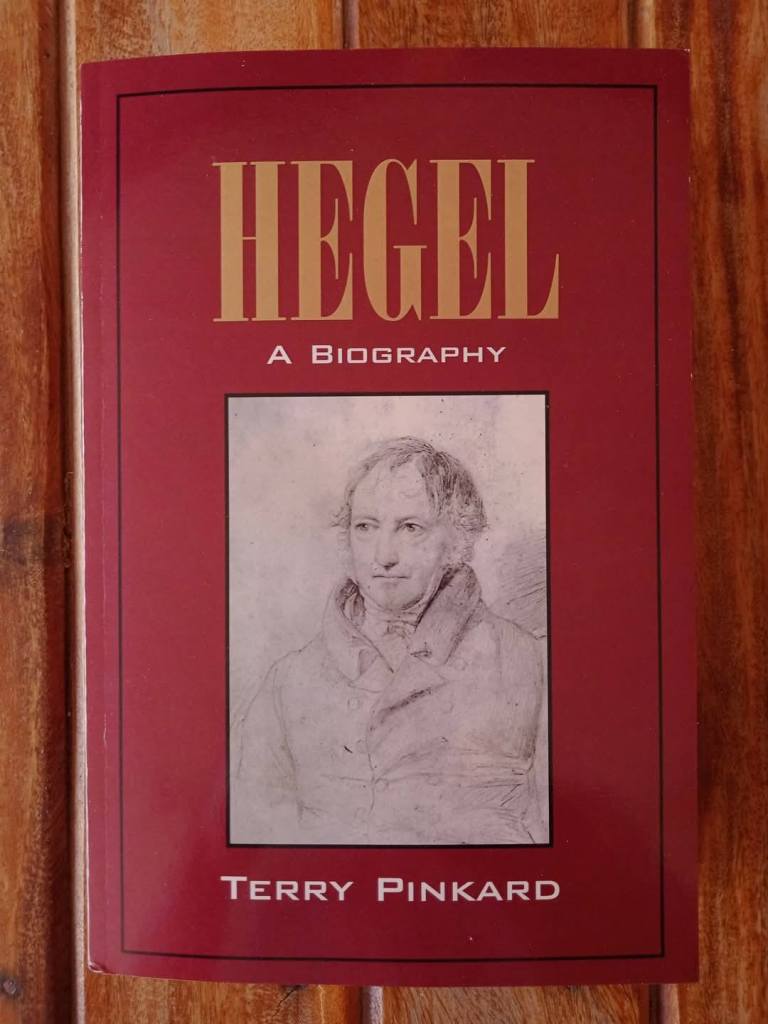
Terry Pinkard’s Hegel: A Biography presents a masterful examination of Georg Wilhelm Friedrich Hegel’s life and thought, contextualized in the tumultuous intellectual and political landscape of late 18th and early 19th-century Europe. Pinkard offers more than a mere chronology of events, he analyses the philosophical currents that shaped Hegel’s worldview, placing him not only as a monumental figure in the history of philosophy but also as a product of the revolutionary period in which he lived. From his birth in 1770 in the Duchy of Württemberg, a politically fragmented region within the Holy Roman Empire, Hegel was steeped in the traditions of both Enlightenment thought and German Protestantism. These early experiences laid the foundation for his complex intellectual trajectory, one that would navigate through periods of great social upheaval, marked especially by the rise of Napoleon and the decay of feudal structures.
Pinkard’s biography is not merely a recounting of Hegel’s philosophical ideas but rather a detailed portrait of the man himself, whose life was as much shaped by the intellectual milieu of his time as by personal encounters with figures such as Hölderlin, Schelling, and Goethe. Hegel’s early education, rooted in the Lutheran traditions of his family, took place against the backdrop of a fragmented society—one that was simultaneously embracing the Enlightenment’s rationalism while struggling to reconcile this with its entrenched customs and social orders. The tensions within his personal and academic life reflect the larger philosophical debates of the era, as Hegel wrestled with the contradictory forces of his time: the rational individualism of the Enlightenment and the communal values that tied him to his provincial roots in Württemberg.
Hegel’s philosophical development is not presented as a linear evolution but as a complex negotiation between the revolutionary ideals of his youth and the more conservative structures he later came to confront. Pinkard details Hegel’s time at Tübingen University, where his early exposure to Kantian thought and his growing disenchantment with traditional theology set the stage for his break with his initial goal of becoming a Lutheran pastor. This shift in intellectual direction coincided with Hegel’s friendship with the poets Hölderlin and the philosopher Schelling, both of whom shared his desire to move beyond the stifling confines of theological education. This trio, often referred to as the “Three Friends,” was instrumental in the development of German Idealism, a movement that sought to synthesize the best elements of Enlightenment thought with a recognition of the historical and social forces shaping human existence.
The biography does not shy away from the complexities of Hegel’s personality, including his personal flaws and contradictions. While he was capable of deep, affectionate friendships, Hegel’s relationships with his family—particularly with his father—were fraught with tension, exacerbated by his father’s more pragmatic worldview and Hegel’s increasingly idealistic aspirations. Hegel’s early years were marked by the loss of his mother and the deep personal and intellectual ramifications of her death, which are subtly explored throughout Pinkard’s account. This personal tragedy may have contributed to Hegel’s later introspective nature, even as he outwardly embraced the social and political upheavals of his era. As Pinkard details, Hegel’s public persona was often that of a gregarious, charismatic intellectual, beloved by students and colleagues alike, though his philosophical commitments sometimes led him to a dogged and less humanistic application of his system to the world’s events. His famous “system” of thought, rooted in dialectical logic and a vision of history as the unfolding of Spirit toward greater freedom, would both capture the imagination of generations of thinkers and provoke sharp criticisms for its perceived detachment from the messier realities of political life.
Pinkard’s biography is a key exploration of Hegel’s commitment to the idea that history itself is a rational process. For Hegel, the tumultuous events of his lifetime, from the French Revolution to the rise of Napoleon, were not chaotic and senseless but part of a larger, intelligible movement of history. Pinkard captures Hegel’s deep engagement with the historical forces of his time, noting how these were reflected in his works, particularly the Phenomenology of Spirit. Yet Pinkard is careful not to present Hegel as merely an abstract thinker detached from the material realities of his time. Hegel’s philosophy, as Pinkard shows, is intricately tied to his understanding of freedom—both as an individual and a collective experience—and to the philosophical idea of reconciliation between the individual and the state, between particularity and universality.
Pinkard’s biography also situates Hegel in the context of the intellectual environment of early 19th-century Germany, dominated by the legacy of Kant, the rise of German Idealism, and the influence of Romanticism. Hegel’s work was in direct conversation with the thoughts of contemporaries such as Fichte, Schelling, and Schopenhauer, as well as with the great cultural figures of the period like Goethe and the Schlegels. Pinkard’s depiction of Hegel’s intellectual maturation is nuanced and full of insight, presenting Hegel not as a solitary genius but as a thinker deeply embedded in a network of relationships with other philosophers and artists who were similarly grappling with the meaning of modernity. This was a time when the very notion of the individual was being redefined, and Hegel’s work reflects this redefinition, grappling with the tensions between individual autonomy and collective identity.
Throughout the biography, Pinkard demonstrates how Hegel’s thoughts on freedom, ethics, and history continue to resonate today. His philosophy of history, with its emphasis on the progress of freedom and the role of the state in the development of ethical life, was a powerful counterpoint to the individualism of earlier Enlightenment thinkers and has had a profound influence on later political thought. Pinkard also addresses the more controversial aspects of Hegel’s legacy, including his relationship to the Prussian state and his views on history, which some critics have seen as complicit in justifying authoritarianism. The biography is careful to present these issues with the depth and complexity they deserve, acknowledging the limitations of Hegel’s thought while emphasizing its ongoing relevance in contemporary discussions of philosophy, politics, and history.
By focusing on both the life and thought of Hegel, Pinkard provides a rich, multifaceted portrait of one of modern philosophy’s most challenging figures. The biography succeeds not only in offering an accessible introduction to Hegel’s often opaque system but also in humanizing him as a figure deeply engaged with the personal and social struggles of his time. Pinkard’s Hegel is not simply an intellectual monument but a thinker whose ideas were profoundly shaped by his personal experiences, his friendships, and the historical moment in which he lived. This biography is essential reading for anyone seeking to understand not only the man behind the philosophy but also the philosophical roots of modernity itself.
 Simon Gros
Leave a comment