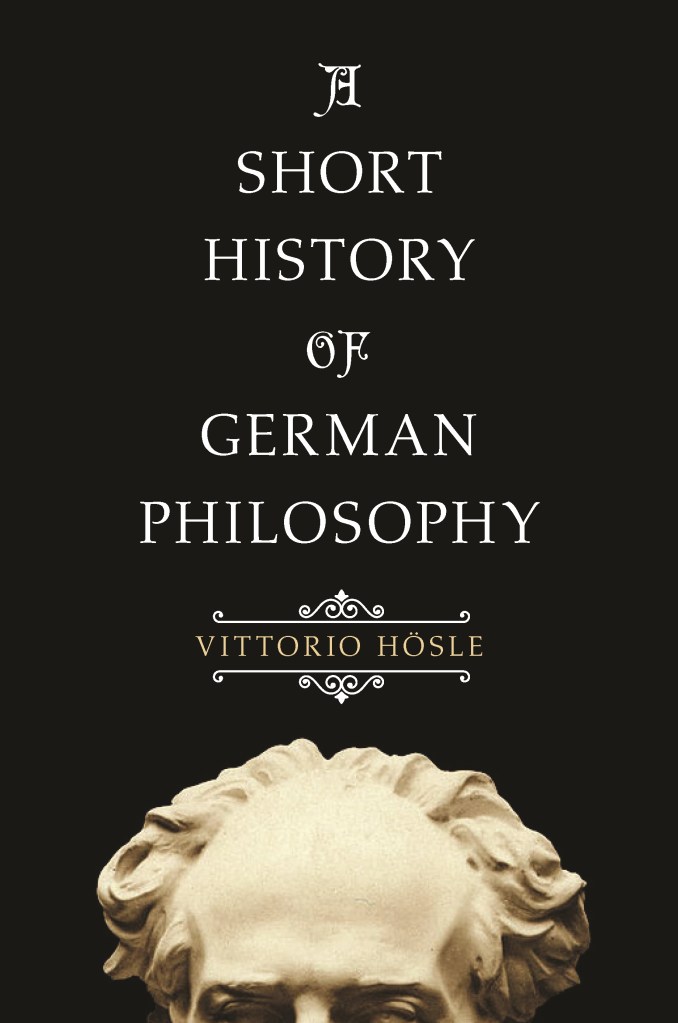
A Short History of German Philosophy by Vittorio Hösle explores through the rich landscape of German philosophical thought, charting its evolution from the Middle Ages to contemporary times. With a masterful blend of clarity and depth, Hösle navigates through complex ideas, making them accessible to a broad audience without sacrificing intellectual rigor.
The book opens with an examination of the transformations instigated by Luther’s Reformation, which laid the groundwork for a distinctively German approach to philosophy. Hösle then guides the reader through the Enlightenment period, highlighting the pivotal contributions of figures like Leibniz and Kant. These philosophers, with their ground-breaking ideas, set the stage for the rise of German Idealism, a movement marked by the works of Fichte, Schelling, and Hegel. Hösle elucidates how their collective efforts sought to reconcile the dichotomies of nature and freedom, reason and faith, and individual and community, establishing a uniquely German merger that influenced a wide array of intellectual persuits.
Moving into the 19th century, Hösle addresses the fragmentation of this synthesis in the works of Schopenhauer, Marx, and Nietzsche. Schopenhauer’s pessimism, Marx’s materialism, and Nietzsche’s existentialism represented significant departures from the idealist tradition, each contributing to a new wave of philosophical inquiry that questioned the foundations laid by their predecessors. Hösle explores how these thinkers, despite their differences, shared a commitment to challenging established norms and seeking truth through rigorous critique.
In the 20th century, Hösle turns his attention to the rise of analytical philosophy and the establishment of the historical sciences, reflecting on how these movements reshaped philosophical discourse in Germany. He offers an insightful analysis of Husserl’s phenomenology, which sought to return to the “things themselves” by examining the structures of consciousness. Hösle also discusses Heidegger’s radical reinterpretation of phenomenology, which introduced existential and ontological dimensions to the study of human existence.
The narrative does not shy away from the darker chapters of German philosophy, including the involvement of philosophers like Gehlen and Schmitt with the Nazi regime. Hösle critically examines their works and the ethical implications of their affiliations, providing a nuanced understanding of the complex interplay between philosophy and politics during this tumultuous period.
Post-World War II, the book explores the revival of German philosophy in West Germany, highlighting the contributions of thinkers who sought to rebuild and redefine philosophical thought in the aftermath of the war. Hösle reflects on the enduring impact of critical theory, particularly the works of Adorno and Horkheimer, who continued the tradition of social critique established by Marx and Nietzsche.
Throughout the book, Hösle argues for the existence of a distinctive German philosophical tradition that flourished from the mid-eighteenth to the mid-twentieth century. He examines the reasons behind the decline of this tradition in recent times, considering the influence of globalization, the rise of English as the lingua franca of academia, and the shifting focus of philosophical inquiry.
A Short History of German Philosophy is more than a historical account; it is an exploration of how philosophical ideas have shaped and been shaped by the broader cultural, political, and scientific contexts in Germany. Hösle’s narrative is interspersed with discussions of German literature, theology, and the human sciences, illustrating the interconnectedness of these fields with philosophical thought.
The book is not just for philosophers but also for students and scholars of intellectual history, German studies, and those interested in the broader questions of how ideas evolve and influence societies. Hösle’s lucid writing, combined with his deep understanding of the subject matter, makes this book a valuable resource for anyone seeking to understand the rich philosophical heritage of Germany and its lasting impact on the world.
By combining historical context, philosophical analysis, and cultural insights, Vittorio Hösle’s work stands as a remarkable achievement, offering a comprehensive yet concise overview of one of the most influential traditions in the history of Western thought.
 Simon Gros
Leave a comment