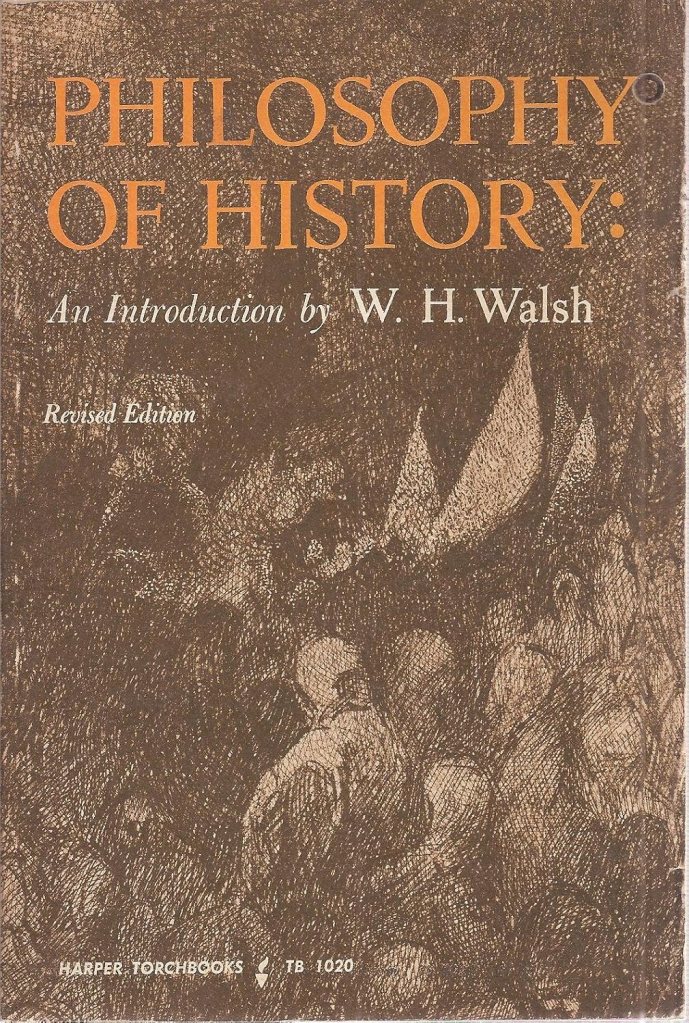
William H. Walsh’s Philosophy of History: An Introduction, first published in 1951 and subsequently revised, stands as a pivotal exploration of how historians conceptualize, interpret, and present the past in light of philosophical reflection.
It offers a long and deeply reasoned commentary on the processes by which historical knowledge is both formed and tested. Within this comprehensive text, Walsh grapples with an array of issues that continue to shape debates in historiography, such as the importance of evidence, the challenges of causal explanation, the role of values and interpretation, and the ultimate possibility of extracting general or “universal” principles from the mass of historical detail. Though relatively modest in length by today’s publishing standards, the breadth of considerations within these pages is extraordinary, demanding the reader’s sustained attention to the logical, epistemological, and metaphysical underpinnings of historical thought.
Walsh begins by highlighting the deceptively simple question of what history is and what it should aspire to be. He draws attention to the perennial tension between historical facts—seemingly stubborn, concrete, and plainly “past”—and the theories or overarching narratives that weave these raw fragments into a meaningful portrait. He argues that the line between fact and interpretation is more malleable than it appears, since historians not only inherit documents, artifacts, and other material traces but also subject these traces to critical study. Documents that seem reliable at first might be riddled with biases, while even a genuine primary source can yield discordant interpretations. Thus, Walsh insists, it is a misguided ambition to think of “pure” historical facts as existing fully apart from our conceptual tools and assumptions. His book devotes considerable effort to dissecting how historians proceed with evidence, including the logic of inference they employ, the tacit dependence they place on inherited knowledge, and the background context of specialized or even commonsense generalizations about human behavior.
In pursuing these lines of inquiry, Walsh connects the heart of historical understanding to what he calls a “critical philosophy of history.” He sees critical philosophy of history as an enterprise distinct from the old tradition of speculative philosophies of history, which had once sought to discover or impose a complete metaphysical plan on the entire human story. He reviews and critiques such speculative approaches, pointing particularly to the work of Kant, Herder, and Hegel, all of whom had attempted to reveal overarching designs or the hidden teleology shaping events.
Kant’s demand that one reconcile a faith in cosmic reason with the sometimes chaotic evidence of the historical record shows the moral and philosophical impetus driving earlier writers to produce a universal interpretation of the past. Herder’s more emotional, imaginative attempt to detect the spirit or animating principle of an entire people signals another effort to find unity in the apparent disunity of events. Hegel, meanwhile, supplies the most architectonic template of all, positing a self-realizing Spirit that unfolds, dialectically, across successive civilizations on its unstoppable path toward freedom. Walsh examines these ambitious writers both admiringly and critically, noting that their desire to find reason or moral vindication in history was a response to deep fears of pointlessness or irrational contingency in human affairs. Yet he cautions that such sweeping metaphysical pronouncements, derived in large part from philosophical systems external to historical research, risk doing violence to the precise, evidence-based work of historians.
Within this framework, Walsh finds that the modern student of history must walk a delicate line. On one hand, there is the attractive claim that history is entirely scientific, built from the ground up by assembling facts, forming hypotheses, and deducing regularities about human actions. On the other hand, there is the equally persistent claim that understanding the past demands a personal re-living of previous experiences, so that one sympathetically grasps the emotional and intellectual world of earlier ages in an almost intuitive way.
Walsh, in reviewing such extremes, shows that each side correctly identifies a facet of the historical enterprise: there is an inescapable reliance on quasi-scientific procedures, such as scrutinizing sources or referring to general propositions about how human beings, under certain pressures, typically behave. Yet at the same time, no historian can do without that imaginative empathy and what might be called an interpretive insight, by which one perceives how people in a past epoch conceived their own experiences. Walsh treats Collingwood’s emphasis on re-thinking the thoughts of past actors as a powerful corrective to purely external or narrowly “scientific” conceptions of historical explanation, but he also probes whether Collingwood’s language of “re-living” can be overstated and can obscure the inevitable role of inference. Collingwood might suggest that the historian steps into a purely intuitive reenactment of Julius Caesar’s strategic reasoning, or Nelson’s sense of duty, but Walsh reminds us that even the most imaginative reconstruction depends on comparing the available documentary or archaeological record against background knowledge of human nature or practical constraints. Hence, the historian’s empathy must always coexist with a certain measure of general knowledge gleaned inductively from life or from other branches of social study.
In emphasizing this interplay, Walsh brings in the role of human nature, which he sees as a fundamental presupposition shaping historical analysis. Because the historian attributes motives, beliefs, and intentions to past figures, some notion of how human beings tend to respond to social or physical circumstances underpins every act of historical explanation. At the same time, Walsh concedes that conceptions of human nature, along with the interpretive standards used in judging the reliability of evidence, vary across cultures, generations, and philosophical schools.
This introduces an inherent relativistic tendency that cannot be wholly eliminated. Indeed, historians of different national or ideological backgrounds may interpret the same period along markedly different lines, each claiming objective truth. But Walsh does not see in this the complete dissolution of historical knowledge. Rather, he suggests that legitimate objectivity can persist if historians observe shared constraints of method, agree on certain minimal canons of evidence, and strive to bracket their subjective biases. Then too, the development of professional historiography, in his judgment, arises precisely out of a longstanding practice in which historians, by examining the same documents critically, by learning from each other’s mistakes, and by revising earlier errors, converge on more robust and more widely acceptable judgments over time. This does not mean that historians arrive at eternal or universal truths; it simply means they strive to minimize distortion through publicly accessible procedures.
Yet while endorsing a modest confidence in historical method, Walsh warns against the naïve hope that the discipline will ever emulate the predictive precision of the natural sciences. He addresses the idea that historical knowledge could be cast in the form of strict general laws—“Whenever there are conditions of type A, outcome B invariably follows”—and finds that this underrates the complexity of historical explanation. While acknowledging that historians do indeed rely on general propositions about human nature (for instance, that severe economic hardship usually provokes social unrest), he questions whether these propositions can ever be formulated as universal “laws” in the sense that physicists or chemists might demand.
Historical events appear overdetermined by numerous factors, including geography, climate, inherited institutions, class structures, religious beliefs, and the unique personality traits of influential leaders. To say that general factors play a part does not require reducing the entire story to a pure sample of general rules. Furthermore, the meaning of an event often depends on its placement within a broader temporal narrative, which does not translate neatly into a set of testable causal statements. The aspiration to discover purely scientific laws of history, championed by nineteenth-century positivists, fails to address the multiplicity of subjective contexts and moral dimensions that suffuse the lived experience of past human beings.
Against that backdrop, Walsh devotes considerable reflection to questions of objectivity and bias. He recognizes that historical writing can lapse into propaganda or moralistic sermonizing if not guarded carefully against partialities. He also acknowledges that no historian can be wholly divorced from personal convictions, political loyalties, or religious and cultural assumptions. The question is whether or not these influences inevitably doom all historical accounts to remain subjective—an endless variety of personal or collective myths.
Walsh insists that the possibility of a shared historical consciousness remains open, provided that historians practice self-criticism, keep open lines of communication with colleagues, and uphold publicly recognized norms of evidence. According to his argument, the worst forms of bias—such as the desire to write a self-serving national epic—are ones that can and should be recognized by honest historians and filtered out. But the subtler influences, such as an inherited sense of what is “important” or a tacit moral orientation, can in principle be made explicit and debated, thus at least partially neutralized. From this vantage point, Walsh suggests that history remains a cognitive discipline, even if it never achieves the impersonal uniformities of the natural sciences. He stands firmly in favor of continuing the historical quest for truth as a rational and cooperative enterprise.
This sense of the continuing quest reappears when Walsh addresses “historical progress” and the attempt by many philosophers—especially Kant, Herder, and Hegel—to discern a grand trajectory in human events. On one level, he admits the attractiveness of a moral desire to see real progress behind the tragedies, cruelties, and reversals that typify recorded history. Indeed, the impetus for earlier speculative philosophy of history often lay in religious or ethical anxieties, such as the fear that human life might be wasted in apparently meaningless violence, or that sophisticated civilizations might repeatedly collapse for no higher purpose. But Walsh soberly underlines the difficulties in proving a universal progress, since even the idea of “progress” presupposes specific value judgments about what is worth advancing and who benefits from it. Moreover, as one tries to universalize progress theories, it becomes more likely that one is imposing a pattern whose basis in the actual records is tenuous. Yet Walsh does not fully deny all progress; he merely insists that the historian’s case for it can only be as strong as the evidence for it in specific times and places. The Enlightenment’s optimism about human perfectibility has indeed shaped historical writing, but ironically, later historians—Walsh included—have found reasons to doubt that any single pattern of cumulative advance extends to all societies.
While dissecting the theoretical arguments for or against universal progress, Walsh revisits the role of causality in history. In the natural sciences, the hallmark of explanation is the derivation of particular events from general laws: place the correct initial conditions into the equation, and the subsequent state emerges. But in history, many find it hard to localize general laws that do not trivialize the extraordinary complexities of human motivations, organizational structures, and cultural traditions. And if such laws exist, the philosopher of history might justly wonder why historians rarely bother to formulate them with any precision. Walsh here clarifies that historians proceed differently: they rely on the notion that some sets of causes are “relevant” or “significant” in virtue of their intimate connection to a chain of developments, and they proceed to link events into a coherent narrative that reveals how the eventual outcome emerged. Unlike the scientist, the historian does not always separate out statements of fact from general rules in a fully explicit way. The result may appear unsystematic, yet in practice it allows the historian to highlight the meaningful transitions that shape the direction of human affairs—how, for example, one political crisis or imaginative breakthrough sets the conditions for the next. In so doing, the historian is not naïvely ignoring generalities but applying them in the background, in an often implicit manner.
By the later sections of his book, Walsh’s analysis of causal explanation in history merges smoothly with his reflections on historical objectivity, moral perspective, and the place of values in shaping both the selection of topics and the resulting interpretations. On this question, he urges caution and balance. It is inevitable that historians are guided by certain conceptions of what is important, by moral convictions of what is admirable or destructive, and by personal interest in certain kinds of subject matter. This does not mean that their conclusions are arbitrary or purely subjective. It is, on the contrary, often the historian’s considered ethical and cultural outlook that suggests fruitful lines of inquiry, enabling an especially keen insight into neglected aspects of social and political life. As a result, different historians might legitimately produce alternative but not strictly incompatible visions of the same period, each capturing different layers of significance. Walsh contends that these “points of view” need not be contradictory if each interprets a different set of elements or explores different questions. Real clashes, however, do occur and cannot be swiftly dismissed. Some are resolvable by adducing more evidence; others arise from fundamental moral or philosophical differences that can be acknowledged but not always reconciled. Walsh does not hide these conflicts, yet he remains convinced that the overall historical enterprise benefits from the discourse of many voices, refining one another’s claims and gradually enabling shared comprehension of the past’s complexity.
In these discussions, the book’s concluding statements, though far from dogmatic, highlight Walsh’s conviction that history, despite its distinctive logic, can take its rightful place among respected branches of human knowledge. He neither reduces it to a purely scientific discipline nor relegates it to the realm of art or subjective literature. Rather, he insists that historians pursue understanding in ways analogous to scientists in certain respects—particularly in their painstaking scrutiny of sources, their grounding in reasoned argument, and their subjection of claims to peer review—while remaining faithful to the irreducibly human dimension of their material. His is thus a middle course, incorporating the best insights of both rationalist and romantic views of history, without surrendering the specificity and autonomy that historical research demands.
One final merit of Walsh’s Philosophy of History: An Introduction arises from the writer’s clarity, methodological rigor, and willingness to engage in direct critical discussion of figures like Collingwood, Kant, Herder, and Hegel. Throughout, Walsh credits these earlier thinkers for drawing attention to the moral, metaphysical, and epistemological stakes of investigating the past, but he also subjects them to incisive scrutiny, exposing both the philosophical depth and the limitations of their “speculative” ambitions. In so doing, he deftly conveys to readers the magnitude of the challenges that historians face whenever they go beyond mere chronicles, aspiring instead to produce interpretations that stand up to reasoned debate. The result is a text that not only sketches the broad outlines of the subject’s problems but also exemplifies a balanced temperament, offering a robust but sensible account of why history matters and why it remains an indispensable forum for grappling with human complexities.
Walsh’s essay indeed stands out as a carefully wrought, philosophically informed reflection on how we come to know—or fail to know—what transpired in ages past. Though first published in 1951, it endures as a touchstone in the continuing dialogue between historians intent on refining their craft and philosophers who seek the deeper underpinnings of that craft. Whether one leans toward Collingwood’s emphasis on re-thinking the thought of historical figures, Kant’s and Hegel’s quest for large-scale patterns of progress or reason, or a more empirically oriented skepticism about overarching schemes, one will find in Walsh a judicious appraiser of each position’s strengths and weaknesses. In doing so, he demonstrates how the crucial idea of objectivity, far from being a simplistic matter of detachment, emerges from an ongoing conversation about evidence, context, values, and interpretive procedures. The moral dimension—long recognized by earlier speculative authors—thus reappears in Walsh’s critical philosophy, but shorn of the extravagant claims that can overshadow rigorous historical practice.
For readers with a passion for historiography and an eagerness to situate historical scholarship within broader philosophical currents, Philosophy of History: An Introduction remains a model of subtlety, coherence, and great argumentation. It addresses with equal seriousness the historian’s painstaking research and the philosopher’s far-reaching concerns, creating a rich tapestry of insights that continues to provoke reflection and debate. The result is a book that, in its very title, promises a straightforward gateway into a specialized arena, yet delivers a compendium of reflections on reason, narrative, factuality, and morality that outstrips ordinary introductions. Its pages demand slow, careful reading, for Walsh’s sentences often carry more weight and implication than casual perusal can reveal. But the effort is richly rewarded, for anyone who desires to know why there is still lively controversy about whether history can be scientific, or whether history can ever be purely factual, or why so many moral contradictions pepper historical narratives, or how historians can hope to navigate the swirling cross-currents of present perspectives and ancient voices, will find few expositions as lucid, as patient, and as well rooted in both historical practice and philosophical thinking as this deceptively modest treatise. It thus remains essential reading for those wishing to move beyond superficial pronouncements about objectivity or about the nature of historical truth, enabling them to see how, in Walsh’s words, a critical philosophy of history can clarify and dignify the entire search for humanity’s past.
 Simon Gros
Leave a comment