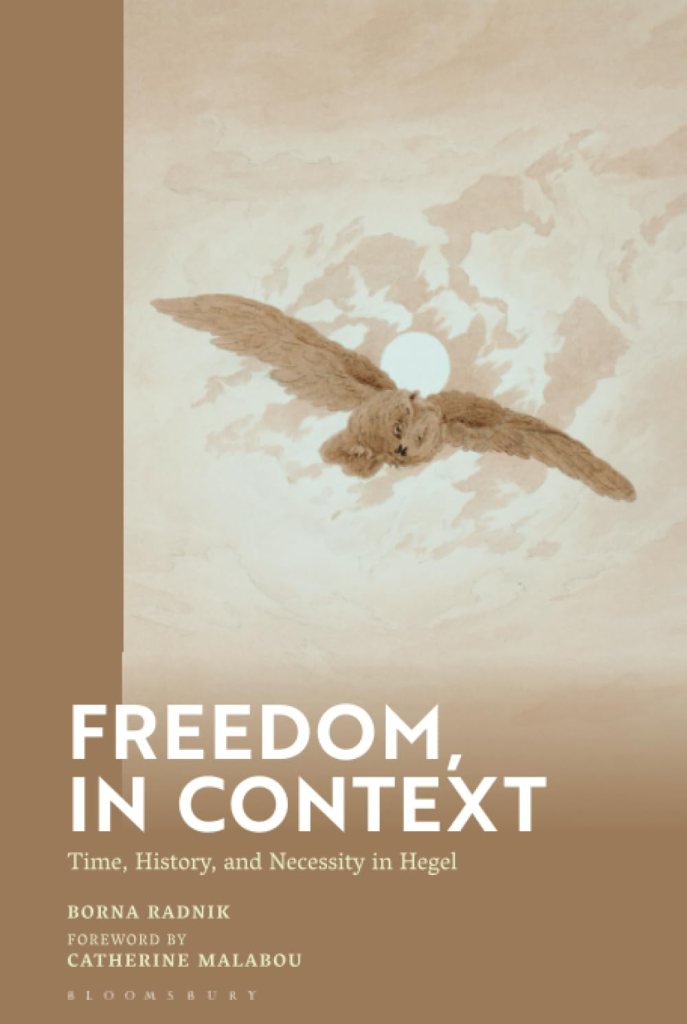
Freedom, in Context: Time, History, and Necessity in Hegel by Borna Radnik offers an extraordinarily comprehensive rethinking of Hegelian freedom in light of our most urgent contemporary contexts, while engaging the full breadth of Hegel’s logical, historical, and ontological framework.
In a work that draws together classical German philosophy and twenty-first-century social struggles, Radnik proposes that freedom, as Hegel insists, must never be reduced to mere caprice or individual choice; rather, it is best understood as a thoroughgoing dialectical process in which human self-determination emerges only through the profound acknowledgment of, and engagement with, causal necessity. This engagement is never static or purely theoretical, for it demands temporal and historical mediations that render freedom simultaneously universal in scope and context-specific in its manifestations. Readers are led into a dense reflection on the various ways Hegel conceptualizes time, whether in the fleeting “now” of natural time or in the profound self-conscious recollection of historical processes, and how, ultimately, the unity of necessity and freedom depends on seeing time itself as both logical and concrete.
From its earliest pages, the book makes plain that Hegel’s restless philosophical vision underpins a panoramic account of why freedom must take shape in the actuality of historical life. Rather than confining itself to purely “Eurocentric” or “colonial” genealogies, this study recasts Hegel’s major categories—such as spirit, self-consciousness, negation, otherness, and the absolute idea—in dialogue with movements far beyond nineteenth-century Prussia. It ventures into moments of collective self-determination in Iran, invokes the resonance of global environmental justice movements, and tracks the radical energies of Black Lives Matter. In so doing, Radnik confirms that Hegel’s great insistence on the bond between the universal and the particular still speaks to the multiplicity of today’s social, political, and economic crises. Even an issue as specific as hair-cutting in Iranian women’s protests, he shows, can count as a universal gesture against oppression without losing its specificity, because for Hegel the universal can coincide with the particular in reciprocal interplay and does not merely absorb or negate local contexts. Thus, the book shows Hegel’s logic of freedom as something that clarifies a wide range of acts, from the call for racial justice in the United States to the impetus for widespread democratic uprisings and demands for economic equality around the globe.
The project is no mere cultural excursus, however; it is also a thorough rearticulation of Hegel’s logic, ontology, and social theory. Readers see how Hegel’s freedom, construed as “being-with-oneself-in-one’s-other,” indicates that self-determination is never mere independence. Instead, freedom is realized in and through its others—both material and social—and likewise requires the backward-and-forward sweep of temporality, a movement that allows events to become necessary only in retrospect, even though they might have appeared merely contingent or even accidental in their immediate occurrence. Borrowing insights from Hegel’s Science of Logic on the necessary transitions between finite categories, Radnik demonstrates that freedom must overcome the simplistic dichotomy of agency versus causation and instead be shown to unfold in the unity of these apparently opposed terms. To make this methodological argument, Radnik traces how Hegel’s notion of self-reflexivity is bound up with the concept of irreducibility: the absolute idea is never reducible to any one historical or cultural juncture, yet it is still fully shaped by its current manifestation and only becomes intelligible, for us, through the diverse contexts of its appearance.
A key emphasis of the book is the place of time in Hegel’s understanding of freedom. Early in the text, the reader encounters the intricate difference between natural time—which is marked by a sequential, fleeting “now”—and historical time—which is partly linear, yet also retroactive, a recollective chain in which meaning and necessity crystallize only through conceptual reflection on past events. Free will, in the Hegelian sense, transcends a shallow freedom-of-choice model by embracing that recollective dimension and indeed transforming it: a free will recognizes that it is made possible by the very determinations that, at a superficial level, might look like constraints. Radnik underscores how Hegel, using notions of negativity and the “cunning of reason,” insists that history is neither random nor teleologically fixed by an external agent; instead, the necessity that emerges from events can only be recognized once spirit rethinks its own path. One sees here how a concept like the “owl of Minerva,” which famously takes flight at dusk, is not a resignation to inaction but a call to self-conscious acknowledgment of the structures enabling genuine social agency in any given epoch.
This sense of retrospective necessity takes on added significance when applied to contemporary movements for social justice. Radnik argues that the “cunning of reason” does not guarantee any inevitable progress, yet it helps explain how local acts can become universal in their import, once recognized as expressions of freedom. He shows that Hegel’s logic also invites us to consider the interplay between universal categories—such as the call for self-determination or the principle of equality—and the particular conditions of oppression under late capitalism, climate change, state violence, or patriarchal legal codes. In that sense, a fight against a polluting corporation in one region becomes a universal stand for environmental justice precisely insofar as it is recognized as part of a global yet context-dependent aspiration for freedom. The same applies to the Black Lives Matter movement, whose universal dimension of human emancipation does not erase but intensifies its roots in the specific materialities and injustices of anti-Black racism. Hegel, for all his well-known limitations and Eurocentric blind spots, supplies a conceptual apparatus for holding at once both the irreducible specificity of an emancipatory struggle and its potential for universal resonance.
In a set of pages that rank among the most philosophically challenging, Radnik shows how Hegel’s dialectical approach in the Science of Logic unites necessity and contingency through real possibility. That is, once all relevant conditions align, what was once a possibility becomes an actuality, and thereby necessary. Yet nothing about these conditions is necessary in itself; the logic of cause and effect only appears to stand outside human freedom so long as we remain unreflective. By situating Hegel’s thorough account of “actuality” alongside the political tensions of the present, Radnik reveals how historical forces can be recognized as objectively constraining and yet still subject to sublation by collective self-conscious agency, if only we see that freedom must operate not outside but within these constraints.
This sense of within-ness is crucial, and it lies at the heart of Radnik’s philosophy of context. Hegelian freedom cannot be a flight from causality or from the historical moment; it is rather the appropriation of the very factors that once seemed alien, so that freedom is “at home” in its other. The author shows that for Hegel, at crucial junctures of The Phenomenology of Spirit, The Science of Logic, and The Philosophy of Right, the free subject is never some abstract individual but a being enmeshed in social norms, institutions, and ethical life. In other words, the emancipation of spirit is realized in communal bonds, through recognized rights, and through the structural transformations that allow the particular will to flourish within a truly universal horizon. At the same time, Radnik makes clear that Hegel’s own historical vantage and preference for the Prussian state need not limit the universal possibility of self-determination. By reading him through a Hegelian Marxist perspective, Radnik shows that the emancipatory kernel of Hegel’s dialectic can be extended into critiques of capitalist exploitation, environmental degradation, and modern systems of domination without forfeiting any of the systematic rigor that Hegel so elaborated.
The book engages deeply with the scholarship of figures like Herbert Marcuse, György Lukács, Slavoj Žižek, and Robert Pippin, all of whom chart different aspects of Hegel’s historical thinking. It also places particular emphasis on how Hegel’s logic reveals the lived temporality of spirit, in which recollection (Erinnerung) transforms finite shapes of consciousness into sublated moments, culminating in absolute knowing’s recognition of its journey. Combined with this is a focus on how Hegel’s treatment of Christianity illuminates freedom’s paradox: the experience of finitude, of suffering and death, yields a retroactive temporality in which spirit can only discover its absolute dimension by internalizing the absolute recoil of otherness. That move helps to clarify why Hegel saw modern subjectivity as historically irreducible to the classical Greek form and points, too, toward the scope of contemporary struggles to become free from oppressive structures.
Because this is a work resolutely anchored in philosophical system, it draws out Hegel’s stance on right, law, sociality, world history, and even economic life. It demonstrates that Hegel’s critique of the unmediated free will—assuming it could operate without necessity—already anticipates modern critiques of capital that highlight how the abstract individual is subsumed by a political-economic framework never truly neutral. Radnik suggests that Hegel thus becomes a critical ally of Marx, especially in the way the latter discerns historical laws in the movement of capital that might first appear purely external but can, in the fullness of dialectical comprehension, be subverted through collective agency. The book therefore calls for a renewed Hegelian Marxism, not as a mere academic curiosity but as a philosophical posture that can harness the cunning of reason for the sake of genuine structural change.
Matthew McManus, in his editorial review, salutes Radnik’s “radical interpretation of the Prussian polymath” and insists on the political stakes of this reading, highlighting that Hegel “defends freedom and struggle within history.” Todd McGowan similarly applauds Radnik’s “spellbinding reading of Hegel,” underscoring how the contextual nature of freedom can become universal precisely because it never stops being contextual. The combined praise from these readers suggests that the book’s core merit is bridging the strict systematic approach so often found in academic Hegel studies with the burning need to reimagine political freedom in the crises of our present age. Catherine Malabou, whose foreword situates Hegel’s concept of context in a lineage that passes from Dieter Henrich to these new horizons, highlights that the key term “context” itself should not be treated merely as a background condition for meaning. She encourages us to see how context, for Hegel, is an essential dimension of free agency’s deployment in time, uniting memory, anticipation, and the retroactive forging of necessity.
Throughout the argument, Radnik’s scholarship draws on decades of Hegel interpretations, as well as the crucial genealogies of modern European philosophy, while never losing sight of how these genealogies appear through historically situated acts, cultures, and institutions. We see a delicate balance between the irreducible singularities of, for instance, modern Iranian women resisting state violence, and Hegel’s claim that freedom is a universal capacity actualized in particular forms of ethical life. This interplay illuminates in new ways the relationship between universal essence and historical contingency, suggesting that even the most apparently context-bound phenomenon can unfold into a concretely universal sign of freedom. Another powerful theme is how memory and trauma figure into the development of world spirit: the collective recollection of injustice and oppression can become, through consciousness, a motor of transformative necessity.
Because the volume reads as much like a sweeping philosophical treatise as a close textual study, it will serve not only specialists in Hegel but also anyone interested in how to conceptualize agency and necessity in an age of crisis. Its author is deeply aware that the environment, inequality, racial justice, and revolutionary politics cannot be relegated to peripheral status. Instead, these struggles are precisely where one sees the Hegelian dynamic of freedom come to life. The text’s culminating gestures connect Hegel’s absolute idea—“being-with-oneself-in-one’s-other”—to modern social movements by showing that no context is too particular or peripheral to express something of universal import. For each moment in which a community asserts self-determination is simultaneously an entry into the universal dimension of spirit’s freedom, and thus finds a place in the ongoing history of freedom’s realization.
The result is a thrilling and challenging volume that reaffirms Hegel’s place at the core of modern debates about political self-determination while painstakingly revising the common notion that Hegel’s system is immovably Eurocentric or triumphalist. By demonstrating that Hegel’s claims about the absolute are inseparable from the ways absolute spirit becomes historical, and by illustrating how even the absolute must be grasped via a self-reflexive historical process of recollection, Radnik neither absolves Hegel of his biases nor discards the philosophical energy that has animated generations of emancipatory movements. Instead, he draws it all together into a bold new vision of Hegel’s relevance to twenty-first-century life, showing that the unity of freedom and necessity cannot be adequately understood without recognizing the integral role of temporality, culture, environment, and collective struggle.
In that sense, Freedom, in Context carries a practical philosophical imperative. To study Hegel is not merely to observe a venerable thinker from the sidelines; rather, it is to reflect on how the fleeting, urgent present might yet become a field of universal emancipation. By insisting that neither the contextual nor the universal side of freedom can be neglected, the book testifies to the depth and plasticity of Hegel’s thought. Simultaneously, it resonates with powerful contemporary calls for equality, self-rule, and ecological sanity. Radnik’s meticulous scholarship, coupled with his insistence on drawing out real-world illustrations, ensures that readers will come away from this text with an enriched understanding of Hegel’s logic, a subtler appreciation of world history’s paradoxes, and an abiding conviction that freedom, if it is to be truly free, must be understood in all its embeddedness within—and transcendence beyond—the structures of necessity.
 Simon Gros
Leave a comment