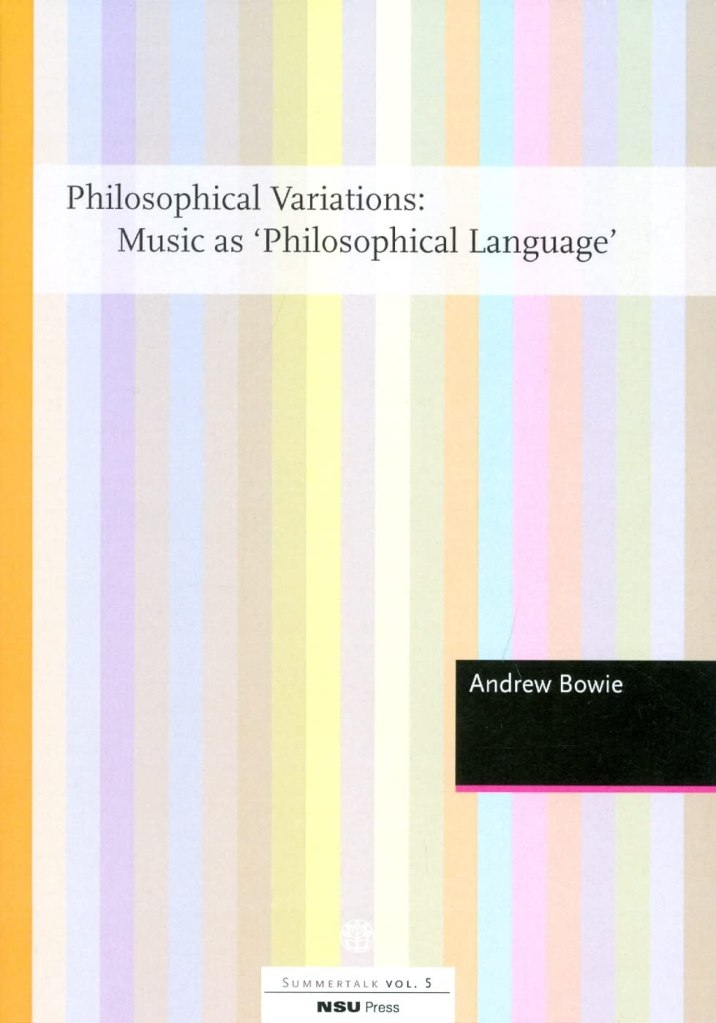
In Philosophical Variations: Music as Philosophical Language, Andrew Bowie presents a collection of essays that offer a sweeping examination of how musical practice, philosophy, and literary understanding converge upon, challenge, and illuminate each other, thereby reshaping our sense of what it means to think and to listen. The author, Professor of Philosophy and German at Royal Holloway, University of London and a jazz saxophonist, allows his musical life to inform his philosophical reflections and vice versa, in a gesture that at once refuses simple compartmentalization and reveals how each sphere of activity demands insights that can only arise through their interconnection. He draws on a wide array of sources, including his extensive knowledge of German Idealism, Romanticism, Shakespearean drama, ethical theory, and improvisational practice, all to show that the vital questions in contemporary philosophy inevitably overlap with the interpretive possibilities opened up by music, and that no single disciplinary approach can accommodate the breadth and depth of this interplay.
He begins by insisting that the seemingly separate compartments of his own life—his formal engagements with philosophy and literary theory, contrasted with his love of performance and his immersion in the experience of listening—can no longer be kept apart if each is to avoid contradictions that would emerge when a theory in one area is silently refuted by a practice in another. This contention resonates with the book’s underlying conviction that philosophical and aesthetic concerns bleed into each other in every serious attempt to make sense of our modern condition. The volume as a whole is thus driven by a critical attitude toward dominant analytical or compartmentalized ways of doing philosophy. It is both a defence and a compelling demonstration of the thesis that if one ignores how music compels us to rethink language, agency, and ethical life, then crucial dimensions of our modern self-understanding will be missed or distorted.
Through a sophisticated confrontation between music and philosophy, these essays aim to show why the question “What does music mean?” can become something more radical than any narrow “philosophy of music” might suggest. Rather than posit music as a mere object of philosophical speculation, the collection pursues the possibility that music itself may constitute a mode of doing philosophy, a practice that reveals aspects of subjectivity, communicative understanding, and intersubjective ethics in a manner inaccessible to purely conceptual discourse. The author explores how this idea has germinated in modern thought, from the early Romantics’ vision of musical form as a language that transcends verbal articulation, to Schopenhauer’s metaphysics of music, to Nietzsche’s account of modern culture, and on to Wittgenstein’s remarks that lead us to notice the proximity of making sense in language to discerning thematic coherence in music. This vision of music as itself a philosophical language supplies a unifying theme that runs throughout these essays, even where the overarching concerns shift from aesthetics to ethics, or from considerations of improvisation to textual analyses of Shakespeare, or from a critique of “Continental philosophy” to reflections on the history of philosophy as a subject of philosophical investigation.
One line of thought in the book focuses on the significance of ethical thought when brought into conversation with music. In an essay reflecting on the possibility of any future “ethics of music,” Bowie traces the roots of aesthetic autonomy and the separation of the aesthetic from the ethical in modernity, showing that while this separation has often been valorized—allowing music to become a free form that is not subordinate to direct moral or religious instruction—there is nevertheless a deep sense in which ethical considerations cannot be excised from musical practices. He interrogates how music-making, whether in performance, composition, or improvisation, reflects a set of values about communal experience, historical inheritance, and the treatment of sound as an expressive means that can both transform and be transformed by social norms. In doing so, he links the question of how we judge music’s rightness or its appropriateness to contexts of shared life, thereby challenging simplistic assumptions that art is amoral or purely self-referential.
This open-ended dialogue between ethics and music emerges again in explorations of how moral claims require justification that reaches beyond mere subjective preference, and yet in music we find new modes of meaningfulness that do not map easily onto strict notions of moral argument. The outcome is the suggestion that, although music seems to inhabit a domain of non-propositional disclosure, its capacity to set norms—whether norms of performance, norms of taste, or norms of expressive urgency—indicates that those who practice or attend to music are consistently evaluating and negotiating a set of shared values. What begins as a question of how to talk about “rightness” in musical performance becomes a question about what it is, more broadly, to do justice to another realm of human experience that cannot be grasped purely by conceptual or moral vocabulary. The upshot is a nuanced rethinking of how an “ethics of music” might manifest itself without lapsing into either authoritarian prescription or vacuous relativism.
Another powerful thread in these essays concerns the function of improvisation and the nature of prereflexive understanding. The author, drawing on his own practice as a jazz saxophonist, speaks from firsthand familiarity with the tension between what is taught, memorized, or rule-bound, and what seems to unfold spontaneously in the moment of improvised performance. Through a philosophical lens informed by Kantian and Romantic insights, he looks to the question of whether improvisation can truly be taught, and how it relies on a complex background of tacit capabilities, learned patterns, and the performer’s capacity to reconfigure what has been learned without falling into the mechanical reproduction of stock phrases. He charts how the spontaneity of improvisation discloses an active engagement by the performer, not simply with a set of compositional or harmonic protocols, but with a deeper sense of historical tradition, linguistic analogy, and a shared ethos of playing together. He insists that improvisation thus highlights the paradoxical fact that neither rigid adherence to rules nor purely chaotic novelty can explain how “wrong’s right” in Monk’s celebrated aphorism. The discovery of meaningful novelty is bound up with a hermeneutic circle of tradition and experimentation, an insight that resonates with both the pragmatist turn in contemporary philosophy and the Romantic insistence on creativity’s resistance to final conceptual closure. Music, in other words, illuminates the irreducible dimension of creative spontaneity, resisting any reduction to mechanism or a merely random procedure.
Amid these reflections on ethics, improvisation, and musical meaning, the essays also look to intellectual history, particularly to the ways in which Shakespeare’s work has functioned as a touchstone for modern philosophy. Rather than presenting a static analysis of Shakespeare’s role in the lineage of European thought, Bowie uses the interpretive strategies that have emerged in Shakespeare criticism to connect them with larger concerns in aesthetics and hermeneutics. He considers how tragedy, in particular, has galvanized philosophical understandings of modernity from Hegel and Schelling onward, and how the tension between the universal and the singular, between fate and freedom, resonates in both the dramatic stage and the musical stage. This reflective move underscores his conviction that philosophical questions can arise in manifold domains of cultural production, and that cross-pollination between drama and music is not incidental but essential if we are to understand how modern subjectivity navigates questions of grief, hope, fragmentation, and reconciliation.
He carries this emphasis on interdisciplinarity into discussions of history and metaphilosophy, suggesting that how one writes and teaches the history of philosophy often encodes tacit assumptions about what philosophy should be. He identifies moments when narrowly circumscribed analytic modes are unable to accommodate deeper issues about the relationship between theoretical reflection and cultural practice. At the same time, he issues a critique of overly dogmatic appeals to tradition in some forms of “Continental philosophy,” showing that a refusal to engage with problems of clarity, argumentation, or naturalism in the sciences can become just as limiting. In illustrating these tendencies, he suggests that certain debates about “the irrelevance of Continental philosophy” have often failed to ask the meta-question of how the philosophical canon is shaped, and of how alternative traditions—especially those that foreground aesthetics and artistic practice—have been sidelined. His willingness to question entrenched boundaries exemplifies the book’s central concern with forging a critical attitude that keeps the conversation open, thereby allowing for new connections to emerge between apparently distant conceptual terrains.
In a world where many philosophical approaches favor extreme specialization, Bowie’s essays champion a style of reflection that endeavors to hold together wide-ranging areas of inquiry. Tracing the meaning of music can lead to rethinking the meaning of language itself; exploring questions of tragedy in Shakespeare can shed light on how improvisational ethics demand a nuanced grasp of context and human finitude. By placing ethics, aesthetics, history of philosophy, and hermeneutics into dynamic relation, these essays suggest that the echoes across disciplines are not superficial analogies but are bound up with the deep structures of how we constitute, interpret, and sometimes creatively transform our collective forms of life.
All of this is reinforced by Bowie’s rejection of a purely insular conception of philosophical argument, one that restricts meaning to a limited analytic vocabulary or to purely logical forms of justification. He recognizes, following Schleiermacher and other Romantics, that much of our understanding cannot be codified by fixed rules or fully explained through conceptual analysis alone. Instead, interpretation in music, like interpretation in language, arises from a prereflexive capacity for making sense, a capacity that cannot be reduced to learned algorithms. There is always a remainder of spontaneity and inventiveness at work, especially in improvisation, and this remainder is akin to the “art hidden in the depths of the human soul” that Kant famously posited as the central enigma of judgment itself. The book’s sustained philosophical inquiry into this enigma signals its far-reaching significance: if even the simplest act of being guided by a rule presupposes an unformalizable moment of engagement, then the same dynamic obtains—at a heightened level—for artistic creativity, especially for music that claims to say something beyond what is available to ordinary language. Music, by virtue of its distinctive interplay of repetition, variation, and resonance, may indeed succeed in articulating dimensions of experience that remain opaque to straightforward conceptual exposition.
The essays also exemplify what might be called a performative dimension: they are themselves acts of bridging gaps, improvising connections, and bringing to light hidden resonances between domains. The author is mindful that a philosopher’s textual analyses can never exhaust the phenomenon of music’s effect on us, yet he is equally convinced that failing to undertake such analyses leaves us impoverished in our self-awareness. In his essay on Beethoven and Romantic thought, for instance, he explores how the transformation of classical forms in Beethoven’s piano sonatas can be understood not simply as a revolutionary expansion of musical structure, but also as a philosophical statement about the nature of reason, the interplay of part and whole, and the modern conception of freedom that both invites and resists closure. This simultaneously musical and conceptual approach to Beethoven—and to the idea of “music as philosophy”—underscores how, even in ostensibly “pure” instrumental works, something like a structured thought-process can take shape in sound. One discovers an alternative way of disclosing the world, a disclosure that is neither reducible to representation nor wholly ineffable, but that resonates with the crises and aspirations of its own historical moment. Placed alongside his reflections on Shakespeare or on the role of preludes and fugues in modern aesthetics, these discussions form a tapestry of argument in which the conceptual and the aesthetic reciprocally inflect one another.
No less important is the context of what Bowie calls “the irrelevance of Continental philosophy,” a phrase that he challenges by showing how so-called “Continental” modes of thought have, for centuries, been preoccupied with issues of praxis, historical situatedness, and the role of interpretation, all of which are integral to understanding music’s function in the modern world. He clarifies that the customary disciplinary boundaries—analytic vs. Continental, or literary vs. philosophical—are frequently self-imposed and do not reflect the more substantial problems of how meaning is formed and how cultural practices shape our moral and cognitive faculties. Throughout, the book urges a more ecumenical stance that acknowledges how analytical precision and hermeneutic sensitivity need not be mutually exclusive. He mobilizes examples from the development of German philosophy, from Kant to Schelling, from Hegel to the early Romantic thinkers, and from the subsequent transformations wrought by Nietzsche, Schopenhauer, and Heidegger, to show that the deeper continuity of these debates resides in a shared quest to understand how we actively, yet often prereflexively, synthesize the data of experience in ways that bear on both our creative expressions and our ethical choices.
Crucially, readers encounter not a disjointed set of expositions but a cohesive network of questions that circle back upon each other in varying thematic guises. The recurring motif is that music and language, far from being segregated domains, each clarify something fundamental about the other’s limits and potentials. Philosophy, if it is to remain relevant, must take seriously the revelatory capacities of art—especially of music—which can “say” what language cannot, or can do so only in haltingly approximate ways. This does not diminish philosophy’s role; rather, it allows philosophy to expand, to become self-reflective about its own conditions of possibility and to grow attentive to what cannot be captured by standard conceptual frameworks. The tension between the active creation of meaning and the inescapable need for shared norms underscores the insistence that music is not merely a solitary, emotional outburst but a practice with social, historical, and ethical dimensions, one that fosters conversation and revision across times and places.
The book ultimately stands as a testament to Andrew Bowie’s distinctive intellectual approach, shaped by his professional background in philosophy and German studies, by his extensive publications on modern European thought, by his engagement with aesthetics and literary theory, and by his personal dedication to jazz improvisation. In a landscape of scholarship where specialized jargon often displaces genuine dialogue, he brings forward a style of writing and reflection that remains faithful to philosophical rigor while remaining open to the richness of cultural life. His translations and editorial projects on figures like F. W. J. Schelling and F. D. E. Schleiermacher inform his understanding of how modern philosophy first arose in close entanglement with questions of interpretation, art, and the subject’s formation through language. Those historical discoveries come alive here in arguments about the inseparability of the aesthetic from questions of knowledge, intersubjectivity, and ethics.
Philosophical Variations: Music as Philosophical Language offers something more than a static or doctrinal account, it invites the reader to partake in the exchange of hearing, speaking, thinking, and playing, to recognize that rationality and aesthetic creativity are not polar opposites but two related dimensions of our being in the world. By combining together reflections on everything from Shakespeare’s tragedies to the improvisational setting of a jazz ensemble, from Romantic claims about the infinite to contemporary debates over metaphilosophy, this collection opens a space in which the philosopher’s love of argumentative clarity becomes reciprocal with the musician’s love of expressive resonance. It posits that the constant crossing of boundaries between disciplines, the refusal to let theory or practice stand alone, and the challenge to purely analytic conceptions of meaning are all imperatives for those who would truly comprehend modern culture in its complexity. The result is a volume that will speak to philosophers curious about the power of music, to musicians interested in the philosophical implications of their art, and to anyone who senses that reflection on art and reflection on life cannot be separated without impoverishing both. In doing so, it stands as a resonant affirmation that, when properly embraced, the meeting of music and philosophy heralds new forms of thought that can, at their best, reinvigorate our modes of living and thinking alike.
 Simon Gros
Leave a comment