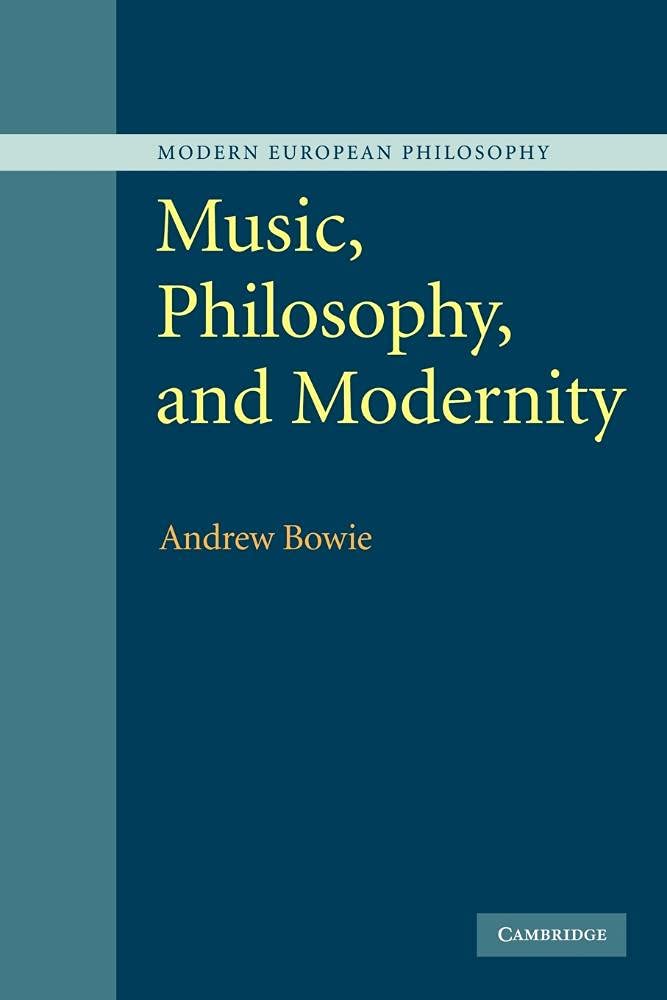
Andrew Bowie’s Music, Philosophy, and Modernity offers a far-reaching exploration of how the confluence of musical practice and philosophy can illuminate core questions about meaning, subjectivity, and truth in the modern world, while simultaneously challenging entrenched assumptions about the very nature of philosophical reflection. In many prevailing accounts, music has been treated as a problem or puzzle that philosophy must solve, as though the sonic and temporal character of musical works were merely an obstacle demanding conceptual clarification. Yet Bowie radically reverses this stance. He insists that music may in fact furnish resources that shed new light on perennial philosophical concerns surrounding language, intersubjective communication, metaphysics, and our attempts to grapple with the elusive status of truth and ethics. His analyses move deftly through a historical narrative, engaging in detail with key thinkers from Kant through the German Romantics, and from Wagner, Wittgenstein, and Heidegger to Adorno, all in the service of unveiling how philosophical engagement with music can disrupt a narrow reliance on analytic or conceptual frameworks that reduce meaning to rigid, propositional models.
Bowie thus situates his project within a philosophical tradition that is itself in tension: on the one hand, there is the drive toward a totalizing, scientifically oriented metaphysics that seeks to ground knowledge in rigorously verifiable propositions, and on the other hand, there is the conviction—shared by many modern European philosophers—that certain pivotal aspects of human experience necessarily escape the boundaries of rule-governed conceptuality. His readings of Kant, for instance, foreground how the so-called “critique of aesthetic judgment” opened fertile terrain for reconceiving music as more than an ancillary problem for metaphysics. Where Kant saw musical form as lacking the representational determinations proper to the other arts, Bowie shows that a deeper thread in Kantian thought suggests music’s capacity to engage subjectivity in ways that exceed the purview of systematic philosophy, precisely because it raises questions about how feeling and immediate affect can embody a mode of “knowing” that resists complete verbal encapsulation. This motif acquires heightened importance in Bowie’s discussions of the German Romantics—Schelling, Schleiermacher, Novalis, and others—thinkers who believed that the expressive and sensuous features of music enact a “philosophical language” of sorts. By proposing that a musical gesture might reveal truths about freedom, selfhood, and the conditions of meaningful communication, these Romantics anticipated conceptions of “negative metaphysics” wherein what cannot be fully articulated in propositional language can still be “shown” or conveyed through artistic form.
Against this backdrop, Bowie’s account of the historical transitions that lead from Beethoven’s symphonic expansions, Schubert’s reconfigurations of song and harmonic development, and the Romantic fascination with the ineffable, to Wagner’s theatrical Gesamtkunstwerk, discloses how nineteenth-century composers and thinkers together exemplified an ever intensifying struggle over music’s place in metaphysical discourse. Far from offering any neat reconciliation, Bowie suggests that these attempts to harness music for speculative ends reflect the deeper cultural predicament of modernity: a predicament in which subject and object, emotion and concept, spontaneity and system, can never be wholly disentangled. One of the leitmotifs is the rift between an objectifying view, where music is treated as a discrete set of acoustic data or “pure form,” and a more holistic, hermeneutic perspective, which sees music as a historically evolving practice that reshapes the very contours of what we take knowledge, meaning, and truth to be. By combining close readings of Romantic aesthetics with reflections on the ways that philosophers since Kant have wrestled with the question of reason’s limits, the book shows how crucial it is to avoid the pitfall of confining musical experience to the realm of mere subjective feeling, even as one acknowledges its irreducibility to purely conceptual analysis.
These tensions become especially vivid in Bowie’s critical engagement with Wittgenstein, Heidegger, and Adorno. In Wittgenstein, Bowie discerns a philosopher whose later writings implicitly call for a recognition of the multiplicity of “language-games,” some of which—like music—operate by different logics and cannot be fully captured by the representational idioms that dominate our talk about the external world. Although Wittgenstein remains suspicious of metaphysical pronouncements, his notion of “aspect-seeing” and his acknowledgment that feeling confers “meaning” upon words dovetail with Bowie’s broader thesis that music can place us in contact with dimensions of sense-making that are performative, participatory, and not merely referential. Likewise, Heidegger’s analysis of being as something that transcends objectification resonates with the idea that music, by refusing neat paraphrase, enacts a temporal unfolding that discloses our finitude and our openness to what exceeds conceptual mastery. Bowie draws out how Heidegger’s own fascination with art, language, and poetic thinking suggests an interpretive framework where music becomes a prime site of what one might call “world-disclosure,” drawing our attention to forms of resonance and communal attunement that cannot be reduced to the kind of information typical of scientific accounts.
Adorno’s singular role in Bowie’s investigation is manifest in the way that Adorno treats modern musical works simultaneously as historical artifacts, socially implicated objects, and philosophical provocations. Bowie underlines how Adorno’s “musical philosophy” operates at the intersection of form and freedom, exposing tensions that reveal the contradictory strata of modern life. Adorno’s writings on Beethoven’s formal procedures or Wagner’s compositional strategies are not merely technical or aesthetic but reflect on broader conflicts in subjectivity, reason, and ethical agency under late capitalism. In a parallel move, Bowie suggests that Adorno’s own style of critical reflection mirrors his understanding of music: it is never reducible to a fully coherent “theory” but rather works by illuminating how musical forms express utopian possibilities and historical crises in ways that purely discursive arguments often cannot. For Bowie, this underscores a central lesson: once philosophy confronts music without presupposing that “conceptual analysis” can exhaust it, the very image of rational discourse as a neat pyramid of systematic clarity is thrown into question, and we acquire the impetus to rethink how we speak of truth, how we relate to tradition, and how we negotiate ethical life in an era of perpetual cultural upheaval.
Crucially, Music, Philosophy, and Modernity thus refrains from simply treating music as an idle metaphor or a decorative example. Instead, Bowie insists that music becomes both a catalyst and a guide for rethinking communication, subjectivity, and the capacity of reason to orient itself in a world whose meaning cannot be pinned down through empirical or strictly logical propositions. His reflections restore the philosophically subversive force of art, recalling the repeated attempts in Romanticism and afterward to locate in music the contours of an alternative form of knowing—one that neither abandons rationality nor capitulates to mysticism, but that widens our sense of how significance operates in human life. By showing how deeply musical experience is merged with the social, historical, and theoretical frameworks in which we encounter it, Bowie also raises timely questions about autonomy, freedom, and the ambiguous legacy of modern self-legislation. Rather than seeking a foundation for music in a completed metaphysical system, or conversely, relegating it to the status of an elegant diversion, he invites us to see music as shaping the very horizon of intelligibility within which philosophical questions arise.
Through this analysis, Bowie’s book offers a series of carefully elaborated reflections that will appeal to philosophers who sense that current philosophical methods often overlook the significance of aesthetic practices, as well as to musicologists eager to explore how philosophical debate has shaped the history and interpretation of musical works. Scholars of Romanticism, German Idealism, and Critical Theory will find detailed considerations of the ways in which figures from Kant to Adorno harness musical form for transformative insights into language, truth, and ethics, while still acknowledging music’s radical difference from verbal discourse. Ultimately, Music, Philosophy, and Modernity challenges readers to think anew about the limits of conceptual thought and the inexhaustible creativity that emerges whenever aesthetic form and philosophical reflection collide. In an era when scientific perspectives increasingly dominate cultural discourse, Bowie’s retrieval of music’s power to unsettle and to expand the philosophical imagination stands as a decisive reminder of modernity’s restless exploration of what cannot be neatly encapsulated by empirical or analytical frameworks. His book, rich in its sweep through centuries of thought, compels one to see music not as a mere illustration of deeper theoretical doctrines, but as a vital participant in shaping the philosophical quest for a more capacious understanding of human meaning.
 Simon Gros
Leave a comment