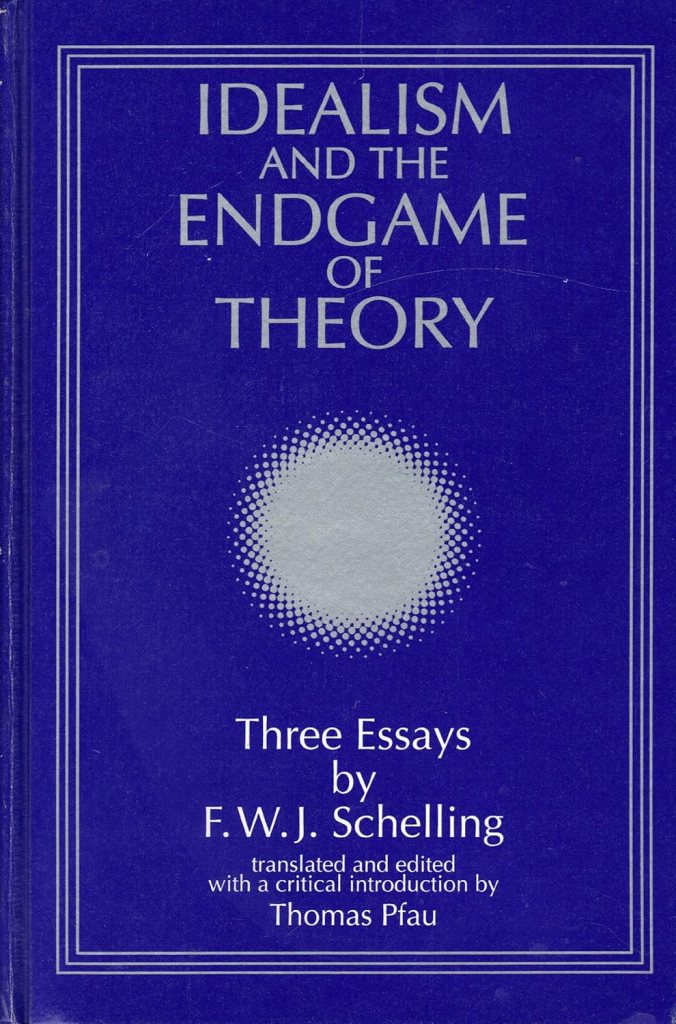
Idealism and the Endgame of Theory by Thomas Pfau offers a challenging, almost vertiginous engagement with the conceptual heart of German Idealism and its repercussions for contemporary debates about the nature, purpose, and limits of theoretical reflection. Although Schelling remains an enigmatic figure in Anglophone philosophical discourse, widely overshadowed by the more systematizing narratives of Kant, Fichte, and Hegel, he stands forth in these pages as arguably the most radical exponent of the metaphysical and epistemological possibilities—and pitfalls—of post-Kantian thought. Here, for the first time in English, three seminal essays are presented together: the Treatise Explicatory of the Idealism in the Science of Knowledge from 1797, the System of Philosophy in General from 1804, and the Stuttgart Seminars from 1810. Their appearance collectively illuminates a philosophical career as restless as it is conceptually rigorous, a career that recasts the problems of subjectivity, identity, and freedom in ways that continue to resonate for today’s theoretical engagements with the self, history, and culture.
From its earliest pages, this volume reveals a Schelling who radically interrogates the notion of a self-grounding subject, the central pivot upon which so much of Kant’s and Fichte’s critical philosophy depends. Whereas Kant struggled with the synthetic a priori structures that undergird representations of space, time, and the categories of thought, and while Fichte formulated a more audacious notion of the “I” positing itself as the principle from which all theoretical and practical knowledge could be derived, Schelling shifts the ground by insisting that neither abstract deduction nor simple recourse to an intellectual intuition can capture the paradoxes of genuine subjectivity. He demonstrates that the transcendental subject championed by Kant and reimagined by Fichte harbours an unresolvable tension between the desire for complete autonomy and the persistent necessity of grounding itself in something that perpetually eludes reflective appropriation. The 1797 Treatise Explicatory of the Idealism in the Science of Knowledge thereby constitutes a critical re-reading of Fichte, and by extension Kant, which pushes the concept of synthesis to its outermost limits. In so doing, Schelling voices a critique that would prove essential for Coleridge’s Romantic project of bridging German speculation and English poetic imagination, while also foreshadowing twentieth-century reckonings with the fragility of subjective self-presence.
What emerges across these essays is a figure of Schelling who, from an early age, was willing to accept that the theoretical apparatus of post-Kantian thought could not be shored up by ever more complex derivations of one absolute ground or principle. Instead, Schelling’s repeated meditations on the finite subject display an acute sense of the contingent nature and inescapable limitations of all theoretical practice. In his Treatise, he underscores the restless labour of the mind as it strives to unify sense, concept, and self-positing activity, only to be thwarted by time and the ever-shifting “ground” that logic cannot wholly master. The text thereby marks him, at merely twenty-two years of age, as a major interlocutor in the swiftly transforming philosophical scene of the 1790s—a voice unafraid to highlight where Critical Idealism might founder under the weight of its own transcendental ambitions.
By the time he delivers his System of Philosophy in General in 1804, Schelling has pushed this stress on limitation and contingency even further, no longer content to remain within the paradigm of a self-positing subject refining itself through an endless process of reflection. Instead, identity becomes for him the pivot around which all philosophical insight and confusion revolve. Yet identity is not to be assumed as the stable property of a pre-given subject or a rationally deducible structure; it is disclosed, rather, as a drama of emergence in which the absolute neither stands aloof as a remote God nor dissolves itself into lifeless abstraction. On the contrary, identity names the dynamic, living exchange of finite and infinite, ideal and real, unity and difference, an interplay that does not unfold in the neat progression of logical categories, but rather in the material, historical existence of conscious beings who cannot wholly possess or negate their dependence on an ungraspable ground. This radical decentering of subjectivity points toward a different sense of systematicity—one where “nature” retains irreducible weight as the inescapable matrix of all human conceptual labors, and where the quest to reflect upon itself draws the philosopher toward conclusions that are no longer strictly epistemological but instead metaphysical, even onto-theological.
Readers may expect that, by naming identity the core problem, Schelling would aim to harmonize all oppositions in a conclusive demonstration of reason’s power. Yet, as Pfau’s critical introduction shows, Schelling does the very opposite: he construes identity as the unending endeavor of thought to cope with its own latent yearnings for totality, while perpetually confronting the recalcitrance of what is other than concept—whether we call it time, history, matter, or that pre-intellectual region he at times calls the “unconscious,” at other times the “ground,” and still elsewhere the “relative nonbeing” that even God cannot dispense with.
In other words, absolute subjectivity, if one might still name it thus, is revealed to be intrinsically bound up with a desire for self-revelation it cannot simply will into existence. That is one reason the System of Philosophy in General locates the apex of its argument in the urgent tension between the mind’s relentless striving for unity and the unbridgeable autonomy, or relative independence, of the “not-I.” We see here Schelling’s daring re-conception of God as simultaneously transcendent source and participant in history, needing the finite world in order to become fully actual. Such a notion was shocking to contemporaries longing either for the security of dogmatic theology or the self-assured discourses of pure reason. It remains equally bracing for today’s theoretical climate, in which the claims of identity—be they about subjectivity, gender, race, or culture—can no longer be considered purely “constructivist” or purely “essentialist.” Schelling’s inquiry into identity underscores that even absolute reason would require difference as the condition for meaningful manifestation, just as human beings require something external, unmastered, and recalcitrant to sustain the drama of consciousness itself.
In his 1810 Stuttgart Seminars, Schelling goes still further, offering a series of discourses that, while addressed to a more general audience of officials and cultivated laypeople, press inexorably into the mystical terrain that arises when one contemplates freedom, history, and the basis of existence in the divine life. Now, however, his reflections on an “absolute identity” and the “ground” of all being become inseparable from an all-pervading sense that rational analysis inevitably reveals its own insufficiency. For a number of modern readers, these seminars mark Schelling’s so-called “later period,” a turn away from rational speculation into a nebulous realm of theological rumination.
Yet Thomas Pfau’s introduction deftly situates them among the works that most explicitly display Schelling’s unique insight: that philosophy, to remain rigorous, must grapple with the finite forms in which the infinite discloses itself and that, accordingly, the highest revelations of reason must acknowledge the irreducible presence of mystery, longing, and transcendence. The Stuttgart Seminars consequently become another vivid testament to the fact that what often appears purely mystical in Schelling is in fact a hard-won recognition that all systematic knowledge must confront the uncanny possibility that the absolute itself requires a finite “other” for its self-showing. Far from an unthinking retreat, this is a reminder that the mightiest aspirations of theory must be perpetually renewed by the very material negativity, or finite contingency, they can never abolish.
This volume’s compelling depth is enhanced by Pfau’s extensive critical apparatus, which includes both a far-ranging introduction—situating Schelling with respect to Kant, Fichte, Hegel, and the charged debates on contemporary theory in the humanities—and a set of annotations that help readers navigate Schelling’s dense conceptual vocabulary. The pages are also enriched by a specialized glossary that clarifies key German technical terms whose nuanced implications do not always survive ordinary English translation, and a multi-lingual bibliography that anchors the student of Schelling in the diverse textual traditions informing this philosophical conversation. An excursus on Schelling’s impact on Samuel Taylor Coleridge further exposes how a towering Romantic figure in English letters could sense, early on, the astonishing fertility of Schelling’s thinking for recasting questions of poetic imagination, the logic of the will, and the hidden substratum of speculative inquiry.
Scholars of literature, religion, continental philosophy, and all those intrigued by the unraveling of totalizing systematic claims will discover, in these essays, the indispensable contexts behind the recurring preoccupation with identity. Schelling might be even more interesting than Fichte and Hegel, and many of these texts are essential for understanding the nerve-center of Idealism’s promise and collapse. One cannot fully grasp the radical shift from early Romantic speculation to the post-Hegelian sea change in European philosophy without following the winding path of Schelling’s reflections on the necessity, yet ultimate unthinkability, of grounding theoretical discourse in an absolute principle.
Offering what can rightly be regarded as a much-needed complement to the Schelling materials already available in English, Idealism and the Endgame of Theory: Three Essays by F. W. J. Schelling is far more than a standard scholarly anthology. It is a window into a philosophical mind wrestling ceaselessly with the paradox of how we can conceive a unity that is neither reducible to the old dogmas of rationalism nor to a purely negative or deconstructive move that leaves us stranded in the flux of endless differences. By gathering together these three epochal works, Thomas Pfau reveals Schelling’s extraordinary evolution toward a metaphysics of life and freedom, a conception of identity that refuses to remain an inert category, and a critique of subjectivity that anticipates many contemporary debates on whether we can ever fully extricate ourselves from our own interpretive structures. Readers interested in the intersection of philosophy, literature, theology, and cultural theory will find themselves continually spurred to re-examine the foundational gestures of their own disciplinary commitments.
Through each page of these newly translated texts and through Pfau’s guidance, we encounter a philosopher who not only emboldens us to think anew about Kant’s and Fichte’s legacy but also forces us to confront our modern theoretical frameworks, testing whether we still harbor hidden illusions of an all-synthesizing reason or whether we can embrace a thinking that treats the mystery of existence, the fragility of the will, and the inescapability of history as central, not incidental, to the ongoing life of the mind. It is this persistent challenge—of how identity is to be thought, lived, and yet never fully owned—that renders Schelling at once so alien and so vital. In the cracks of subjectivity and reflection, he unveils the practical and metaphysical tasks of a modernity still on the verge of deciphering its own origins. In so doing, he implicates us all in a venture that can neither be abandoned nor mastered, but only engaged, with the utmost seriousness and humility, as the endgame of theory approaches.
 Simon Gros
Leave a comment