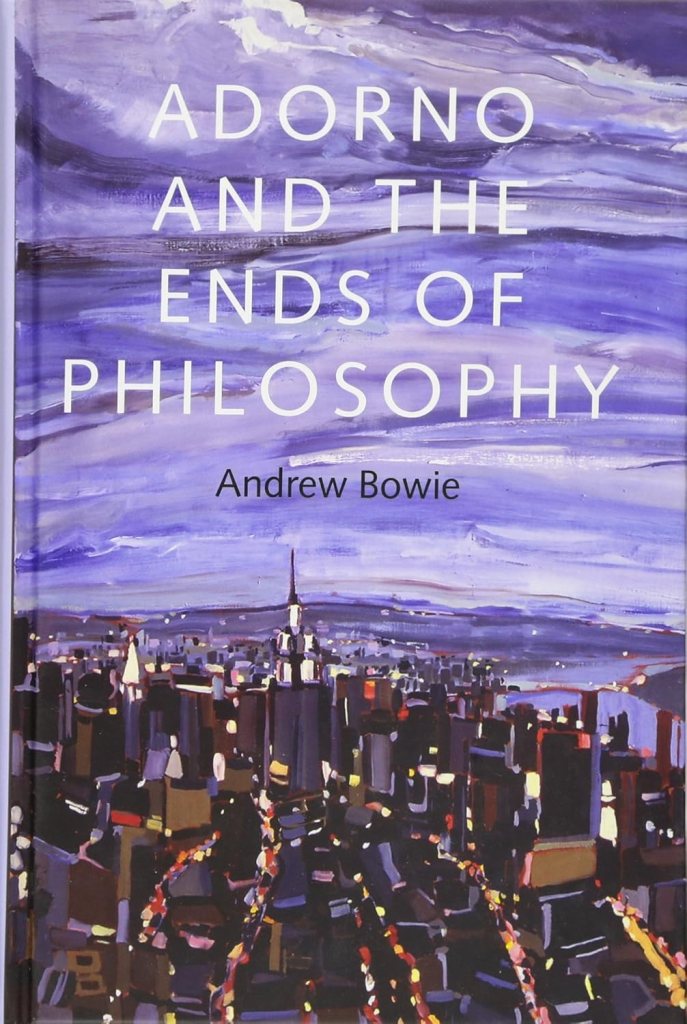
Andrew Bowie’s Adorno and the Ends of Philosophy offers an extraordinarily fertile questioning of what Theodor W. Adorno’s thought can mean for us today, illuminating a path through his dense theoretical landscapes while refusing to reduce that complexity to easy formulations. From the very start, the work underscores the ambiguities and challenges in Adorno’s legacy: he is well-known as a cultural critic, associated with the Frankfurt School’s unrelenting critiques of capitalism and commodification, but his status as a philosopher has often been hindered by the imposing obscurity of his published writing. Bowie shows, however, that Adorno did not always express himself in hermetically sealed prose; indeed, the public lectures Adorno gave during his lifetime could be strikingly lucid, hinting at a clarity of philosophical insight that often lies beneath the difficult veneer of works like Negative Dialectics and Aesthetic Theory. By recovering strands of Adorno’s thinking that have been eclipsed—and by situating them alongside developments in analytic philosophy, pragmatism, and recent Hegel scholarship—Bowie discloses anew the productive tensions that animate Adorno’s distinctive philosophical voice.
Central to Adorno and the Ends of Philosophy is the claim that Adorno’s critical stance, forged in the shadow of twentieth-century catastrophes such as the Holocaust, has not only a negative dimension—the unmasking of ideologies, reification, and the dire consequences of instrumental reason—but also a constructive dimension aimed at rescuing possibilities for meaning in a disenchanted modern world. Bowie places particular emphasis on how Adorno’s vision resonates with, and in some cases anticipates, developments in Hegel interpretation. Many modern appropriations of Hegel—especially those oriented toward pragmatism and intersubjective reason—share an interest in moving beyond the old dichotomies of subject versus object, or mind versus world. Bowie argues persuasively that Adorno’s critique of “identity thinking” anticipates many of these themes, but insists at the same time that no purely rational or pragmatist framework can fully address the wreckage left by modern history. If we are to gauge the rationality of the modern age, Adorno suggests, we must keep the Holocaust at the center of reflection, precisely because it exemplifies reason’s darkest turn, where the powers of scientific-technical progress served a monstrous project of annihilation. Bowie’s reading thus draws attention to that crucial point at which Hegelian and pragmatist optimism about the integration of subject and object collides with what Adorno names the “negative” moment of reflection, one informed by the irreducible memory of historical horrors.
Yet Bowie’s analysis is not confined to Adorno’s most distressing diagnoses. The book also illuminates Adorno’s insistence on the philosophical significance of art, a theme often lost in the more politically and sociologically oriented receptions of Frankfurt School thought. Drawing on Adorno’s reflections on music, literature, and the concept of aesthetic experience, Bowie shows that for Adorno, the work of art stages a resistance to the forms of conceptual domination that prevail in scientific and everyday discourses alike. Adorno’s aesthetics become, in Bowie’s reading, a key to understanding how Adorno’s vision of philosophy refuses to relinquish the idea of metaphysics altogether, even while it acknowledges that the traditional forms of metaphysics—rooted in an Enlightenment project that has sometimes slid into barbarism—cannot simply be revived in their old guises. This “negative metaphysics” exposes the failures of conceptual totalities while still gesturing toward experiences that outstrip purely discursive articulation. Music, for instance, in Adorno’s account, can allow us to feel the pull of a promise not fully capturable by our existing cognitive frameworks. And yet, Bowie shows how Adorno never lapses into simple Romanticism: art is no cure-all. Rather, it is one powerful way of illuminating the damage in the world, raising experiences of dissonance that rational theory might too readily screen out.
Bowie’s achievement in this regard, as highlighted by editorial reviewers and scholars, is twofold. First, he offers what the New Humanist describes as a “massive range of reading with an extraordinary power of lucid exposition,” thereby transforming Adorno’s vexed reputation as a philosopher of impenetrable negativity. Second, he shows Adorno’s pivotal role in the ongoing conversation that traverses the analytic–continental divide. Albrecht Wellmer, himself recognized with the Adorno Prize in 2006, remarks that Bowie “shows with Adorno why art is not just one of many possible topics of philosophical reflection, but has a philosophical significance of its own,” one that has been relegated to the margins in many strands of modern thought. Sebastian Gardner further observes that Bowie’s book “puts Adorno in sharp focus while also offering a synoptic view of the general state of contemporary philosophy,” clarifying Adorno’s relation to the post-Kantian tradition while integrating and critiquing the neo-Hegelian and pragmatist currents that captivate philosophy today. Bowie thus gives us a vantage point from which we see Adorno not merely as the notoriously cantankerous essayist of the Minima Moralia, but as an intellectual bridge-builder whose reflection on nature, subjectivity, and society helps lay bare the inherited dilemmas that contemporary philosophers continue to wrestle with, from the problem of disenchantment to the specter of reductive naturalism.
Yet Bowie’s text also confronts the reality that Adorno’s critiques can never be fully absorbed into a tidy philosophical system. Even when Adorno’s formulations seem hyperbolic—such as his claim that “the whole is the untrue”—they point to a crucial tension between modernity’s liberating achievements and its capacity for unprecedented destruction. Bowie draws our attention to the way in which Adorno, like Heidegger, grapples with the question of the “end of philosophy,” acknowledging that the success of modern science has, in many ways, displaced the comprehensive explanations that metaphysics once promised. Indeed, Adorno insists that scientific rationality and technological advancement cannot be understood solely as benign progress; their catastrophic potential is crystallized in historical traumas like Auschwitz. Bowie uses this insight to challenge the notion that analytic metaphysics can simply recover a pure domain of “fundamental kinds of things,” devoid of the messy processes of socio-historical transformation. In line with Hegel’s assertion that philosophy must think its own time in thought, Adorno encourages us to see that what might appear as timeless conceptual problems often encode nature-history processes, real contradictions, and social antagonisms. Bowie’s reading draws out that if the very function of philosophy is to make sense of the modern predicament, then ignoring these contradictions would be deeply unphilosophical, whatever one’s methodological predilections.
Bowie’s engagement with specific examples—from the meltdown of financial markets to aesthetic ruptures in contemporary art—illustrates Adorno’s continuing relevance, even in contexts that Adorno never directly discussed. As one of the top reviewers (“toronto”) notes, Bowie’s exposition reveals how Adorno’s themes of commodification and reification speak hauntingly to the present, where capitalist rationality so often appears both pervasive and irrational. Bowie highlights the peculiar exchange between the ways we rationalize our economic and social orders, and the recognition that the categories we use—drawn from Kant, Hegel, or other major sources in the post-Kantian tradition—are at once enabling and distorting. The intangible line dividing objective necessity from historical contingency frequently shifts, and Adorno calls on us to remain vigilant toward such shifts, since they shape the very knowledge practices that we mistakenly take to be timeless. Bowie’s approach underscores how, for Adorno, the interaction of forces in our socio-historical world is not just an accidental background to epistemological or metaphysical questions, but can alter the meaning of those questions themselves.
Building on these reflections, Bowie’s concluding sections push us to interrogate the “ends” of philosophy in multiple senses. He sketches how, since the decline of traditional metaphysics, philosophers have turned toward naturalist frameworks or have attempted to reconstruct rational discourse on purely immanent grounds. While he fully engages with the significance of these developments, Bowie suggests that Adorno’s central lesson remains potent: the project of enlightenment cannot regard the horrors of the modern epoch as an incidental anomaly. If metaphysics once asked whether we could ground truth in eternal forms or guarantee the coherence of reason, Adorno’s lesson is that we must keep the possibility of radical evil in our sights, so as not to collapse into dogmatic illusions of progress. Consequently, the “end of philosophy” is not merely the replacement of speculative inquiry by scientific explanation—though it partly involves acknowledging that science has commandeered many of philosophy’s classical explanatory tasks—but the awareness that philosophy’s role must also be to reveal where reason fails and how knowledge itself might become complicit with structures of domination. From this vantage point, Bowie’s study merges Adorno’s negative dialectics with other attempts to articulate conditions of meaningfulness—reminding us that the moment we think we have arrived at a definitive totality, the dimension of nonidentity erupts to show that something has always been left out, repressed, or silenced.
Yet Bowie does not foreclose more hopeful aspects of Adorno’s thought. In his emphasis on how art resists the flattening of meaning, Bowie highlights the distinctly philosophical significance of aesthetic experience for Adorno. Far from merely a decorative add-on to a political or sociological critique, art for Adorno becomes a site where the longings and contradictions of modernity lay themselves bare. In aesthetic production and reception, one encounters the possibility of naming what discourse cannot fully articulate and of seeing the tensions that saturate rationalized forms of life. Bowie patiently underscores that Adorno’s aesthetic theory is inherently bound up with the project of rethinking “metaphysics” after its apparent collapse. This rethinking does not restore the illusions of an unassailable conceptual framework, it rather gestures toward the salutary reminder that our interpretations of life, knowledge, and community must remain as open-ended as the experiences that give them urgency.
Throughout Adorno and the Ends of Philosophy, Bowie adopts an integrative approach, tracking how Adorno’s legacy can indeed “ignite debate surrounding the reception of Adorno’s philosophy,” as the book’s summary promises, and how it can also carry him into mainstream philosophical discussions at a time when the old demarcations between “analytic” and “continental” thought are dissolving. Indeed, one of Bowie’s major contributions is to show why Adorno need not remain confined to an intellectual niche where only specialists in German Critical Theory venture. By comparing Adorno’s moves against representationalist epistemologies with parallel moves in pragmatism, or by exploring how Adorno’s dialectical negativity stands in fruitful if uneasy relation to the current revival of Hegelian thought, Bowie repositions Adorno as an indispensable voice for anyone grappling with the tensions of modernity, the status of science in our conceptual life, the significance of history, and the enduring question of how to create meaning under conditions that too often degrade it. In doing so, Bowie clarifies that Adorno’s most difficult writings were never intended to shut out broader audiences but were instead forms of vigilance against the comfortable illusions that so often accompany conceptual clarity.
Finally, Bowie’s interpretation reminds us that part of Adorno’s moral and philosophical import lies in an unyielding refusal to treat the catastrophes of history—most prominently Auschwitz—as mere data points in an otherwise smooth narrative of enlightenment. Because Adorno insists on the imperative that philosophy must “make the Holocaust central to the assessment of modern rationality,” Bowie notes how this inescapable historical consciousness sets Adorno apart from many more optimistic or purely theoretical frameworks. Precisely in demanding that the darkest moments of modernity remain at the forefront of any philosophical claim about reason’s ends, Adorno compels thought to measure itself against extremes that threaten to overwhelm it. Bowie’s book painstakingly traces how these extremes both arise from and indict the dominant forms of rationalization, thereby challenging philosophers who would separate themselves from the pressing concerns of historical life. The result, as Bowie suggests, is a mode of thinking forever caught between the hope that rational understanding can guide us to a better world and the dread that this same rationality may be turned against human flourishing in the most devastating ways. By embracing this tension, rather than evading it, Adorno and the Ends of Philosophy offers a key reflective journey into a form of critical thought as indispensable now as it was during the calamities of the twentieth century.
Andrew Bowie’s work provides a remarkably clear, historically astute, and philosophically rigorous reinterpretation of Adorno’s legacy, illuminating pathways that run between Adorno’s vexed dialectical negativities and the live debates of contemporary theory. It shows how Adorno, frequently dismissed for his opacity or sidelined by rival schools of thought, has a great deal to offer precisely at a time when the boundaries between intellectual traditions are being reexamined and new forms of conceptual engagement are emerging. The book will be indispensable not only to students at all levels who seek to navigate Adorno’s challenging intellectual landscape, but also to philosophers, critics, and cultural theorists of various persuasions who grapple with the paradoxes of modernity and the ongoing crises of rationality. Above all, Bowie’s scrupulous scholarship encourages a reappraisal of Adorno, casting him not as a remote figure issuing arcane pronouncements, but rather as a thinker whose lessons on disenchantment, history, and aesthetic defiance continue to resonate. Adorno and the Ends of Philosophy is thus both a definitive invitation to read Adorno in a new light and an important reflection on why philosophical reflection, far from reaching a neat conclusion, remains charged with the unending task of measuring itself against the real suffering and yearnings of our time.
 Simon Gros
Leave a comment