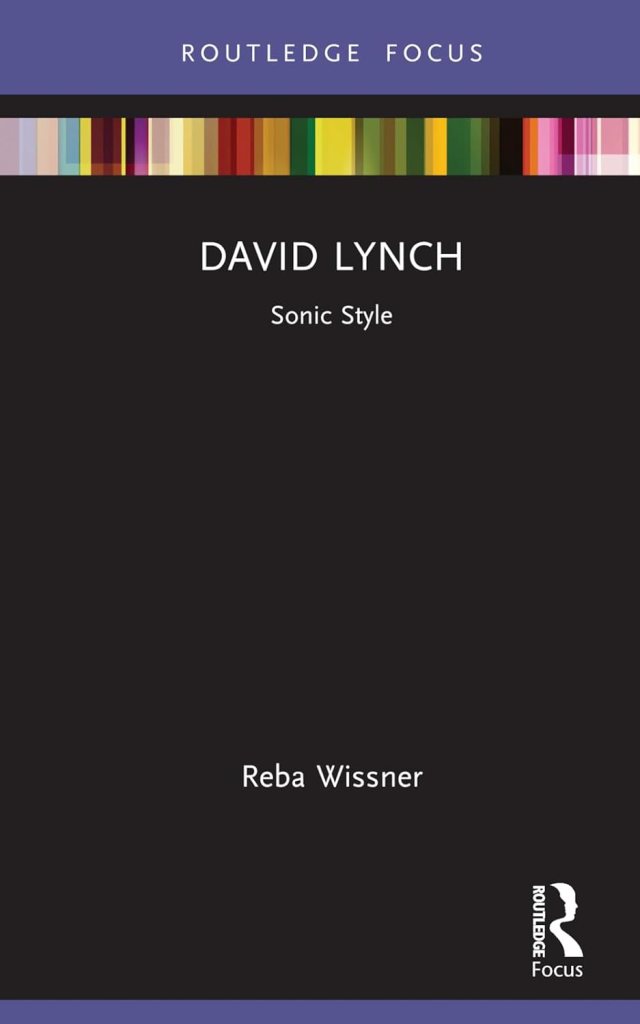
David Lynch: Sonic Style by Reba Wissner offers an uncommonly illuminating journey into the resonant worlds that David Lynch conjures in both his films and television projects, exposing layers of auditory craft that reveal new pathways to understanding his distinctive aesthetic. From the earliest moments of Lynch’s filmmaking, sound has persisted as a living organism underpinning his cinematic visions. Across these pages, what emerges is a vibrant variety of history, technique, and philosophy, combined to illustrate how sonic details permeate the uncanny “Lynchian” universe. Wissner’s study is at once richly granular in its examination of the director’s films and thoroughly philosophical in its reflections on the inextricable link between sonic form and cinematic meaning.
Because the Lynchian lexicon of crackles, drones, howls, hums, and industrial rumbles is so uniquely recognizable, the author aims to answer the deceptively challenging question of what “Lynchian sound” really is. She discusses how Lynch writes specific sounds into his scripts, often giving them nearly the same weight as visual elements. Lynch’s obsession with everything from the rumble of electricity to the deeper roar of industrial machinery evidences a worldview in which the invisible currents of energy—mechanical, psychological, and natural—swell just beneath the thresholds of ordinary perception. The book’s opening dwells on Twin Peaks: The Return, where The Fireman’s ethereal exhortation to Agent Cooper to “listen to the sounds” cues us to the existential gravity of noise, harmony, and disruption. From there, the reader is taken methodically through each sonic pivot point that reveals how Lynch harnesses sound to disturb, seduce, and bewilder.
Throughout this study, Wissner shows how Lynch transforms background tones—like incessant industrial drones or the buzz of electricity—into foregrounded instruments that contour the emotional geography of his worlds. She devotes careful attention to the machinery of Eraserhead, where airy ambiences, hydraulic hissing, and the calls of illusory creatures entangle to communicate Henry Spencer’s fear and isolation. She likewise probes Lost Highway, emphasizing the immediate sonic imprint etched into the psyche of those who experience its menacing rhythms and disorienting roars. The distinction between what is properly “musical” and what counts as “sound design” dissolves under Lynch’s hand, and Wissner excavates each such dissolution. When pure pulses or shimmering drones infuse a scene in Blue Velvet, for example, we come to realize that in the Lynchian cosmos the incidental can throb with more emotional potency than melody itself.
Even seemingly mundane noises—a flicking lightbulb, the dull roar of a distant factory, the coarse static of an empty television channel—acquire profound signification once Lynch distorts them or layers them in unexpected contexts. Wissner, in her painstakingly thorough chapters, charts how these manipulations enrich the narrative texture, both in the sense of introducing uncanny disruptions and in forging a sense of metaphysical layeredness. What at first might appear to be a harsh static merges with or overtakes musical scoring, forcing audiences to question boundaries of diegetic and non-diegetic space. This process effectively destabilizes the viewer, drawing them deeper into a labyrinth of sensation. The book documents Lynch’s singular capacity to guide an actor, a sound designer, or a composer with vivid adjectives like “ominous,” “beautiful,” or “mechanical,” prompting them to hunt for peculiar timbres and frequencies until the final effect is perfectly “married” to the image.
This volume reminds us of Lynch’s Wagnerian scope, in which his films assemble myriad artistic elements—visual compositions, dialogue, ambient noise, musical underscores, and processed voices—into holistic “total artworks.” Wissner patiently notes how critics, theorists, and even Lynch’s close collaborators each struggle to pin down precisely what makes a film feel “Lynchian.” Her interpretation suggests that the crux lies in the uncanny synergy between spaces, bodies, and the intangible wash of mechanical or organic tones. The director’s immersive approach to designing, mixing, and sculpting sounds results in experiences that do not merely accompany the visuals: they bind themselves to the images, extend them, warp them, or subvert them, pulling the viewer into a space between dream and reality. Indeed, in reading how Lynch once painstakingly created a love scene’s audio texture by floating a water bottle in a bathtub while capturing the resonance from inside the glass, one confronts just how integral sonic invention is to his cinematic authorship.
The book’s “three different sound styles” are parsed as cohesive threads that run through Lynch’s creative timeline. First, Wissner traces his earliest short films—Six Men Getting Sick, The Alphabet, The Grandmother, and The Amputee—and the landmark Eraserhead, each revealing Lynch’s initial explorations of manipulating industrial drones, wind, and pitch-shifted organic noises. In these films, he establishes a primal language of weird hums, whirring sirens, amplified footsteps, and nightmarishly obscured voices. These elements not only reflect his life in Philadelphia, a city whose gritty environment stoked his imagination, but they also set forth the building blocks for everything to come. Next, the author illuminates how these proto-techniques evolved in collaboration with composers and sound designers such as Alan Splet, Randy Thom, and especially Angelo Badalamenti, whose haunting melodies frequently fuse so completely with the atmospheric rumbles that they emerge as a single conceptual entity. Finally, she illuminates the ways Lynch’s use of new technologies, especially with longtime sound collaborator Dean Hurley, cements and expands his fascination with electricity, reverb, layered drones, and that intangible hum that drifts in the background of The Return.
David Lynch is, by Wissner’s account, not a director who leaves the sound mixing to post-production specialists in any casual sense. His presence is constant: rewriting the script of acoustic reality, recording half-speed whispers through aluminum ducts, pushing low frequencies into gut-rumbling territory, or tuning a squealing wind effect until it occupies precisely the right emotional register. This unwavering involvement, she argues, solidifies him as a soundtrack auteur, one whose grasp of sonic ambience surpasses routine “score vs. effects” constraints. Every spoken line might be subject to a warped tape speed or underscored by a relentless swirl of noise. Every threat or moment of transcendence might be heralded by mechanical roars or intangible static bursts. In some scenes, the absolute hush between lines is more ominous than any musical chord could be. In other moments, the bleating of an unseen animal or the thick industrial pounding from a remote engine underscores the entire sequence, an unsettling metronome that signals uneasy transitions between cinematic planes.
Wissner carefully documents how these distinct aural phenomena become leitmotifs stretching across Lynch’s oeuvre. She shows that the “wind whooshing” overhead in Twin Peaks is not merely scenic flavor: it is part of the moral and cosmic tapestry of the narrative, signifying unearthly forces lurking behind seemingly banal small-town life. The swarming electronica or reversed tape scratch in Lost Highway signals the bending of space and time. The periodic introduction of pure, room-filling drones in Inland Empire reflects the dissolving barriers between identity and performance. And the recurring reliance on archaic devices—telephones, Victrolas, old amplifiers—manifests Lynch’s fascination with outmoded technologies as vessels for the uncanny. In each case, sonic cues do more than foreshadow or highlight events; they precipitate emotional responses on an almost subliminal level, rewriting the viewer’s sense of proximity or distance from the scene.
Cementing the study’s philosophical complexion, the book grapples with how Lynch’s soundscapes unsettle established hierarchies of sight and sound. Where mainstream cinema often relegates music to an auxiliary role, Lynch’s approach reorders the senses, thrusting the aural dimension into equivalence with or even precedence over the visual. Wissner reads this as emblematic of a deeper metaphysical interest: Lynch’s repeated depiction of parallel dimensions and half-articulated truths finds a direct corollary in the textural densities of droning atmospheres, echo chambers, and outlandish collisions of noise. The viewer, hence, is asked to renounce purely rational vantage points and steep themselves in an emotional, dreamlike space. In that sense, the essential “Lynchian” hallmark is not just about bizarre imagery or elliptical narrative but about how the intangible energies of sound reflect interior psychic conditions.
By the time the study arrives at its broader conclusions, readers will see precisely how the combined efforts of Lynch and his collaborators have methodically built an evolving sound world that has shaped modern cinema’s discourse on sonic design. We come to appreciate the repeated emphasis on industrial hiss in Eraserhead as the primal blueprint for decades of subsequent work. We revisit the musical, mechanical synergy in The Elephant Man and hear anew the ways that John Merrick’s labored breathing merges with the distant mechanical churn of Victorian London. We grasp how the high-density shrieks, layered guitars, and half-speed chaos of Lost Highway overlap with the stuttering illusions of identity on-screen. We finally arrive at Twin Peaks: The Return, where everything from the ephemeral jukebox crackle in the Roadhouse to cosmic sonic blasts in Part 8 underscores Lynch’s enduring desire to subvert the boundary between the heard and the seen.
David Lynch: Sonic Style stands out for its deft combination of historical production details, interpretive close readings, and conceptual insights into why Lynch’s sonic approach resonates so powerfully with viewers. Wissner’s analyses confirm that in Lynch’s cinema, neither sight nor speech alone can decode the narrative. Instead, the swirling clusters of tone, noise, and song function like a labyrinth, inviting us to read them as signposts to deeper meanings. This painstaking documentation of how diegetic and non-diegetic music mix with meticulously shaped sound effects offers unprecedented clarity on the subtle powers of Lynch’s art. As one grasps how a faint electrical hum might herald a supernatural presence or how a jarring distortion of everyday clamor might evoke a sense of existential dread, the recurring motif becomes clear: for Lynch, sound is the secret passage, the intangible architecture that renders the entire cinematic dream vivid, terrifying, and sublime.
In this concise but extraordinarily detailed study, Wissner succeeds in breaking down three distinct yet interlinked stylistic periods that together construct the core of Lynch’s sonic identity, all while celebrating the myriad ways he reinvents the boundaries between industrial roars, ambient drones, haunting popular tunes, voice manipulations, and the profound hush of silence. David Lynch: Sonic Style thus offers a compelling invitation to step beyond the threshold of the simply “weird” or “eerie” and enter a realm where the subtlest rustle might signal the unraveling of reality itself. In doing so, it not only enriches our understanding of a key American auteur but also provokes deeper reflection on how sound organizes cinematic meaning at its most primal level. The result is an immersive textual experience that captures Lynch’s own guiding principle: that in the right hands, sound is never merely an addition to the image but an unearthly force awakening hidden dimensions of consciousness.
 Simon Gros
Leave a comment