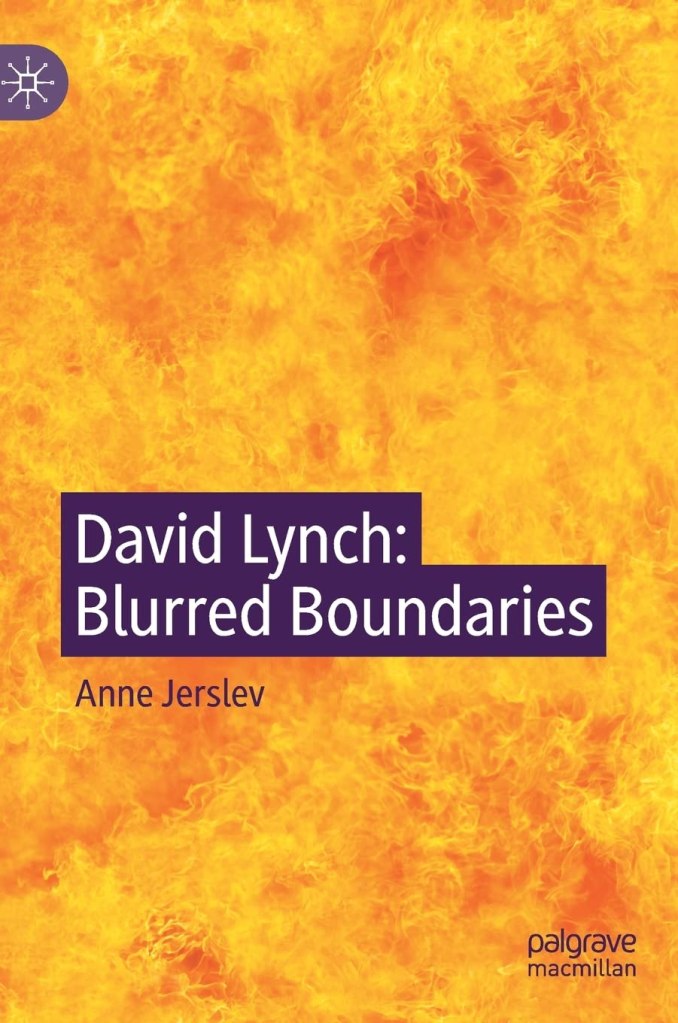
David Lynch: Blurred Boundaries by Anne Jerslev offers a strikingly comprehensive and original exploration of David Lynch’s multifaceted oeuvre, illuminating how this celebrated artist-director has, from the very beginning of his career, tirelessly tested and dissolved the boundaries separating film, television, photography, painting, drawing, music videos, commercials, and short experimental works. Through a thorough engagement with Lynch’s entire creative output, from his iconic feature films and the Twin Peaks series to his lesser-known work on the YouTube channel David Lynch Theater, the expansive Internet documentary The Interview Project, and the remarkable 2007 Paris exhibition The Air is on Fire, this book advances the crucial argument that no single medium or genre can claim primacy within Lynch’s body of work. Instead, each realm or format that Lynch touches is seen to vibrate with, to transform, and to enrich the others, fostering a dynamic intermedial dialogue that unfolds in layered and often fragmentary ways. Jerslev situates Lynch as a pioneering intermedia artist whose vision, deeply influenced by his foundational interest in painting, revolves around the plasticity of sound, image, and texture, and the evocative capacities of atmosphere.
In combining Lynch’s widely varied artistic practice, David Lynch: Blurred Boundaries immerses the reader in a discussion of how painting and drawing intrude upon and energize his cinematic images, and how the haptic sensibility of his music videos, commercials, and digital experiments interrupts conventional expectations of linear narrative. Anne Jerslev interprets these many pieces of Lynch’s work not as mere tangential efforts appended to a central filmography but as crucial, interwoven parts of a single ever-developing total artwork. Repeatedly, she demonstrates how, for Lynch, boundaries between one medium and another—or between one genre and another—are provocative sites of experimentation and discovery. Whether it is the merging of still and moving images in his paintings (some of which, as Lynch himself has suggested, can almost be said to move and breathe), or the blending of fact and fiction, documentary and dream in The Interview Project, or even the confluence of digital photography and abstract expression in his Distorted Nudes series, every artifact in Lynch’s output is implicated in this overarching struggle to blur distinctions and challenge unexamined certainties.
Drawing on carefully selected scholarly, philosophical, and aesthetic theories, Jerslev makes explicit the conceptual underpinnings of Lynch’s ongoing search for new means of representation. Throughout, the book treats not only Lynch’s cinematic narratives but also the intangible thickness of his worlds, the way they envelop viewers in thick curtains of sound, layered images, and elusive plot structures. Allister Mactaggart, author of The Film Paintings of David Lynch: Challenging Film Theory, notes in his commendation of this new study that Jerslev’s approach greatly enhances our understanding of the significance of these lesser-explored components of Lynch’s “highly creative art life” by arguing persuasively that each work contributes to “a continuing and expanding experimental total work of art.” Likewise, Will Scheibel, co-author (with Julie Grossman) of Twin Peaks (2020), highlights how Jerslev’s refocusing of our lens onto Lynch’s music videos, web documentary series, and installation work pushes us to think about Lynchian aesthetics in profoundly new ways. In so doing, Jerslev not only reveals how installations such as The Air is on Fire effectively become Lynch works in their own right, but also shows how such exhibitions and projects reflect Lynch’s fascination with that core philosophical question of how art can break through the usual demarcations of narrative, medium, and genre.
By giving due weight to exhibitions such as The Air is on Fire, Jerslev underscores her belief that one must dwell in the spaces where paintings, sketches, digital manipulations, soundscapes, and even bits of texts and found objects jostle side by side. The Air is on Fire, presented at the Fondation Cartier in 2007, emerges here as a stage upon which an all-encompassing Lynchian world is performed, with confounding architectural design, enveloping soundscapes, sudden bursts of color, and labyrinthine paths of visual fragments that the visitor is invited to tread. In Jerslev’s account, this monumental exhibition is no mere retrospective but is instead one of the vital central works of the entire Lynch canon. Just as she considers Twin Peaks: The Return to be a sweeping demonstration of Lynch’s enduring fascination with time, mystery, and blurred realities, so too does she identify The Air is on Fire as a prime demonstration of how tangible paintings, for Lynch, might be orchestrated like film sequences, filled with hidden portals that invite the viewer to slip in and out of strange atmospheres.
What is seen from Jerslev’s richly detailed analysis is that, for Lynch, forms and media are flexible containers that can be combined and recombined at will. The book shows how fragments of painting or sculpture crop up unexpectedly in film frames, how the scribbled texts on small drawings share conceptual DNA with Lynch’s short film experiments or animated series, and how the ephemeral interplay of photography and directorial composition is constantly shaped by the guiding impulse of the abstract, the mysterious, and the dreamlike. Andreas Halskov, author of TV Peaks: Twin Peaks and Modern Television Drama, praises Jerslev’s capacity to examine David Lynch in light of “fragments, textures, digital art and ambiguities,” thus allowing us to see how each corner of his work resonates with echoes of all the others. Jerslev’s scholarship, in addition to cataloging these resonances, draws on a philosophical perspective that, among other things, navigates the interplay between meaning and non-meaning, presence and absence, the real and the dream, and the uncanny and the sublime.
A vital contribution of this volume lies in its account of how Lynch crafts atmospheres across different mediums. Whether one is studying the distinct sense of foreboding in the dark corridors of Lost Highway, the jarring acoustic spaces of his short films, the melancholic hush of his factory photography, or the idiosyncratic dreamlike distortions of Crazy Clown Time, one recognizes that Lynch is continually summoning a realm in which soundtrack, image, color, and even the viewer’s own perceptual or bodily reactions are inextricably bound together. Jerslev attends to this phenomenon in great depth, demonstrating how the director’s fascination with texture—be it the crumbling textures of abandoned factories or the tactility of an oil-slicked body in a photograph—amounts to a sustained commentary on time, mortality, creativity, and the beautiful erosion of surfaces. In discussing the photograph series of decaying snowmen or the presence of wrinkled faces and aged skin in The Straight Story and Twin Peaks: The Return, Jerslev reveals that these images offer a crucial meditation on how time transforms matter and how Lynch’s aesthetic finds authenticity and richness in such transformations.
Also included into Jerslev’s study are illuminating discussions of Lynch’s embrace of digital tools, from his early ventures with the davidlynch.com website—home to short experiments and ephemeral sketches—to the fully digital film Inland Empire, which so profoundly distorts conventional viewing parameters and effectively annihilates the comforting boundaries that once kept dream separate from filmic real. Jerslev maintains that the digital realm, for Lynch, becomes another site of boundary-blurring, with images literally smeared, pixelated, layered, and partially effaced, as if the digital were less a medium for polished surfaces and more a container for illusions, illusions that can be stretched, warped, or compressed into new imaginative shapes.
It is indeed the philosophical heart of the book that will strike the reader as a major step forward in contemporary Lynch scholarship. By employing thinkers from fields such as phenomenology, visual studies, intermediality, and affect theory, Jerslev breaks open the question of how we might understand the swirl of dread, euphoria, and uncanny delight that so often attends the Lynch experience. Her aim is never to “decode” or “solve” Lynch’s mysteries in a single interpretive gesture but rather to demonstrate that these works beckon the viewer toward a labyrinth of partial meanings and ephemeral intensities. Bringing to bear the concept of the fragment—in a manner recalling the Romantic notion of incomplete totalities—she shows that Lynch’s devotion to dreamlike non-linearity and to splinters of narrative logic can be seen as a coherent ethic of creativity. Moments that appear disconnected or abrupt in the films or on the painter’s canvas turn out to be pivotal sites of meaning and feeling, holding open the space for the viewer’s own imaginative immersion.
As a result, this monograph reveals that the boundary-blurring ethos is not a superficial quirk but a profound statement of Lynch’s unwavering interest in discovering the subtle correspondences between mediums, images, and realities. The invitation is extended to each reader to follow the circuitous paths—through moving images, paintings, drawings, web-based projects, installation art, music performance, and more—and to sense how each path arrives ultimately at the same horizon: the potent, elusive, and sensorially charged realm we term Lynchian. Jerslev shows that in such a realm, the viewer is often left suspended between dream and waking reality, between a mode of classical storytelling and its abrupt dissolution, between what is defined and what is perpetually opaque.
David Lynch: Blurred Boundaries concludes by affirming its own core argument that, taken as a whole, Lynch’s oeuvre constitutes a vast experimental total work of art. Its shifting temporalities, its blurred categories, its commitment to the uncannily liminal, and its bold, almost obsessive creation of atmosphere all demonstrate the singularity of Lynch’s artistic ambition. This book firmly situates Anne Jerslev as one of the foremost authorities on David Lynch’s seemingly endless artistic expansions, recognizing her long-standing engagement with Lynch’s worlds, stretching back to her earliest writings on the subject. Jerslev’s enduring expertise allows her to identify and articulate the continuous lines of experiment and aesthetic invention that run through each of Lynch’s undertakings, no matter how large or small they appear. Her achievement here is further validated by the acclaim of scholars such as Allister Mactaggart, Andreas Halskov, and Will Scheibel, each of whom praises the wealth of insight Jerslev offers into Lynch’s “installational” modes, his “fragmentary” logic of storytelling, and his capacity to unsettle us in ways that remain incomparable in modern media.
Such depth and breadth of examination ensure that David Lynch: Blurred Boundaries will appeal to anyone intrigued by the complexities of contemporary media, by the dissolution of boundaries between the plastic arts and the moving image, by the refashioning of narrative conventions, and by the irreducible mysteries that arise when the abstract becomes tangible, or when dreamlike intensities spill into the carefully mapped terrain of the everyday. Equally, this study is an indispensable resource for specialists in film and media theory, art history, philosophy, and cultural studies who seek to understand the shifting forms and tonalities of multimedia storytelling. For, in the final analysis, Jerslev makes plain that David Lynch’s greatness lies in exactly that capacity to move seamlessly between media, to perform the strangest of experiments without ever forfeiting the potent emotional core that grips viewers and compels them to keep watching, listening, and wondering. This is precisely what comes alive on every page of David Lynch: Blurred Boundaries: a vivid demonstration that, to experience Lynch’s work is to grasp, however fleetingly, a mode of creativity that both resists and invites interpretation, a perpetual dance of confusion and clarity that refuses to settle comfortably within any known border or frame. And, like the best of Lynch’s images, the implications of Jerslev’s account linger long after one has closed the book, prompting renewed reflection on how it is that we, as viewers, inhabit this labyrinth of vision and sound, drawing us back again and again into the spellbinding multiplicity of the Lynchian universe.
 Simon Gros
Leave a comment