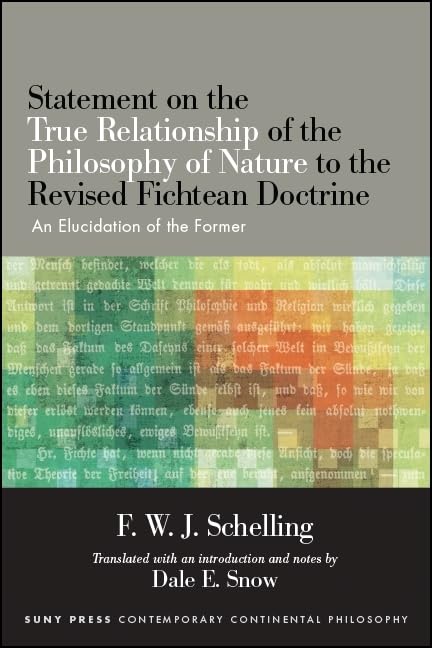
Friedrich Wilhelm Joseph Schelling’s Statement on the True Relationship of the Philosophy of Nature to the Revised Fichtean Doctrine is an impassioned philosophical treatise that encapsulates Schelling’s ultimate confrontation with Johann Gottlieb Fichte. Composed in 1806, this work stands not only as Schelling’s final major engagement with the philosophy of nature but also as a polemical reckoning born from a fractured intellectual alliance. In a tone sharpened by perceived betrayal and intellectual divergence, Schelling systematically dismantles Fichte’s evolving philosophical positions, targeting the latter’s mechanistic and reductive conception of nature.
At the heart of Schelling’s critique lies a deep disagreement over the nature of reality itself. Fichte’s transcendental idealism, Schelling argues, reduces nature to mere opposition—lifeless matter to be overcome by the self’s activity. For Fichte, nature is instrumental, a passive field that impedes and defines human freedom only by serving as the resistance the self must surmount. Schelling vehemently opposes this reduction, asserting instead that nature is not inert but vibrantly alive, an organic totality in which humanity is integrally embedded. This vision of nature as a dynamic, self-organizing whole aligns Schelling with later developments in ecological thought and environmental philosophy, wherein the interconnectedness of human beings and the natural world is a foundational principle.
The polemical nature of the work is evident in Schelling’s rhetorical strategy. He likens Fichte’s recent philosophical publications to Dante’s Divine Comedy, casting them respectively as the hell, purgatory, and illusory paradise of Fichtean thought. Through scathing analysis, Schelling accuses Fichte of perpetrating a philosophy grounded in subjective idealism and hollow abstraction, lacking the intuitive grasp of the living reality of nature. He contends that Fichte’s self-intuition—the cornerstone of his philosophy—is a circular and ultimately inadequate foundation for a comprehensive understanding of being. This critique touches on the broader debate within German Idealism concerning the adequacy of self-consciousness as the basis for all knowledge and existence.
Schelling’s text is not merely a personal attack but a key philosophical exposition that seeks to clarify the foundations of Naturphilosophie. He argues that the Enlightenment’s mechanistic view of nature renders it exploitable and devoid of intrinsic value, a perspective that Fichte, despite his revolutionary idealism, inadvertently perpetuates. By portraying nature as fundamentally unholy, irrational, and dead, Fichte’s system, according to Schelling, fails to recognize nature’s inherent vitality and its indispensable role in the unfolding of spirit.
This fundamental philosophical divide also manifests in Schelling’s exploration of the concept of Schwärmerei—a term historically used to deride ungrounded enthusiasm. Fichte accuses Schelling of engaging in mystical excess, yet Schelling ingeniously reverses this charge, suggesting that it is Fichte’s system, grounded in subjective abstraction without objective anchoring, that embodies true Schwärmerei. This rhetorical inversion serves to underscore the depth of their intellectual schism: where Fichte sees unwarranted mysticism, Schelling perceives a necessary and deep engagement with the living essence of nature.
Schelling’s defense of Naturphilosophie is also a defense of philosophy itself as a dynamic and integrative enterprise. He criticizes Fichte’s rigid separation of subject and object, advocating instead for a philosophy that acknowledges the identity of the ideal and the real. This identity philosophy posits that nature and mind are not two opposing realms but expressions of a single, living reality. In this framework, nature is not an external obstacle to be overcome but a vital, self-organizing system that mirrors the structures of thought and spirit.
Dale E. Snow’s translation and critical apparatus in this edition render Schelling’s rhetorically charged prose accessible to contemporary readers. Snow’s introduction provides the necessary historical and philosophical context, elucidating the personal and intellectual ruptures that culminated in this work. Extensive notes further clarify Schelling’s numerous references to Fichte’s writings and illuminate the subtleties of their philosophical confrontation.
Statement on the True Relationship of the Philosophy of Nature to the Revised Fichtean Doctrine is a monumental document in the history of German Idealism. It is both a passionate defense of the philosophy of nature and a rigorous critique of the limitations of transcendental idealism. Schelling’s vision anticipates later philosophical movements that seek to transcend the dualism of mind and nature, foreshadowing ecological and holistic approaches to understanding reality. His insistence on recognizing nature’s intrinsic vitality and its unity with human consciousness continues to resonate, offering profound insights into the perennial questions concerning humanity’s place within the natural world.
 Simon Gros
Leave a comment