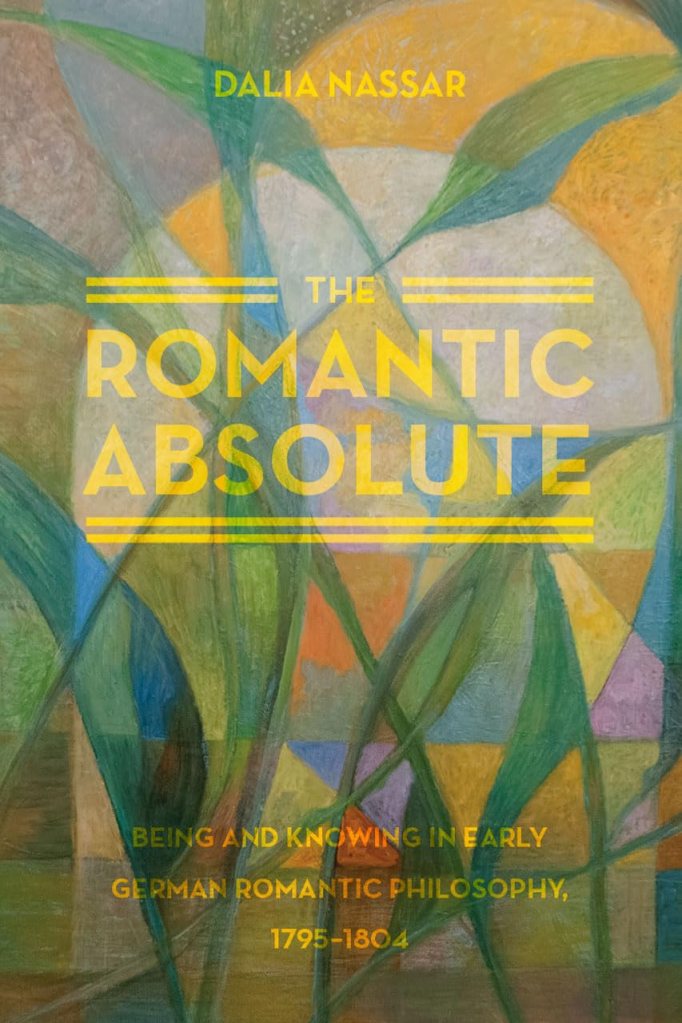
Dalia Nassar’s The Romantic Absolute offers an invaluable contribution to understanding the evolution of Romantic philosophy, particularly through its detailed analysis of three key figures—Novalis, Friedrich Schlegel, and Friedrich Schelling. Nassar’s work stands out not only for its intellectual rigor but also for its distinctive approach to understanding the intersection of epistemology and metaphysics in early German Romantic thought. Rather than reducing Romanticism to mere metaphysics or epistemology, she emphasizes its simultaneous concern with both, arguing that the Romantics conceived the absolute as a dynamic, relational principle linking the human subject to the world. This relational view is central to her study, which seeks to illuminate how these thinkers approached the absolute as a living, self-organizing reality.
Nassar’s interpretation of these thinkers, deeply rooted in the post-Kantian intellectual climate, brings forward an understanding of the absolute that was as much about the human capacity to know the world as it was about the metaphysical underpinnings of that world. In the wake of Kant’s critical philosophy, which questioned the limits of human knowledge, the Romantics found themselves grappling with the dual challenge of addressing both the epistemological and metaphysical questions Kant had left unresolved. The absolute, as conceived by Novalis, Schlegel, and Schelling, arises out of this tension and reflects a desire to reconcile the mind’s role in constituting reality with a more expansive metaphysical system.
For Novalis, the absolute is fundamentally relational, a principle that mediates between mind and nature, self and other, the intelligible and the sensible. Nassar traces how Novalis’s conception of the absolute evolves, particularly in his engagement with Fichte, Kant, and Hemsterhuis, drawing on Goethe’s influence in blending the empirical with the ideal. This synthesis leads Novalis to develop an “empirical idealism” that integrates the natural world into the philosophical system, highlighting a creative, dynamic process of knowledge formation that is deeply embedded in both human subjectivity and nature’s own creativity.
Schlegel’s contribution is similarly characterized by a relational understanding of the absolute, but with a distinct emphasis on historicity and moral activity. Schlegel, like Novalis, rejects any notion of an unconditioned, timeless ground, instead favoring a view of reciprocal determination that unfolds historically. This historical relationality not only shapes his metaphysical conception but also informs his theory of hermeneutics, where texts are understood in their historical and cultural contexts. Schlegel’s philosophy pushes against the limitations of transcendental systems, such as those offered by Fichte, by positing a conception of the absolute that remains open-ended and dialectical, always in the process of becoming.
Schelling’s philosophy, while often seen as more systematic than that of Novalis or Schlegel, shares a similar commitment to the idea of a relational absolute. Nassar examines how Schelling’s Naturphilosophie, influenced by Goethe’s views on metamorphosis and the self-productivity of nature, offers a view of the absolute as immanent to nature. For Schelling, the absolute is not an external, separate entity but is the very ground of nature’s unfolding. Nassar traces how Schelling’s thought evolves, particularly in his integration of Fichtean idealism and Spinozan pantheism, to create a more unified view of the absolute that transcends the mind-nature divide.
Nassar also addresses the ongoing debate about whether the Romantics can be considered philosophers proper, arguing that their philosophical positions are as sophisticated and genuine as those of their Idealist counterparts. Nassar sidesteps the debate over whether the Romantics were primarily metaphysicians or epistemologists, opting instead to show how they engaged both domains in their conception of the absolute. She argues that this dual approach, which blends the epistemological with the ontological, makes the Romantic project distinct from the more rigid systems of German Idealism.
Nassar’s book is significant not only for its scholarly analysis of Novalis, Schlegel, and Schelling, but also for its challenge to the traditional view of Romanticism as a mere literary or artistic movement. By demonstrating the philosophical depth of the Romantics’ engagement with the absolute, she positions Romanticism as a deeply philosophical endeavor, one that addresses the key intellectual concerns of its time. The Romantics, according to Nassar, were not simply responding to Kantian or Fichtean thought but were actively reshaping the philosophical landscape by offering a new conception of the absolute—one that was both epistemological and ontological, and that could not be reduced to the frameworks of previous systems.
However, while Nassar’s work provides an insightful and nuanced interpretation of these thinkers, it also invites further questions. One of the challenges in Nassar’s study is her attempt to unify the different conceptions of the absolute put forth by Novalis, Schlegel, and Schelling. Though they share a relational view of the absolute, the specific ways in which they develop this concept differ significantly. Nassar argues that their common commitment to a relational absolute unites them, but this raises questions about the extent to which Schelling’s more systematic approach fits within the Romantic model of thought that Nassar outlines. Moreover, the connection between their philosophical ideas and their literary works remains a subject of debate, particularly with respect to whether the Romantics should be viewed primarily as philosophers or as literary theorists engaging with philosophical problems through artistic means.
In this sense, Nassar’s book contributes to the larger project of re-evaluating Romanticism in the context of German Idealism, challenging the reductionist view that sees the Romantics merely as precursors to Hegelian philosophy. While Nassar successfully rescues Romanticism from this reductive interpretation, her focus on the philosophical dimensions of their work leaves open the question of the role of literary form in Romantic philosophy. This issue was explored in depth in The Literary Absolute by Lacoue-Labarthe and Nancy, whose work highlights the literary and critical dimensions of the Romantics’ engagement with the absolute. Nassar’s failure to engage more directly with this perspective leaves room for further exploration of how Romantic literature itself can be seen as a response to philosophical problems, particularly those raised by Kant and Fichte.
Nassar’s The Romantic Absolute offers a sophisticated and invaluable reading of early German Romanticism, shedding light on the intellectual complexity of Novalis, Schlegel, and Schelling. Her work challenges traditional interpretations of the movement and positions it as a crucial intellectual force that straddled the boundary between metaphysics, epistemology, and aesthetics. However, her focus on the philosophical dimensions of the Romantics’ thought also raises important questions about the interplay between philosophy and literary form in the Romantic period, an area that warrants further investigation. Nevertheless, Nassar’s study is a major contribution to the scholarship on German Romanticism and provides a compelling framework for understanding the movement’s intellectual legacy.
 Simon Gros
Leave a comment