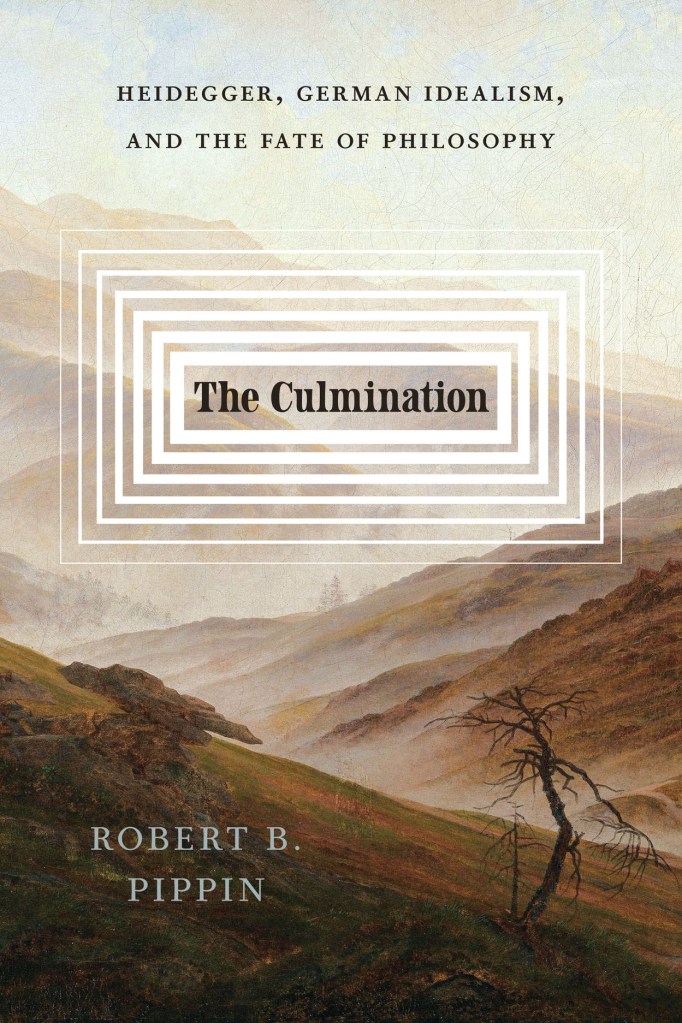
The Culmination: Heidegger, German Idealism, and the Fate of Philosophy by Robert B. Pippin is an exhaustive engagement with Martin Heidegger’s provocative claim that Western philosophy reached its culmination—and perhaps its collapse—in the German Idealist tradition, particularly in the monumental works of Kant and Hegel. Pippin, a preeminent scholar of German Idealism, examines Heidegger’s penetrating critique of this tradition, going into the implications of its purported culmination for the trajectory and ultimate destiny of Western rationalist thought. By situating Heidegger’s philosophy within the larger arc of Western intellectual history, Pippin unpacks the philosophical stakes of Heidegger’s challenge and its enduring relevance to contemporary debates about the nature and limits of reason, the disclosure of meaning, and the essence of philosophy itself.
At the base of Pippin’s investigation lies Heidegger’s contention that the German Idealist tradition represents both the zenith and the exhaustion of a metaphysical project that began with Plato and persisted through the early modern period. This project, characterized by its commitment to the fundamental intelligibility of being through rational, discursive thought, reaches its most ambitious expression in Hegel’s claim to have achieved absolute knowing—a comprehensive reconciliation of thought and being. Pippin deftly explores Heidegger’s reading of Hegel, portraying the latter’s ‘Science of Logic’ as the culmination of metaphysics and, paradoxically, as the site where its inherent limitations are laid bare. Heidegger’s critique, as Pippin demonstrates, is not merely a rejection of Hegel’s system but a revelation of the deeper assumptions that have guided Western philosophy from its inception, assumptions that Heidegger argues have led to a profound forgetting of the fundamental question of the meaning of being.
Pippin’s interpretation emphasizes the existential stakes of Heidegger’s critique, particularly the challenge it poses to the rationalist tradition’s equation of being with intelligibility. According to Heidegger, the dominance of this equation has occluded non-rational dimensions of human existence, leading to a distorted and impoverished understanding of meaning. In this light, Pippin examines Heidegger’s insistence on the finitude of human reason and his call for a new way of thinking that goes beyond the metaphysical tradition’s fixation on cognition. Heidegger’s alternative—a hermeneutic phenomenology that seeks to uncover the pre-conceptual conditions of meaning—challenges philosophy to reimagine its role as a disclosure of being rather than a theoretical mastery of it.
Central to Pippin’s analysis is his exploration of the dialogical relationship between Heidegger and Kant. While Heidegger initially celebrated Kant for emphasizing the finitude of human understanding in the first edition of the Critique of Pure Reason, he later criticized Kant for failing to fully confront the implications of this insight. Pippin traces how Heidegger’s shifting interpretation of Kant reveals the stakes of Heidegger’s own philosophical ambitions, particularly his critique of the transcendental subject and his efforts to recover a more primordial sense of being. In turn, Pippin highlights the ways in which Heidegger’s engagement with Kant illuminates the broader tensions within German Idealism, especially the tension between the autonomy of reason and the situatedness of human existence.
Pippin’s treatment of Heidegger’s reading of Hegel is equally compelling. He argues that Heidegger’s critique of Hegel’s system as the culmination of metaphysics rests on a fundamental challenge to the rationalist tradition’s self-understanding. For Heidegger, Hegel’s ‘absolute knowing’ is both the fulfilment of metaphysics’ aspirations and the disclosure of its failure to account for the pre-theoretical conditions of meaning. Pippin contends that Heidegger’s critique exposes a profound flaw in the rationalist project: its assumption that the intelligibility of being can be fully comprehended through conceptual thought. This assumption, Heidegger argues, ignores the historical and existential conditions under which being is disclosed to finite human beings.
Through his engagement with Heidegger’s thought, Pippin also raises critical questions about the future of philosophy. Is Heidegger’s critique of German Idealism a fatal indictment of the metaphysical tradition, or does it open new possibilities for philosophical inquiry? Can philosophy move beyond the rationalist framework without abandoning its commitment to understanding the human condition? In addressing these questions, Pippin situates Heidegger’s critique within the broader context of 20th-century European philosophy, engaging with figures such as Nietzsche, Derrida, and Levinas who grappled with similar issues of finitude, meaning, and the limits of reason.
The Culmination is not merely a study of Heidegger’s critique but a masterful intervention in the ongoing debate about the relevance and viability of philosophy in the modern age. By carefully reconstructing Heidegger’s arguments and situating them within the broader history of Western thought, Pippin offers a profound meditation on the stakes of philosophical inquiry. His analysis reveals the enduring significance of Heidegger’s challenge to the rationalist tradition and the possibilities it opens for a renewed engagement with the sources of meaning in human life.
This book is an indispensable resource for scholars of Heidegger, German Idealism, and the history of Western philosophy. With its depth, rigor, and philosophical acumen, it provides a compelling account of the fate of philosophy in the wake of Heidegger’s critique and offers a vision for its future that remains faithful to the existential and theoretical insights of the tradition it seeks to renew.
 Simon Gros
Leave a comment