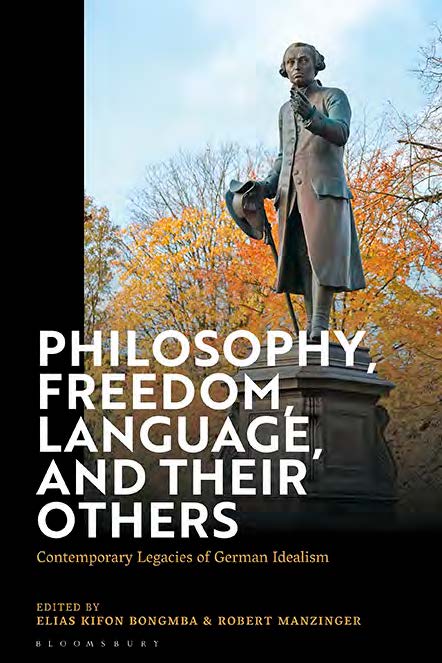
Philosophy, Freedom, Language, and Their Others: Contemporary Legacies of German Idealism is an ambitious exploration of freedom, philosophy, and their interconnections with language, politics, religion, aesthetics, and ethics. Anchored in the conceptual frameworks of Kantian and Hegelian thought, this anthology does more than merely revisit German Idealism; it transforms the legacy of this philosophical tradition into a vibrant and dynamic discourse suited for contemporary inquiries.
Edited by Elias Kifon Bongmba and Robert Manzinger, the volume offers a kaleidoscopic engagement with the philosophical concept of freedom as it intersects with language and various cultural, ethical, and political dimensions. The essays collectively reflect an unyielding commitment to philosophy’s critical vocation to interrogate its own boundaries and extend its insights to disciplines beyond its conventional confines. This methodological openness mirrors the interdisciplinary ethos of Jere P. Surber, to whom the volume pays tribute, celebrating his pedagogical and intellectual legacy.
The book begins with an examination of German Idealism’s foundational contributions to understanding freedom as a synthesis of reason, autonomy, and self-determination. In the essays by William Maker and Stephen Houlgate, the dialectics of freedom are unpacked through Hegel’s speculative sentences, with attention to how they challenge presuppositional thinking and highlight the transformative unity of subject and predicate. Jeffrey Reid deepens this by illuminating the political implications of these speculative structures, demonstrating how Hegel’s grammar of freedom transcends mere abstract theorization to engage with real-world phenomena, such as social hierarchy and the dialectics of domination and subservience.
The anthology’s engagement with language is not confined to Hegelian or Kantian frameworks but is enriched by the linguistic turn in continental philosophy. Frank Schalow revisits Kant’s Critique of Judgment to reveal the intersection of freedom and aesthetics, while other contributors, such as Andreas Dörner and Ludgera Vogt, explore how media and aesthetics mediate our experiences of freedom in contemporary society. Language emerges not merely as a medium but as a dynamic field of meaning production, whose speculative and hermeneutic dimensions shape human self-understanding and action.
By including perspectives from critical theory, ancient philosophy, and modern political thought, the volume’s scope extends far beyond classical German Idealism. Essays by Gary Percesepe and Jared Niefts address the politics of representation, memory, and cultural patrimony, illustrating the enduring relevance of philosophical freedom in understanding socio-political structures, from Guy Debord’s spectacle society to Nelson Mandela’s ethics of reconciliation. These essays reveal that freedom is neither an abstract ideal nor an immutable essence but a dynamic process of negotiation, resistance, and transformation within historical and cultural contexts.
In its exploration of philosophy’s “others,” the book engages a diverse array of topics and disciplines. Robert Manzinger’s reflection on Kierkegaard’s humour illuminates the boundaries between philosophy and religion, while Miglena Dikova-Milanova investigates how Kant’s sublime resonates within contemporary literature. These essays underscore the necessity of interdisciplinary dialogues, emphasizing that philosophy’s vitality lies in its capacity to engage other modes of thought while maintaining its critical and speculative rigor.
In this anthology is a shared commitment to the emancipatory potential of thought. Philosophy, as articulated by the contributors, is a transformative practice that intersects with lived experience. It is through such intersections—whether in the ethical dimensions of Mandela’s politics, the speculative ambiguity of Hegel’s grammar, or the media’s role in shaping public consciousness—that the book affirms freedom as a living, contested, and dialogical process.
Philosophy, Freedom, Language, and Their Others exemplifies the best of contemporary philosophical scholarship, uniting historical analysis with bold theoretical innovation. It shows the enduring relevance of German Idealism and its capacity to inform and inspire new ways of thinking about freedom, language, and their interplay with the manifold dimensions of human existence. For anyone committed to understanding the philosophical underpinnings of freedom in today’s world, this volume is a must read.
 Simon Gros
Leave a comment