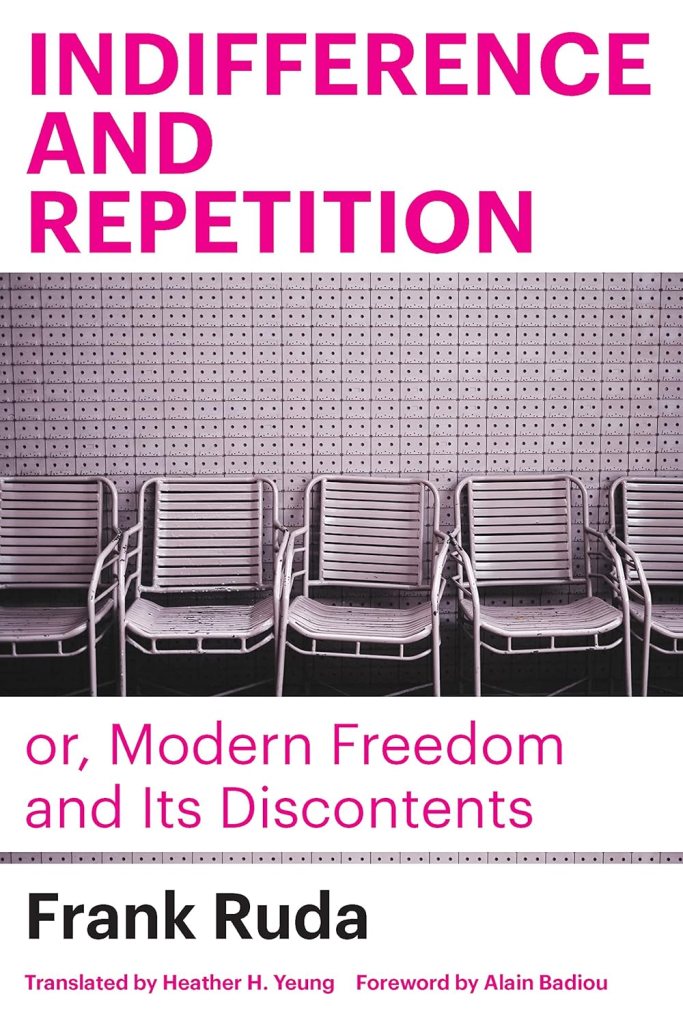
Indifference and Repetition; or, Modern Freedom and Its Discontents by Frank Ruda presents a densely argued analysis of the philosophical dimensions of freedom as they intersect with the dynamics of modernity and capitalism. Through a detailed engagement with the thought of Descartes, Kant, Hegel, and Marx, Ruda uncovers the persistent tension between freedom as an aspirational ideal and its misrepresentation as a natural possession. This misrepresentation, Ruda argues, underpins an ideological structure that reinforces unfreedom even as it proclaims liberation.
Ruda’s central focus is the concept of indifference, a mode of thought and action that arises when freedom is mistaken for an inherent capacity or static attribute. Indifference reduces freedom to the arbitrariness of choice, a framing that obscures its ethical and existential dimensions. By tracing the development of this misunderstanding through the history of modern philosophy, Ruda demonstrates how freedom, when viewed as given, becomes a vehicle for domination rather than agency. Philosophers across centuries have identified and critiqued this problem, offering insights into how freedom’s ideological appropriation serves broader systems of power, particularly within capitalist frameworks.
The book examines how modern philosophy positions freedom as a site of struggle against indifference. Descartes’ reflections on the “freedom of indifference,” Kant’s confrontation with natural necessity, Hegel’s analysis of the alienation within freedom itself, and Marx’s critique of ideological freedom illustrate how these thinkers addressed freedom not as a possession but as an ongoing process of negation. For Ruda, this negation is the refusal to accept the given as final or immutable—a perspective that disrupts the complacency of inherited forms of thought.
Ruda situates this philosophical genealogy in the context of contemporary life, where algorithms, virtual interactions, and consumerist ideologies have transformed the conditions of freedom. The illusion of choice, perpetuated by the mechanisms of digital capitalism, mirrors the historical structures critiqued by rationalist philosophy. Freedom appears as a collection of prepackaged options, detached from genuine agency or the possibility of transformation. Ruda’s analysis reveals how these conditions perpetuate a deeper indifference, eroding the capacity for meaningful engagement with the self, others, and the world.
Through his examination, Ruda advances the idea that freedom must be understood as a dynamic negation of what is given, rather than a simple affirmation of choices presented. This perspective challenges entrenched assumptions about individuality, agency, and autonomy, encouraging a rethinking of freedom as a lived, relational, and transformative practice. By aligning this rethinking with the tools of modern philosophical rationalism, Ruda extends the legacy of critique into the present, offering a framework for resisting the ideological reduction of freedom to mere capacity or possession.
Indifference and Repetition explores the intersection of freedom and indifference with a sustained commitment to philosophical rigor. Ruda engages with canonical texts while also addressing contemporary concerns, weaving historical insights into a broader critique of modernity’s ideological frameworks. The work does not simply diagnose the problems of freedom in modernity, it systematically unpacks the conditions that sustain these problems and offers pathways for rethinking freedom in light of them.
This book is a comprehensive and challenging investigation into the philosophical and practical implications of freedom, indifference, and their misinterpretations. It serves as an essential text for those interested in philosophy, critical theory, and political thought, combining a deep engagement with the history of ideas and a timely relevance to the conditions of contemporary life. By examining the genealogy and persistence of indifference, Ruda reveals how freedom remains a contested and vital concept in the modern age, demanding ongoing critical engagement.
 Simon Gros
Leave a comment