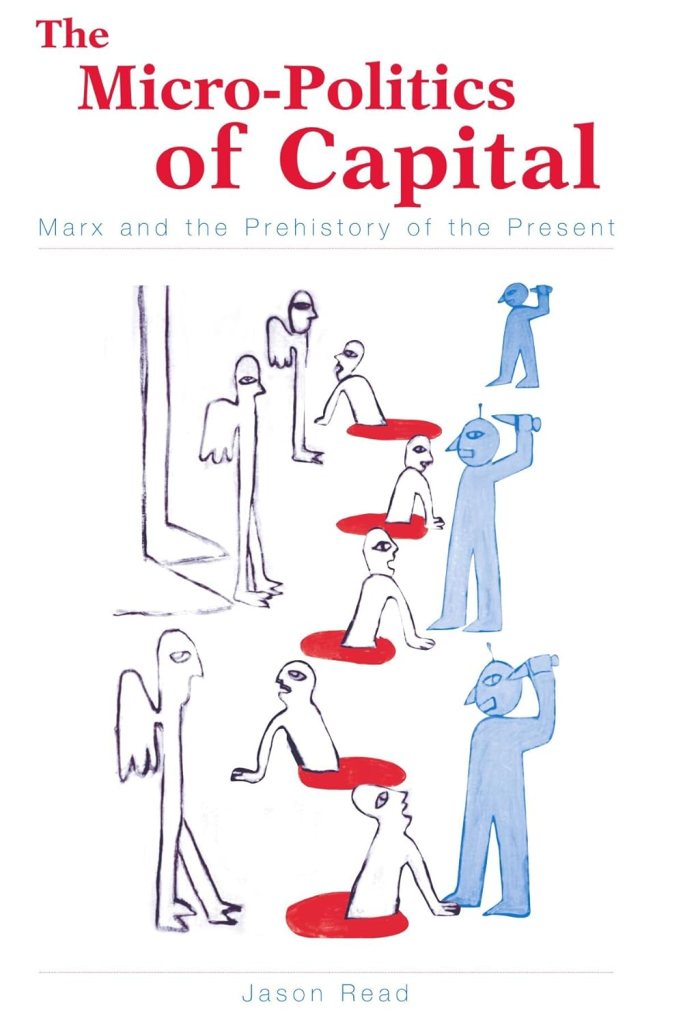
Jason Read’s The Micro-Politics of Capital: Marx and the Prehistory of the Present is a ground-breaking philosophical work that reconfigures Marx’s historical materialism through the prism of contemporary interrogations into subjectivity, illuminating the production of desire, belief, and knowledge under capitalism. This ambitious project bridges the divide between classical Marxism and poststructuralist thought, revealing their latent affinities and offering a critique of the transformations capitalism has wrought upon society, culture, and individuality.
At the heart of Read’s analysis is a radical re-reading of Marx’s concept of the mode of production, reinterpreted as not merely an economic mechanism but a broader framework that accounts for the formation of subjectivity within specific historical contexts. This theoretical innovation resists any reductive economic determinism, positing instead that capitalism’s development involves the continual constitution and dissolution of social, cultural, and individual formations. Read demonstrates that Marx’s thought, far from being antiquated or economistic, contains within it a nascent theory of the production of subjectivity—one that has only become more urgent in light of contemporary developments in critical theory and the global economy.
Read combines Marx’s insights with those of Althusser, Foucault, Deleuze, Guattari, and Negri, crafting an intellectual variety that challenges the dichotomy between production and reproduction, base and superstructure. By placing Marx in dialogue with poststructuralist thinkers, Read excavates the micro-political dimensions of capital—the ways in which capitalism infiltrates and reconfigures every aspect of life, from the factory floor to the most intimate domains of belief and desire. This is a reorientation of Marxism itself, emphasizing how the antagonistic forces of production and labour operate within the nexus of culture, subjectivity, and power.
The book traces the evolution of capitalism from its “formal subsumption,” in which pre-capitalist social forms were subordinated to the logic of the market, to its “real subsumption,” wherein all facets of life—knowledge, communication, and even affect—are directly harnessed for the extraction of surplus value. Read shows how this transition marks a key shift in the locus of exploitation and struggle, moving beyond the factory to encompass society as a whole. In doing so, he situates Marx’s concepts of living labor and abstract labor within a broader philosophical framework, elucidating their relevance to the postmodern condition.
What distinguishes Read’s analysis is his ability to merge diverse intellectual traditions without reducing them to a singular framework. He draws on Althusser’s notion of immanent causality to critique the reduction of economic processes to deterministic forces while simultaneously engaging with Negri’s autonomist Marxism to foreground the productive and resistant capacities of labor. These dual influences enable Read to explore how subjectivity is simultaneously produced by and resistant to the mechanisms of capitalist valorization. Subjectivity, as Read compellingly argues, is not a passive effect of economic structures but an active site of conflict, negotiation, and transformation.
The book’s theoretical audacity is matched by its historical scope. Read revisits Marx’s discussions of primitive accumulation and pre-capitalist economic formations, demonstrating how the violent processes that gave rise to capitalism continue to operate in new forms. The expropriation of common lands, the imposition of wage labor, and the transformation of traditional social relations are not merely historical events but ongoing processes that have adapted to the neoliberal era. Today, as Read observes, capital colonizes not just physical resources but the very fabric of social life, from genetic codes to digital networks.
Read engages with Foucault’s concept of disciplinary power and Deleuze and Guattari’s notion of assemblages, elucidating how the production of subjectivity under capitalism is deeply interconnected with mechanisms of control and governance. Yet, unlike some poststructuralist critiques, Read refuses to abandon the centrality of class struggle. Instead, he reconceptualizes it, showing how the conflict between labor and capital manifests in the production of knowledge, desire, and sociality itself. This reframing not only revitalizes Marxist theory but also points toward new forms of resistance that are attuned to the complexities of contemporary capitalism.
Read’s engagement with the “fragment on machines” from Marx’s Grundrisse is particularly interesting. Here, he explores the transition from machinery as fixed capital to subjectivity as the central productive force under postmodern capitalism. This shift, Read argues, represents both a new form of exploitation and a potential site of liberation. By emphasizing the role of cooperative networks, communication, and intellectual labor, Read highlights the ambivalence of subjectivity as both a tool of capitalist domination and a source of collective power.
The Micro-Politics of Capital urges us to rethink the conditions of possibility for a radical politics that can confront and subvert the pervasive logics of capitalism. Read’s analysis of the production of subjectivity, far from being abstract or detached, offers insights into the lived realities of neoliberalism and the potential for emancipatory struggle.
For readers willing to engage with its theoretical density and historical depth, The Micro-Politics of Capital offers an unparalleled exploration of the intersections between Marxism and poststructuralism. It is a vital resource for anyone seeking to understand the complexities of capitalist modernity and the possibilities for its transformation. By rethinking Marx in light of contemporary critical theory, Read not only demonstrates the continued relevance of Marx’s thought but also provides a powerful framework for addressing the challenges of our time.
 Simon Gros
Leave a comment