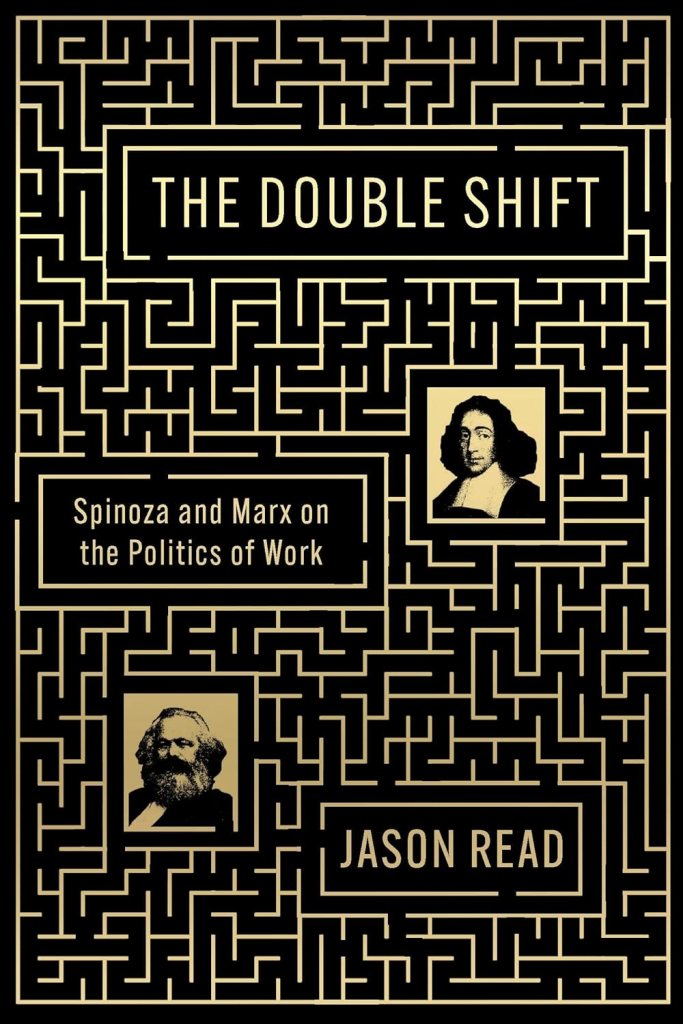
The The Double Shift: Spinoza and Marx on the Politics of Work by Jason Read is an investigation into the entangled realities of labour, ideology, and political economy as experienced within the structures of late capitalism. At the intersection of Spinozist philosophy and Marxist critique, Read presents a variety of thought that transcends conventional disciplinary boundaries, engaging the reader in an exploration of work as a pivotal axis of human existence, ethical valuation, and social organization. This book interrogates the affective, ideological, and material underpinnings that compel individuals to embrace, even valorise, the hardships of work, often against their own liberation.
In a world defined by precarious wages, exploitative gig economies, and the erosion of traditional labour protections, Read unravels the paradox of why individuals persist in defending their exploitation as if it were synonymous with freedom. Drawing upon Spinoza’s incisive question—why people “fight for their servitude as though it were salvation”—and Marx’s enduring critique of alienation, Read excavates the ideological and affective attachments that bind individuals to the tribulations of labour. This investigation is grounded in an expansive theoretical framework that juxtaposes Marx and Spinoza with figures like Plato, Hegel, and Arendt, while also engaging contemporary thinkers and movements in Italian and French critical theory.
The book offers an account of “negative solidarity,” a term Read uses to describe the current ideological regime in which the difficulties of work are internalized and celebrated rather than challenged. This perverse solidarity is manifest in widespread cultural phenomena: the glorification of capitalists as “job creators,” the moral policing of those deemed insufficiently industrious, and the valorisation of suffering as a marker of authenticity and worth. Through a Spinozist-Marxist lens, Read illustrates how this dynamic fosters an ethical and political allegiance to the very conditions of subjugation.
What distinguishes The Double Shift is its insistence on engaging with both philosophical abstraction and the lived realities of work under capitalism. Read situates his analysis in the concrete, drawing upon an array of cultural artifacts—from the melancholic critique of office labour in Office Space to the existential dilemmas of identity and mastery explored in Breaking Bad and Better Call Saul. These cultural texts are not mere illustrations but integral components of the book’s argument, revealing the pervasive and insidious ways in which labour ideology is both reflected and reproduced in popular imagination. Through these case studies, Read contends that the modern obsession with “hard work” as a path to salvation has transformed work into an almost mythological force, eclipsing collective political action as a means of societal transformation.
The book advances a tripartite argument about the immanence of work to economics, politics, and ideology. Read unpacks the “double shifts” that structure this immanence: the interplay between economics and politics, between material conditions and ideological constructions, and between praxis (action) and poiesis (creation). These shifts reveal how labor mediates the relationship between individual subjectivity and the broader social order. Drawing on Spinoza’s concept of immanence, Read argues that the relations of production and reproduction in capitalism are not external to the individual but are lived, felt, and experienced as intrinsic to one’s very being.
The theoretical centerpiece of the book is its dialogue between Marx and Spinoza. Read resists reductive comparisons or oppositional readings, instead articulating their intersection as a dynamic framework for rethinking ideology, subjectivity, and power. For both thinkers, practical activity—work—forms the basis of human consciousness and social existence. Yet, as Read demonstrates, this practical orientation is also the site of mystification, where ideology operates not merely as false consciousness but as an embodied, affective reality. Spinoza’s insistence on the materiality of imagination and affects provides a crucial supplement to Marx’s critique of ideology, allowing Read to illuminate how labor under capitalism is experienced as both an imposition and a source of meaning.
Read’s account of labour as a “real abstraction” underscores its dual role as both a site of alienation and a potential ground for solidarity. He traces how abstract labour—characterized by its indifference to particular tasks or identities—becomes the basis for a universalizing ethic of productivity. This ethic, however, is fraught with contradictions, as it simultaneously enables social recognition and enforces a relentless drive for exploitation. In this respect, Read extends Marx’s analysis of alienation into the realm of affect, showing how work becomes a source of pride, identity, and even desire, despite its dehumanizing conditions.
The book culminates in a provocative vision for transforming the collective imagination of work. Rejecting the resignation of “negative solidarity,” Read advocates for an affirmative and transformative solidarity that recognizes work as a site of subjugation rather than salvation. This requires not only a critique of the material conditions of labour but also a reconfiguration of its affective and imaginative dimensions. By engaging with speculative texts like Sorry to Bother You, Read gestures toward the possibility of an emancipatory politics that contests the ideological and emotional hold of work, envisioning new modes of collective action and social belonging.
In The Double Shift, Jason Read delivers an intellectual tour de force, a synthesis of philosophy, cultural critique, and political theory that is as accessible as it is erudite. This book is indispensable for anyone seeking to understand the contradictions of labour in contemporary capitalism and the possibilities for its transformation. More than a critique, it is an invitation to rethink the politics of work, to challenge its ideological grip, and to imagine a world where human flourishing is not subordinated to the imperatives of labour and capital.
 Simon Gros
Leave a comment