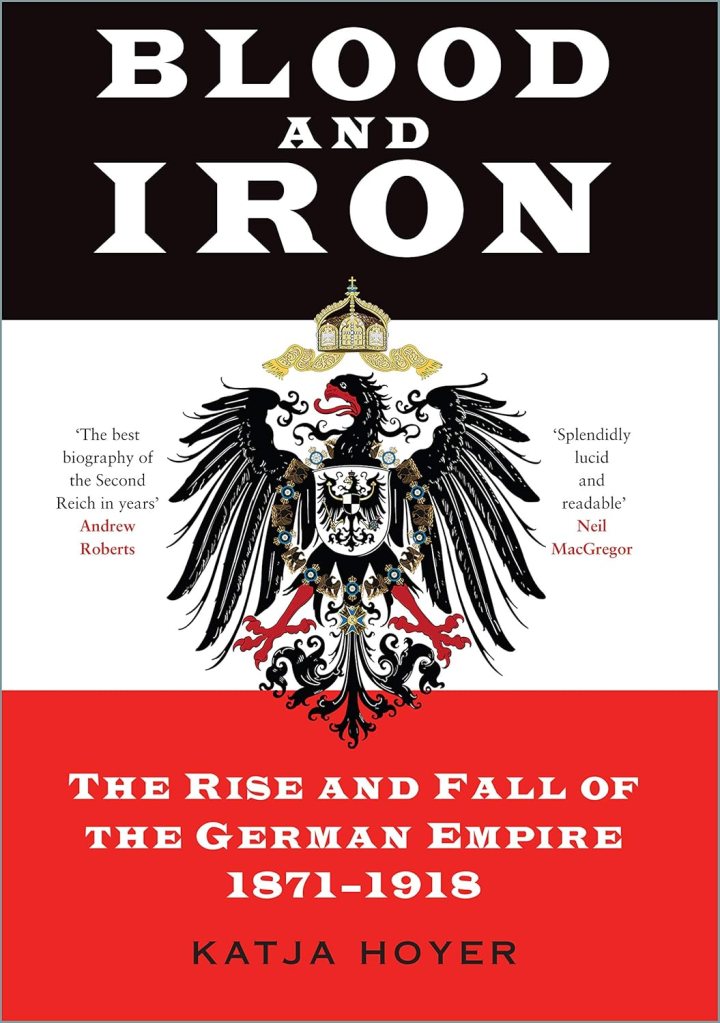
Blood and Iron: The Rise and Fall of the German Empire 1871–1918 by Katja Hoyer offers an intensely detailed analysis of a pivotal epoch in European history, where the relentless currents of power, identity, and realpolitik converged to shape the German Empire from its inception in 1871 to its demise amidst the chaos of the First World War. Through Hoyer’s research and masterful narrative, this volume transcends the conventional bounds of historical biography, situating the Second Reich as not merely a political entity but as the epicentre of a transformative and tragic trajectory that would define modern Europe.
The work begins by framing the very notion of Germany as an idea rather than a unified nation, a conceptual struggle that predates its political birth. Hoyer invites readers to witness the tumultuous ascension of Otto von Bismarck, the Iron Chancellor whose formidable will and unrelenting pragmatism forged a German identity from the disparate and often fractious states of the Confederation. Through a detailed recounting of the Franco-Prussian War and the fateful proclamation of the empire in the Hall of Mirrors at Versailles, Hoyer encapsulates the duality of Bismarck’s Germany: a nation born of conquest, yet perpetually struggling to reconcile its newfound unity with the cultural, religious, and regional pluralities that threatened to tear it apart.
Hoyer goes deeply into the essence of Bismarckian realpolitik, illustrating how the architect of German unification masterfully manipulated external conflicts and internal divisions to preserve his fragile creation. She vividly portrays Bismarck’s shrewd manoeuvrings against Austria and Denmark, his calculated engagement with the Kulturkampf to secularize and centralize authority, and his relentless suppression of socialist movements to maintain order. The narrative reveals a nation-state glued together by external conflict and internal adversaries, a mosaic held in tenuous cohesion by the blood of wars and the iron will of its leaders.
As the focus shifts to the reign of Kaiser Wilhelm II, Hoyer unpacks the tragic unraveling of the empire under a leader less adept at navigating the complex dynamics of power. Wilhelm’s impetuous quest for global prestige—his infamous pursuit of “a place in the sun”—reveals the inherent contradictions of an empire defined by militarism and expansionist aspirations, yet unable to sustain the ideological and infrastructural stability required for such ambitions. The narrative crescendos with the geopolitical miscalculations and rising tensions that culminate in the First World War, a conflict that would expose and exacerbate the inherent weaknesses of the Second Reich.
Hoyer’s work is not merely an account of events but a deep reflection on the philosophical underpinnings of nationalism, identity, and statehood. She examines the intellectual currents of 19th-century Germany—the romanticism of the Brothers Grimm, the idealism of Fichte and Hegel, and the revolutionary fervour of 1848—and situates them within the broader tapestry of German cultural and political development. These intellectual roots, combined with the industrial and economic might of the empire, provide the backdrop against which the tensions of class, religion, and region play out in a narrative that is as much about the German psyche as it is about the nation-state.
The final chapters address the catastrophic unravelling of the Second Reich during the First World War, where the very forces that had forged the empire—militarism, nationalism, and industrial strength—became instruments of its undoing. Hoyer’s account of the war is unflinching, capturing the devastating human cost, the internal fractures, and the ultimate collapse that left Germany humiliated and vulnerable to the destructive currents of the 20th century.
Through her rich and evocative prose, Hoyer constructs a narrative that is both sweeping and intimate, illuminating the grand historical forces that shaped the German Empire while grounding her account in the lives, decisions, and ideologies of the individuals who steered its course. The book is a monumental achievement, combining academic rigor with an accessible and engaging style, making it an indispensable resource for scholars and general readers alike.
Blood and Iron is more than a history of the German Empire; it is an inquiry into the nature of power, the fragility of unity, and the relentless tensions between ideals and realities that define the human condition. Hoyer’s work stands as a testament to the enduring relevance of this period, offering insights into the forces that continue to shape modern Europe and the world at large. It is, as Andrew Roberts aptly describes, “the essential account” of a chapter of history that resonates with urgency and significance to this day.
 Simon Gros
Leave a comment