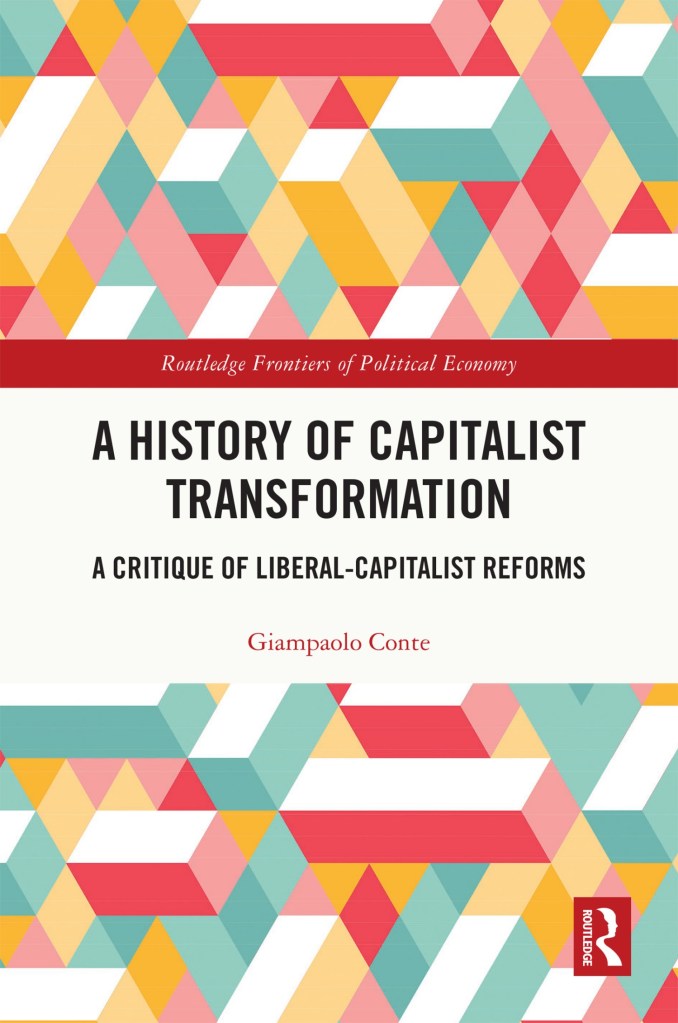
Giampaolo Conte’s A History of Capitalist Transformation: A Critique of Liberal-Capitalist Reforms is an exhaustive exploration of the structural mechanisms that have historically underpinned and perpetuated the liberal-capitalist world order. The book scrutinizes the ideological and material frameworks that have defined capitalist expansion from the onset of the Industrial Revolution to the neoliberal reforms of the late twentieth and early twenty-first centuries. Conte analyses the historical, economic, and socio-political transformations enacted through reformist policies, revealing their dual character as both instruments of global integration and engines of systemic inequality.
At the heart of Conte’s analysis is the concept of “liberal-capitalist reformism,” a historically contingent process by which dominant hegemonic powers – first Britain and later the United States – orchestrated the integration of semi-peripheral states into the capitalist world-economy. These reforms, ostensibly framed as progressive and necessary for modernization, emerge in Conte’s telling as tools of coercion. Their purpose: to universalize capitalist norms, enforce free trade, and impose institutional structures favourable to the accumulation of capital and the perpetuation of the ruling élites’ dominance. In doing so, they ensured the subjugation of peripheral and semi-peripheral states while preserving the hegemonic power’s supremacy within the global order.
Conte traces the ideological lineage of these reforms, drawing on the intellectual contributions of thinkers such as Karl Polanyi, Antonio Gramsci, and Immanuel Wallerstein. He situates the reforms within the broader trajectory of capitalist development, from the laissez-faire policies of classical liberalism to the coercive financial restructuring of neoliberalism. At every stage, Conte exposes the inherent contradictions between the ideals of freedom and progress that liberalism professes and the economic and social dislocations it enacts. This duality, he argues, reveals a key tension between the rhetoric of modernization and the realities of exploitation and dependency.
The book provides a richly detailed historical narrative, examining case studies from the Ottoman Empire, Egypt, and China during Polanyi’s “long nineteenth century,” as well as the structural adjustments imposed on European states in the aftermath of the 2008 financial crisis. Through these examples, Conte demonstrates how liberal-capitalist reforms have consistently facilitated the extraction of surplus value, the consolidation of élite power, and the perpetuation of global inequalities. These reforms, he contends, are not neutral mechanisms of economic modernization but deeply political interventions designed to reshape social orders in alignment with the imperatives of capital.
Conte’s analysis goes into the class dynamics that underpin reformist policies. Drawing on Gramsci’s theory of hegemony, he elucidates how the bourgeoisie, as the dominant social class within hegemonic states, has exported its economic and cultural logic to semi-peripheral societies. The reforms serve as a means of fostering alliances with emerging capitalist élites in these regions, co-opting them into the global capitalist framework while marginalizing traditional and counter-hegemonic forces. In this context, liberal-capitalist reforms become an instrument of what Conte describes as “vertical and horizontal integration,” binding domestic economies to the global market and subordinating local sovereignties to the dictates of international capital.
Conte explores the role of debt as a mechanism of control, highlighting how financial dependence has been leveraged to compel peripheral states to adopt reforms favourable to foreign creditors. The accumulation of public debt, he argues, not only erodes national sovereignty but also entrenches structural inequalities by diverting wealth from debtor nations to creditor powers. This dynamic, rooted in the asymmetries of global finance, underscores the systemic nature of the liberal-capitalist order, in which the economic interests of hegemonic states are secured through the subjugation of weaker economies.
The book’s theoretical framework draws extensively on world-systems theory, unequal exchange theory, and the longue durée perspective of Braudel and Wallerstein. Conte synthesizes these approaches to construct a comprehensive account of the capitalist world-economy, emphasizing the centrality of reformist interventions in maintaining its coherence and perpetuating its hierarchies. He argues that reforms, far from being merely reactive measures, have been proactive instruments of class struggle, designed to stabilize and reproduce the conditions for capital accumulation on a global scale.
In its sweeping scope and analytical rigor, A History of Capitalist Transformation challenges readers to reconsider the narratives of progress and modernization that underpin liberal-capitalist ideology. It exposes the structural violence inherent in reformist policies and invites a critical interrogation of the socio-economic systems they have created. Conte’s work is a compelling call to rethink the historical trajectories of global capitalism and the possibilities for alternative futures.
For scholars of political economy, global history, and critical theory, Conte’s book is an indispensable resource. It offers a sophisticated and deeply researched critique of the liberal-capitalist paradigm, shedding light on the historical continuities and ideological conflicts that have shaped the modern world. With its erudite analysis and incisive historical detail, A History of Capitalist Transformation stands as a landmark contribution to the study of capitalism and its discontents.
 Simon Gros
Leave a comment