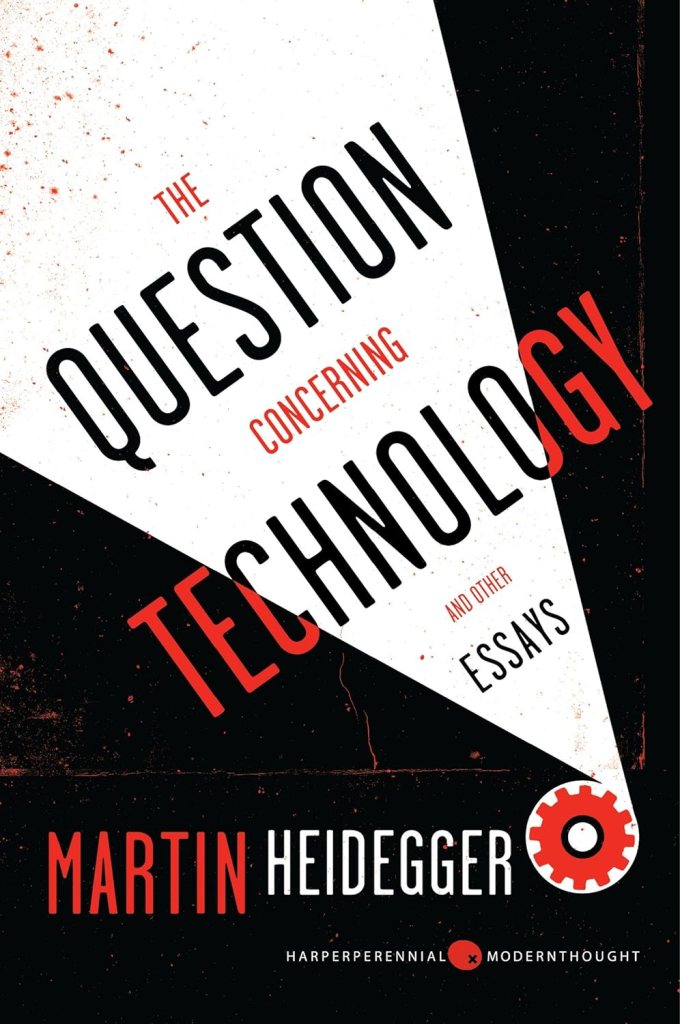
As relevant now as ever before, this accessible collection is an essential landmark in the philosophy of science from “one of the most profound thinkers of the twentieth century”. —New York Times
Martin Heidegger’s The Question Concerning Technology and Other Essays unfolds as a philosophical reflect on the interexchange between human existence and the essence of technology, challenging readers to reframe their understanding of the modern world. This collection represents Heidegger at his most speculative, exploring themes that transcend mere technological critique to interrogate the deeper metaphysical underpinnings of the modern age. It is a work not only of intellectual depth but also of poetic resonance, asking readers to confront the very foundations of their thinking.
At the basis of this volume lies the titular essay, The Question Concerning Technology, a cornerstone of Heidegger’s thought. Here, Heidegger dismantles the conventional, instrumentalist view of technology as a mere tool or neutral means to human ends. Such a conception, while “correct,” he argues, does not grasp technology’s essence. Instead, Heidegger reveals that technology is a mode of revealing (techne), a way in which truth (aletheia) comes into unconcealment. Yet, in modernity, this revealing has been distorted into what Heidegger terms “Enframing” (Gestell), a mode of ordering that reduces the world to standing-reserve (Bestand), stripping beings of their intrinsic essence and transforming them into mere resources for exploitation.
This “challenging revealing,” Heidegger contends, is not merely a consequence of human actions but is rooted in the destining of Being itself. Through Enframing, Being withdraws, concealing its true essence and leaving humanity ensnared in a world where everything—including human beings—is subjected to calculative thinking and instrumental manipulation. Heidegger does not, however, succumb to a simplistic rejection of technology. Instead, he insists that the danger posed by Enframing also harbors the potential for salvation. Within the essence of technology lies the possibility of a turning (die Kehre), a transformative moment where humanity might regain its openness to Being and recover a more authentic relationship with the world.
This dynamics of danger and saving power is explored further in The Turning, a densely poetic essay that complements The Question Concerning Technology. Heidegger portrays the turning as a moment of insight (Ereignis), where the concealment inherent in Enframing is itself unconcealed, revealing the mutual belonging of humanity and Being. Such a turning demands a radical reorientation of thought, one that Heidegger likens to a leap into the abyss—a relinquishment of the dominance of calculative reasoning in favor of meditative thinking (Besinnung), which listens attentively to the self-disclosure of Being.
The Word of Nietzsche: “God Is Dead” goes into the metaphysical roots of modernity, tracing the culmination of Western thought in Nietzsche’s proclamation. Heidegger interprets Nietzsche’s will to power as the final expression of metaphysics, wherein Being is reduced to a value posited by the human subject. This metaphysical framework, Heidegger argues, underpins the technological age, revealing the continuity between Nietzsche’s thought and the essence of modern technology. Yet, by exposing this continuity, Heidegger also gestures toward a possibility of overcoming—an openness to Being that transcends the nihilistic horizon of value-positing.
In The Age of the World Picture, Heidegger examines the historical conditions that gave rise to modernity’s technological worldview. He traces this transformation to the Cartesian subject-object dichotomy, which established man as the sovereign subject and the world as a picture to be represented and manipulated. This epochal shift, Heidegger argues, marked the ascendancy of calculative thinking and the corresponding decline of a more primordial openness to Being. The essay serves as a historical and philosophical genealogy of modernity, revealing the intimate connection between metaphysical assumptions and technological developments.
Finally, Science and Reflection engages with the philosophical foundations of modern science, challenging its claim to objectivity. Heidegger demonstrates that science, like technology, is a mode of revealing that presupposes an instrumental and calculative understanding of Being. By reflecting on this presupposition, Heidegger calls for a more profound questioning of science’s role in shaping our relationship to the world—a questioning that opens the possibility of a freer, more thoughtful engagement with both science and technology.
Throughout this volume, Heidegger’s language is deliberate and evocative, crafted to draw readers into the transformative journey of thought. Words like “revealing,” “essence,” and “destining” are charged with layers of meaning, demanding careful and meditative engagement. Heidegger’s etymological investigations uncover the forgotten roots of language, inviting readers to reconsider the very terms with which they approach reality.
More than a critique of technology, The Question Concerning Technology and Other Essays is a call to rethink the essence of human existence in the modern age. It challenges readers to move beyond the superficiality of technological mastery and toward a deeper attunement to the ways in which Being reveals itself. Heidegger’s essays are not easy; they require patience, attentiveness, and a willingness to question deeply held assumptions. Yet for those willing to undertake the journey, this collection offers profound insights into the nature of technology, the history of Western thought, and the possibilities of a freer and more authentic relationship with the world. It is an essential text for anyone seeking to understand the philosophical dimensions of our technological age.
 Simon Gros
Leave a comment