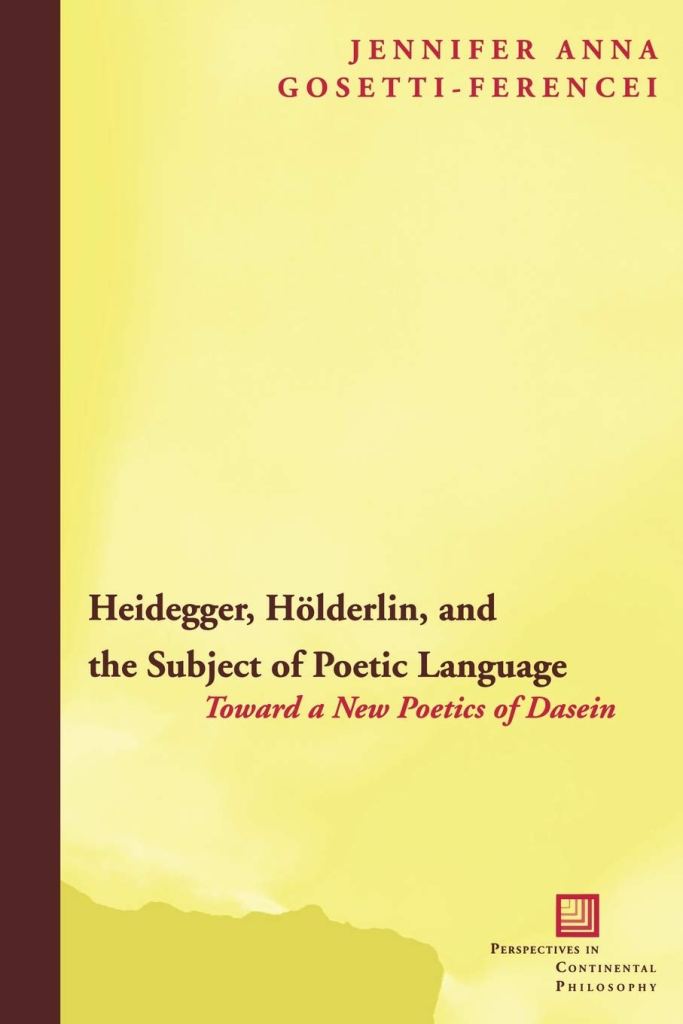
Jennifer Anna Gosetti-Ferencei’s Heidegger, Hölderlin, and the Subject of Poetic Language presents a transformative reappraisal of Martin Heidegger’s philosophical engagement with Friedrich Hölderlin’s poetry, ultimately crafting a “new poetics of Dasein.” At once rigorous and imaginative, the book revisits the dynamics between poetic language and philosophical thought while challenging the prevailing Heideggerian interpretations that have shaped both scholarly and mainstream understandings of Hölderlin’s work. By excavating neglected elements of Hölderlin’s poetics—elements rooted in a Kantian aesthetic subjectivity and Enlightenment ideals—Gosetti-Ferencei reveals a richer, more complex framework of poetic subjectivity that stands in resistance to the more politically fraught dimensions of Heidegger’s readings.
Gosetti-Ferencei’s study is an incisive critique of Heidegger’s tendency to sever poetic language from its grounding in subjectivity, elevating it instead to a locus of historical-ontological truth and nationalistic founding. Against Heidegger’s vision of the poet as a heroic figure who “grounds” Being within a determinate national or historical framework, Gosetti-Ferencei offers an alternative: a vision of Hölderlin’s poetic subjectivity as one shaped by alienation, exile, and wandering. In this, she aligns Hölderlin’s poetics with Heidegger’s concept of Gelassenheit—a “letting-be” or calm receptivity—but critically reconfigures it to recover the centrality of the poetic self. This recovery illuminates a path toward a phenomenologically sensitive theory of poetic language that reconciles Heidegger’s philosophical insights with Hölderlin’s aesthetic and ethical commitments.
Gosetti-Ferencei foregrounds Hölderlin’s philosophical-poetological writings, which Heidegger often cited yet sidelined in favor of his own ontological narrative. By engaging Hölderlin’s essays—texts brimming with reflections on the subject-object relationship, the harmony and disjunction of consciousness, and the operations of poetic spirit—she challenges Heidegger’s dismissal of subjectivity as a metaphysical relic. Instead, Gosetti-Ferencei reveals Hölderlin’s poetic subject as a site of fragile yet deep engagement with the world, embodying a receptivity that resists the domination and objectification characteristic of modern metaphysics and its technological manifestations.
The book’s theoretical ambition lies not only in disentangling Hölderlin from Heidegger’s interpretive shadow but also in advancing a new paradigm for thinking about poetic language and existence itself. Drawing on phenomenological insights, Gosetti-Ferencei situates the poetic subject within a field of finitude and historicity, where language becomes an act of sheltering rather than heroic founding. This approach resists Heidegger’s eschatological tendencies, offering instead a vision of poetic language as inherently marked by its temporal and existential limitations. The poetic subject, in this account, is not a metaphysical anchor or an apocalyptic visionary but a figure of analeptic restoration—an effort to recover unity and meaning through the very acknowledgment of their precariousness.
Through deft philosophical analysis, Gosetti-Ferencei engages with broader intellectual currents, including Hölderlin’s inheritance of Kantian and Idealist thought and its transformation into a poetic critique of philosophical absolutism. She juxtaposes Heidegger’s critique of metaphysical subjectivity with Hölderlin’s insistence on the enduring relevance of subjective experience, consciousness, and receptivity as conditions for poetic creation and understanding. In doing so, she bridges the gap between modernist assertions of subjectivity and postmodernist deconstructions of the self, suggesting that Hölderlin’s poetic logic offers a model for reconciling these seemingly incompatible frameworks.
Gosetti-Ferencei does not shy away from confronting the political implications of Heidegger’s interpretations. She examines the troubling intersections of Heidegger’s nationalist valorization of Hölderlin with the ideological currents of his time, revealing how Heidegger’s readings obscure Hölderlin’s more universalist and democratic aspirations. This critique is not merely historical but philosophical, as it interrogates the ways in which Heidegger’s ontology can overshadow the ethical dimensions of Hölderlin’s poetics, particularly his vision of harmony and communal existence that transcends state and nation.
Heidegger, Hölderlin, and the Subject of Poetic Language articulates a “new poetics of Dasein,” one that is both a phenomenological framework for understanding poetic experience and a philosophical scaffolding for reimagining the self. This poetics rejects the heroic and eschatological strains of Heidegger’s thought in favor of a vision of poetic existence that is humble, finite, and attuned to the fragility of being. It is a vision that acknowledges the transformative power of language while remaining grounded in the ethical and aesthetic dimensions of human life.
For scholars of continental philosophy, literary theory, and poetics, Gosetti-Ferencei’s work offers an indispensable resource. Her synthesis of rigorous philosophical critique with a sensitive and erudite reading of poetry exemplifies the best of interdisciplinary scholarship. By reclaiming the poetic subject from the margins of Heideggerian thought and repositioning Hölderlin as a thinker in his own right, this book opens new avenues for understanding the intersections of language, selfhood, and Being. It is a compelling reminder that the question of poetic language is not merely a theoretical concern but one that speaks to the deepest possibilities of human existence.
 Simon Gros
Leave a comment