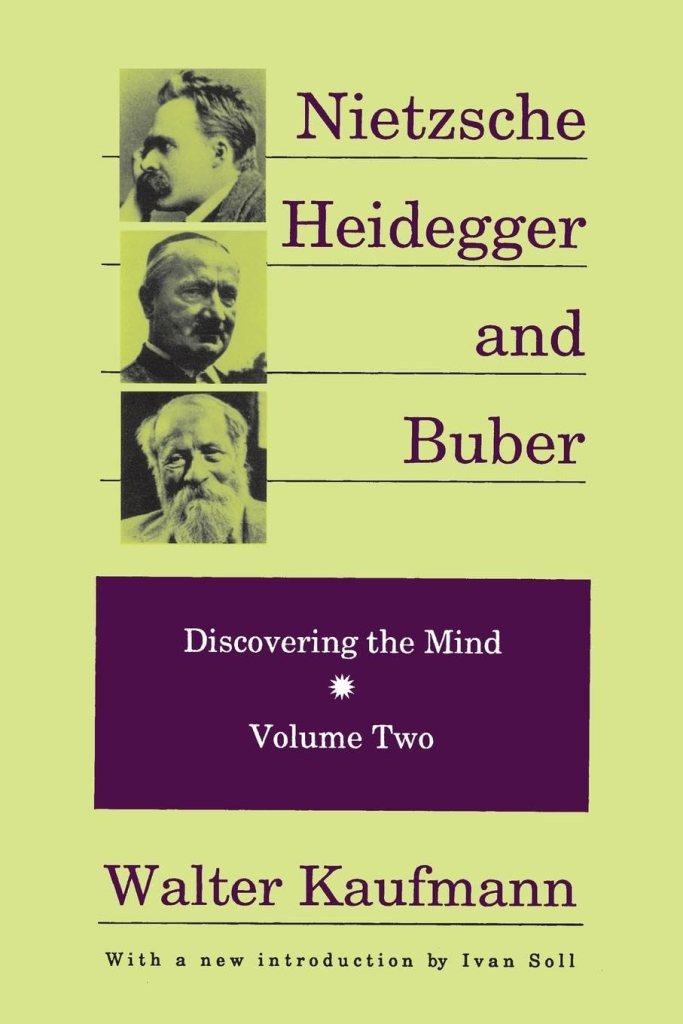
In the second volume of his monumental trilogy, Discovering the Mind, Walter Kaufmann deepens his incisive exploration of human self-understanding by focusing on the psychological and philosophical contributions of Friedrich Nietzsche, Martin Heidegger, and Martin Buber. This volume is not merely a continuation but an expansion of a quest that seeks to illuminate the development of the mind—an enterprise encompassing feeling, intelligence, reason, emotion, perception, and will. Through Kaufmann’s rigorous analysis, these three thinkers are not only re-examined but revealed in ways that challenge prevailing interpretations, revealing both their insights and their shortcomings in the broader project of self-discovery.
Kaufmann opens with a brief yet penetrating consideration of two key figures who laid the groundwork for later developments: Søren Kierkegaard and Arthur Schopenhauer. Their ideas, particularly Kierkegaard’s notions of despair and existential dread, and Schopenhauer’s analysis of repression and the will, set the stage for what is to come. Yet, Kaufmann quickly distinguishes Nietzsche’s revolutionary psychology from his predecessors. For Kaufmann, Nietzsche was the first true depth psychologist, and his significance lies in his relentless excavation of the layers of human motivation, self-deception, and the masks we wear. Nietzsche’s conception of the “will to power” is explored not as a metaphysical doctrine but as a profound empirical hypothesis about human behavior, one that prefigures and in some ways transcends the insights of psychoanalysis.
Kaufmann’s reading of Nietzsche is informed by his decades of scholarship and translation, but it is not an uncritical admiration. Nietzsche’s psychological insights are situated within a broader cultural and philosophical context, showing how his work responded to and diverged from the intellectual currents of his time. Kaufmann reveals Nietzsche’s insistence on the importance of self-knowledge and the dangers of self-deception, tracing his influence on subsequent psychological thought. Nietzsche’s “philosophy of masks,” his understanding of human beings as complex, self-contradictory entities, and his critique of morality are shown to be foundational to modern psychological inquiry. Kaufmann’s Nietzsche is not the misunderstood nihilist of popular imagination but a thinker committed to the liberation of human potential through self-awareness and the overcoming of inherited illusions.
In contrast, Kaufmann’s treatment of Martin Heidegger is a scathing critique, both intellectually and ethically. Heidegger’s existential philosophy, particularly as articulated in Being and Time, is dissected with surgical precision. Kaufmann exposes the obscurity and pretentiousness of Heidegger’s language, arguing that this opacity is not a sign of profundity but a symptom of intellectual confusion or deliberate obfuscation. He links Heidegger’s philosophical style to his failure to achieve genuine self-knowledge, suggesting that the philosopher’s notorious inability to clarify his ideas stems from a deeper unwillingness to confront the contradictions within his own thought and character.
Moreover, Kaufmann does not shy away from addressing Heidegger’s political failings, particularly his involvement with National Socialism. Heidegger’s advocacy of “authenticity” as resolute commitment is revealed to be dangerously indifferent to the moral content of that commitment. Kaufmann’s critique suggests that Heidegger’s philosophy provided a framework that could, and did, justify morally reprehensible positions. This is not merely an ad hominem attack but a demonstration of how Heidegger’s philosophical errors are inseparable from his ethical failures. For Kaufmann, Heidegger’s influence has been a catastrophe for modern thought, promoting a culture of intellectual obscurantism and moral irresponsibility.
In the final major section of this volume, Martin Buber is examined with a balanced and nuanced perspective. Buber’s I and Thou offers a profound, if limited, insight into human relationships. Kaufmann appreciates Buber’s emphasis on genuine dialogue and the recognition of the “other” as a subject rather than an object. This idea is presented as a corrective to the alienation and objectification endemic to modern life. However, Kaufmann also critiques Buber’s rigid dichotomy between “I-Thou” and “I-It” relationships, arguing that it oversimplifies the complexities of human interactions. The insistence that a true “I-Thou” relationship cannot tolerate any objectification is, for Kaufmann, an impractical ideal that risks condemning ordinary human relationships as fundamentally inauthentic.
Kaufmann’s discussion of Buber extends to his theory of translation and interpretation, which Kaufmann champions as a model of intellectual integrity. For Buber, understanding another mind requires a deep and respectful engagement with its unique voice, a principle that stands in stark opposition to the Heideggerian practice of imposing one’s own ideas onto a text. This commitment to discovering the mind of the “other” is, for Kaufmann, an essential component of the broader project of self-knowledge and human understanding.
Throughout this volume, Kaufmann’s method is both historical and philosophical. He does not merely summarize the ideas of Nietzsche, Heidegger, and Buber but engages with them critically, drawing connections between their thought and their lives. This approach challenges the conventional academic taboo against considering the personal character of philosophers, arguing instead that understanding a thinker’s mind is inseparable from understanding the thinker as a person. This is not reductionism but an enrichment of interpretation, a way of illuminating the biases, aspirations, and self-deceptions that shape philosophical thought.
Kaufmann’s prose is marked by clarity, passion, and an unrelenting commitment to intellectual honesty. He rejects the obscurity and pretension that often plague philosophical writing, advocating instead for a style that reflects clear thinking and a genuine engagement with reality. His critiques are sharp but never cynical; they are driven by a belief in the importance of philosophy for the advancement of human self-understanding.
Discovering the Mind, Volume Two is not merely a study of three influential thinkers but a reflection on the nature of philosophy, psychology, and the human condition. Kaufmann’s work invites readers to question their assumptions, confront uncomfortable truths, and embark on their own journey of self-discovery. This volume is essential reading for anyone committed to understanding the forces that have shaped modern thought and the ongoing quest to discover what it means to be human.
 Simon Gros
Leave a comment