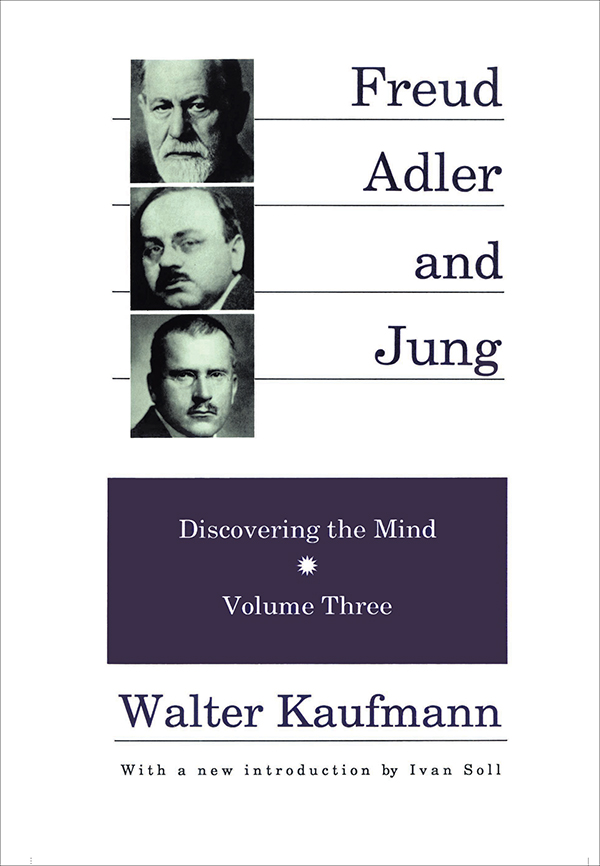
Walter Kaufmann’s Discovering the Mind (Volume Three: Freud, Adler, and Jung) is the monumental culmination of his decades-long intellectual engagement with the traditions of Germanic thought, psychology, and philosophy. Completed just before his untimely death in 1980, this third and final instalment of Kaufmann’s trilogy solidifies his position as one of the most discerning critics and interpreters of the human mind’s development. This volume is not merely an exploration of Freud, Adler, and Jung’s contributions to psychology; it is a key examination of intellectual integrity, the nature of humanistic inquiry, and the personalities that shape, and sometimes warp, the course of ideas. Kaufmann’s engagement with these seminal figures reaches beyond their theories, offering a finely balanced blend of philosophical critique, psychological insight, and biographical assessment.
At the heart of this volume is Kaufmann’s nuanced and forceful defense of Sigmund Freud. While Freud has been praised, criticized, misinterpreted, and vilified, Kaufmann approaches his subject with a reverence born not out of blind loyalty but out of a clear recognition of Freud’s unparalleled courage and insight. For Kaufmann, Freud is not merely the father of psychoanalysis but a scientist of the mind who melded analytical precision with a humanistic sensibility. Freud’s achievement, Kaufmann argues, lies in his creation of a “poetic science”—a disciplined yet imaginative exploration of the psyche that neither succumbed to the sterility of rigid empiricism nor the mystifications of abstract metaphysics. This poetic science, rooted in observation, introspection, and narrative interpretation, provided a revelatory map of the unconscious and its mechanisms. Kaufmann lauds Freud’s willingness to confront the unpalatable, to embrace discomforting truths about human sexuality, repression, and neuroses, and to eschew dogma in favour of a continually self-critical inquiry.
Kaufmann’s defense of Freud is also a defense of intellectual rigor, honesty, and openness. He methodically dismantles the common misconceptions and misrepresentations of Freud’s work, many of which he attributes to poor translations, superficial readings, and hostile critics. For Kaufmann, Freud’s detractors, particularly Alfred Adler and Carl Gustav Jung, represent a profound failure of both intellectual and personal integrity. His critique of Adler and Jung is unrelenting, not as an exercise in character assassination but as a necessary act of intellectual housekeeping. Adler emerges as a muddled thinker, whose ideas, Kaufmann asserts, were driven more by personal resentment and an unacknowledged inferiority complex than by coherent psychological insight. His concept of the “inferiority complex,” though catchy, is shown to lack the depth and systematic rigor that characterized Freud’s investigations. Adler’s individual psychology, for Kaufmann, appears reductive and reactionary, a simplification of Freud’s far more dynamic and comprehensive model of the mind.
If Kaufmann’s assessment of Adler is severe, his critique of Carl Jung is merciless. Jung’s theories, with their esoteric symbolism and collective unconscious, are portrayed as lapses into obscurantism, mysticism, and a disconcerting anti-Semitism. Kaufmann contends that Jung’s intellectual dishonesty and pettiness—particularly in his break from Freud—cast a long shadow over his theoretical contributions. Jung’s reworking of Freud’s libido theory, which Kaufmann sees as a capitulation to societal prudery and a disavowal of sexuality’s central role in psychic life, is exposed as both theoretically impoverished and ethically suspect. Jung’s archetypes and his reliance on universal symbolism, Kaufmann argues, represent a retreat from the concrete, lived reality of individual psychology into the fog of abstraction and myth. While Jung’s ideas found popular appeal, Kaufmann sees them as a betrayal of the very enterprise of “discovering the mind”—a process that demands engagement with the gritty, uncomfortable particulars of human experience rather than the safety of universalized mythologies.
Throughout his analysis, Kaufmann combines themes of character, integrity, and intellectual honesty. The personalities of Freud, Adler, and Jung are not incidental to their theories; they are, in Kaufmann’s view, intrinsic to understanding the strengths and weaknesses of their respective psychologies. Kaufmann’s insistence on this connection aligns with his broader philosophical project—one that sees self-knowledge and authenticity as prerequisites for genuine discovery. Freud’s willingness to interrogate his own motivations and biases becomes, in Kaufmann’s narrative, a model of intellectual virtue. By contrast, the self-deceptions of Adler and Jung become cautionary tales about the dangers of allowing personal grievances and unexamined biases to shape one’s theoretical constructs.
Kaufmann’s prose, like Freud’s, is marked by a clarity and directness that reflects his own commitment to transparency and honesty. His writing resists the obfuscations and pretensions that he condemns in others. This clarity is not a stylistic choice alone but a philosophical stance—a belief that the discovery of the mind, like any genuine inquiry, must be conducted in the open, free from the distortions of jargon, authority, or personal aggrandizement. Kaufmann’s engagement with these figures is passionate and unflinching, marked by the same fearless confrontation with uncomfortable truths that he praises in Freud.
In defending Freud’s scientific and philosophical contributions, Kaufmann also challenges the boundaries that have traditionally separated disciplines. Discovering the Mind operates at the intersection of psychology, philosophy, and literature, reflecting Kaufmann’s conviction that the exploration of human consciousness cannot be confined to any one field. This interdisciplinary approach, inspired by the German intellectual tradition that Kaufmann so deeply admired, allows for a richer, more holistic understanding of the mind. Kaufmann’s work stands as a testament to the value of crossing these disciplinary boundaries, of embracing the complexity and messiness of human experience rather than reducing it to formulaic models or rigid frameworks.
Discovering the Mind (Volume Three) is more than a study of Freud, Adler, and Jung. It is a meditation on the nature of intellectual courage, the ethical responsibilities of thinkers, and the ever-elusive quest for self-knowledge. Kaufmann’s defense of Freud becomes a defense of a broader vision of what it means to engage in the discovery of the mind—a vision that demands clarity, integrity, and an unrelenting commitment to the pursuit of truth. In this final volume, Kaufmann offers not only an incisive analysis of three pivotal figures but also a challenge to his readers to approach their own inquiries with the same honesty and rigor that he so admired in Freud. It is a fitting conclusion to a life spent exploring the complexities of thought, character, and the human psyche—a final act of philosophical generosity that invites us all to take up the work of discovering the mind with renewed passion and purpose.
 Simon Gros
Leave a comment