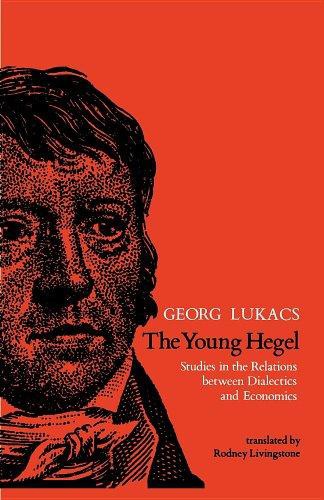
Georg Lukács’ The Young Hegel: Studies in the Relations between Dialectics and Economics, translated by Rodney Livingstone, is an indispensable philosophical investigation into the formative period of Hegel’s thought. This monumental work, first completed in 1938, is a rigorous and detailed analysis of Hegel’s intellectual trajectory and its far-reaching influence on Marxist theory. It situates itself at the intersection of German idealism, revolutionary social dynamics, and the dialectical underpinnings that would later inspire Marx’s historical materialism. Lukács, a foremost Marxist theorist, approaches Hegel not merely as a philosopher ensconced in abstractions but as a thinker whose dialectical method emerged from, and responded to, the economic and political upheavals of his time, particularly the French Revolution and the nascent industrial revolution in England.
Lukács asserts, with unrelenting precision, that to comprehend Marx’s dialectical materialism fully, one must first grasp the details of Hegel’s dialectical method—both its immense philosophical achievements and its historical limitations. Hegel’s thought, for Lukács, represents a critical merger of the Enlightenment’s rationalism, the moral philosophy of Kant, and the revolutionary fervour ignited by 18th-century socio-political transformations. Yet, Hegel’s idealism, as Lukács painstakingly details, carries the inherent contradiction of reflecting revolutionary social change while ultimately retreating into the metaphysical domain of absolute spirit. This duality between Hegel’s insight into historical dynamism and his philosophical idealism constitutes a “stumbling-block” for irrationalist critiques of dialectics and, simultaneously, a foundation for the Marxist inversion of idealist dialectics into materialist praxis.
In delineating the “four phases of Hegel’s intellectual development,” Lukács provides a dissection of Hegel’s evolution from his early republicanism to the consummation of his dialectical system in The Phenomenology of Spirit. The “early republican phase,” characterized by Hegel’s immersion in Enlightenment ideals and his reflections on the decline of the Greek polis, reveals his concern for collective social praxis and the erosion of communal freedom under the encroachment of bourgeois individualism. Lukács demonstrates how this phase is imbued with the historical optimism of the French Revolution, tempered by Hegel’s realization of the Revolution’s contradictions—a realization that would lead him towards a more complex dialectical understanding of societal development.
The subsequent “crisis in Hegel’s views on society and the earliest beginnings of his dialectical method” marks a pivotal transformation in Hegel’s thought. Here, Lukács exposes the influence of political economy on Hegel’s emerging dialectical framework. Drawing on Hegel’s engagement with the economic theories of Adam Smith and the realities of early capitalist development, Lukács reveals how Hegel’s thought begins to reflect a dialectic that grapples with social fragmentation, alienation, and the contradictory dynamics of modern bourgeois society. Hegel’s confrontation with these economic realities, though mediated through the idealist prism of his philosophy, foreshadows Marx’s materialist critique of capitalist social relations.
In the phase dealing with the “rationale and defense of objective idealism,” Lukács delves into Hegel’s attempt to reconcile the fragmentation of modernity with a unified philosophical system. Hegel’s objective idealism was an ambitious endeavor to overcome the antinomies left unresolved by Kant and Fichte. Through a dialectical method that embraces contradiction, negation, and synthesis, Hegel constructs a philosophy that aspires to comprehend the totality of historical development. Yet, Lukács argues that this synthesis remains constrained by Hegel’s metaphysical commitment to spirit as the ultimate reality, preventing his dialectics from achieving the full materialist transformation realized by Marx.
The “breach with Schelling and the Phenomenology of Spirit” phase represents the culmination of Hegel’s intellectual maturation. Lukács unpacks the decisive rupture between Hegel and Schelling, demonstrating how Hegel’s dialectics transcend the static and irrationalist tendencies of Schelling’s philosophy. In his analysis of Phenomenology of Spirit, Lukács underscores the text’s significance as both a philosophical and socio-historical document. The Phenomenology reflects Hegel’s deep engagement with the historical reality of the French Revolution, the dialectic of master and slave, and the unfolding contradictions of modern society. Lukács elucidates how Hegel’s exploration of consciousness, self-consciousness, and absolute knowing parallels the trajectory of human history, yet remains ensnared in the idealist conception of spirit’s self-realization.
Lukács’s methodological approach in The Young Hegel is deeply dialectical, combining historical materialism, philosophical critique, and an acute awareness of socio-political context. He does not merely recount Hegel’s ideas; he situates them within the lived realities of 18th and 19th-century Europe—a period marked by revolutionary upheaval, the dissolution of feudal structures, and the rise of industrial capitalism. By doing so, Lukács demonstrates how Hegel’s dialectics arose not in a vacuum of speculative thought but as a response to the pressing contradictions of his time. This historical grounding enables Lukács to show both the progressive and the regressive elements in Hegel’s philosophy: its capacity to illuminate the dynamics of historical change and its limitation in anchoring this change in idealist abstractions.
The Young Hegel is not merely an exploration of Hegel’s youth; it is a reflection on the relationship between thought and historical reality, between dialectics and the economic foundations of society. It is a work that demands of its readers not passive consumption but an active engagement with the contradictions and developments that shape human history. In this sense, it remains a vital contribution to Marxist philosophy and a necessary text for anyone seeking to understand the dialectical heritage that links Hegel and Marx. For while Hegel’s idealism represents a “stumbling-block” for subsequent irrationalist philosophies, it also serves as the “great stumbling-block” that revolutionary materialism had to overcome and appropriate in order to grasp the real movement of history.
Lukács’s intellectual biography of Hegel is thus more than a historical study; it is a dialectical intervention that sheds light on the philosophical roots of Marxism, the limitations of idealism, and the enduring task of understanding the world in order to change it. For contemporary readers—especially those concerned with the socio-economic crises of capitalism and the possibilities of revolutionary change—The Young Hegel remains a “must,” a work of inexhaustible depth and unrelenting philosophical intensity.
 Simon Gros
Leave a comment