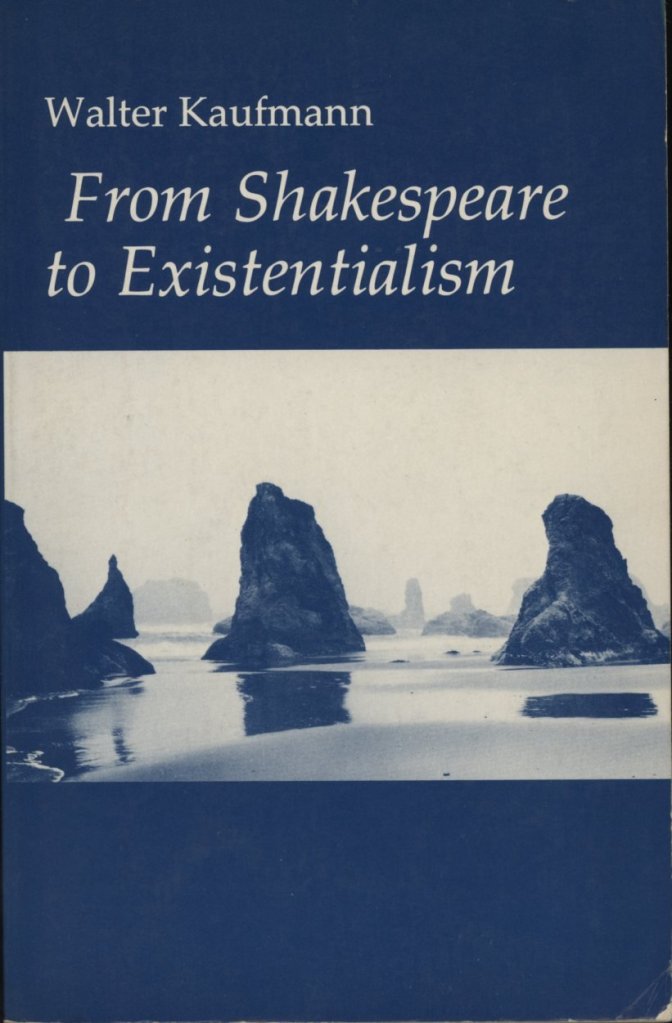
Walter A. Kaufmann’s From Shakespeare to Existentialism is a masterwork of intellectual exploration, charting a constellation of Western thought that spans literature, philosophy, and the crises of modernity. First published in 1959, this volume brings into sharp focus Kaufmann’s unique philosophical temperament—a confluence of rigorous analysis, historical consciousness, and Nietzschean skepticism. The book unfolds as a reflection on the evolving ideals of individuality, freedom, and existential responsibility, seen through the lens of figures who have, in their own ways, shaped the landscape of modern consciousness. These essays, simultaneously historical and philosophical, provide incisive interpretations that pierce through ideological veneers, forcing us to confront the marrow of human experience.
Kaufmann’s range is staggering. He navigates the intellectual topography that stretches from the sublime dramatic tensions of Shakespeare to the searing existential anguish of Heidegger. At the core of this journey lies the Aristotelian ideal of the “great-souled man,” an ideal obscured by the medieval preoccupations of Christendom but resurrected in the defiant humanism of the Renaissance and German Idealism. Shakespeare’s tragic heroes, Goethe’s Faustian strivings, and Nietzsche’s affirmation of life all testify to the recovery of an ethos that celebrates human potential in the face of cosmic indifference.
Kaufmann, an unrelenting critic of dogma and intellectual complacency, juxtaposes the grandeur of these visions with the existential dilemmas articulated by Kierkegaard, Jaspers, and Heidegger. Yet he remains skeptical of the bleakness that often pervades 20th-century existentialism, arguing that the existential vision, when properly understood, should empower rather than enervate. For Kaufmann, the existentialist confrontation with absurdity and finitude is a call to creative engagement, a Nietzschean “self-overcoming” that rejects nihilism in favor of a more vigorous and authentic existence. The “thrownness” of human existence is not a lamentable fate but an opportunity to wrest meaning from contingency.
Through essays on Goethe, Kaufmann illuminates the dialectic of tradition and innovation, illustrating how the German poet’s expansive worldview resists simplistic categorization. Goethe’s Faust becomes a symbol of the human spirit’s relentless pursuit of knowledge and self-actualization, embodying a synthesis of reason, passion, and artistic vision. In Kaufmann’s hands, Goethe’s work is not merely literature but as a philosophical project that anticipates the existential struggles of modernity.
Hegel, another pivotal figure in Kaufmann’s analysis, is approached with a blend of admiration and critical acuity. Kaufmann resuscitates Hegel from the morass of misinterpretations, revealing him as a thinker whose dialectical method offers a dynamic way of understanding reality and human history. Hegel’s emphasis on the unfolding of Spirit and the realization of freedom provides a counterpoint to existentialism’s focus on individual subjectivity. For Kaufmann, Hegel is less a system-builder than a philosopher of becoming, one who charts the development of human consciousness in its quest for self-realization.
Kierkegaard, the “father of existentialism,” is treated with a nuanced respect that acknowledges his profound insights into faith, anxiety, and the individual’s confrontation with the Absolute. Yet Kaufmann is wary of Kierkegaard’s leap of faith and his theological commitments. He regards Kierkegaard’s existential rebellion as an essential corrective to Hegelian abstraction but ultimately sees in Nietzsche a more emancipatory path—one that refuses the comforts of faith and embraces the uncertainties of a godless world.
Nietzsche himself is the fulcrum upon which much of Kaufmann’s thought pivots. In Nietzsche, Kaufmann finds a philosopher who not only diagnoses the “death of God” but also articulates a vision of life that transcends despair. Nietzsche’s notion of the Übermensch, the eternal recurrence, and his critique of ressentiment form a radical challenge to the complacencies of modernity. Kaufmann’s interpretation rescues Nietzsche from the distortions of fascist misappropriation and nihilistic despair, presenting him instead as a philosopher of courage, creativity, and life-affirmation.
The psychological dimensions of this intellectual odyssey are deepened in Kaufmann’s essays on Freud and Rilke. Freud’s psychoanalytic project, with its unflinching examination of the unconscious, becomes a modern counterpart to Socratic self-inquiry—a path to self-knowledge that is fraught with conflict and repression. Meanwhile, Rilke’s poetry is portrayed as a lyrical exploration of existence at the limits, where beauty and terror converge. For Kaufmann, both Freud and Rilke are engaged in the same existential task: confronting the depths of the human psyche and the mysteries of being.
In his critiques of Heidegger and Jaspers, Kaufmann challenges the existentialist turn away from reason and toward mysticism. Heidegger’s ontology, with its obscure language and flirtations with nihilism, is dissected with a sharp, unsparing logic. Kaufmann argues that Heidegger’s insights into Being are undermined by his political failures and his retreat from critical thought. Jaspers, though more humane, is similarly critiqued for his reliance on transcendence and his failure to ground existential thought in the concrete realities of life.
The book’s title, From Shakespeare to Existentialism: Essays on Shakespeare and Goethe; Hegel and Kierkegaard; Nietzsche, Rilke, and Freud; Jaspers, Heidegger, and Toynbee, encapsulates its expansive scope: a journey that begins with the dramatist’s exploration of human nature and culminates in the philosophical confrontations of the modern era. Yet this journey is no linear progression; it is a series of dialogues that illuminate the perennial questions of existence, freedom, and authenticity. Kaufmann’s writing, infused with erudition and passion, demands that readers engage these questions not as passive spectators but as active participants in the drama of thought.
From Shakespeare to Existentialism is an invitation to embrace the fullness of the human condition—to face finitude with courage, to seek knowledge with humility, and to cultivate a life of depth and integrity. In a world where facile answers and ideological dogmas proliferate, Kaufmann’s insistence on critical inquiry and existential responsibility is both a challenge and a gift. His book stands as a testament to the enduring power of philosophy to illuminate, provoke, and transform.
 Simon Gros
Leave a comment