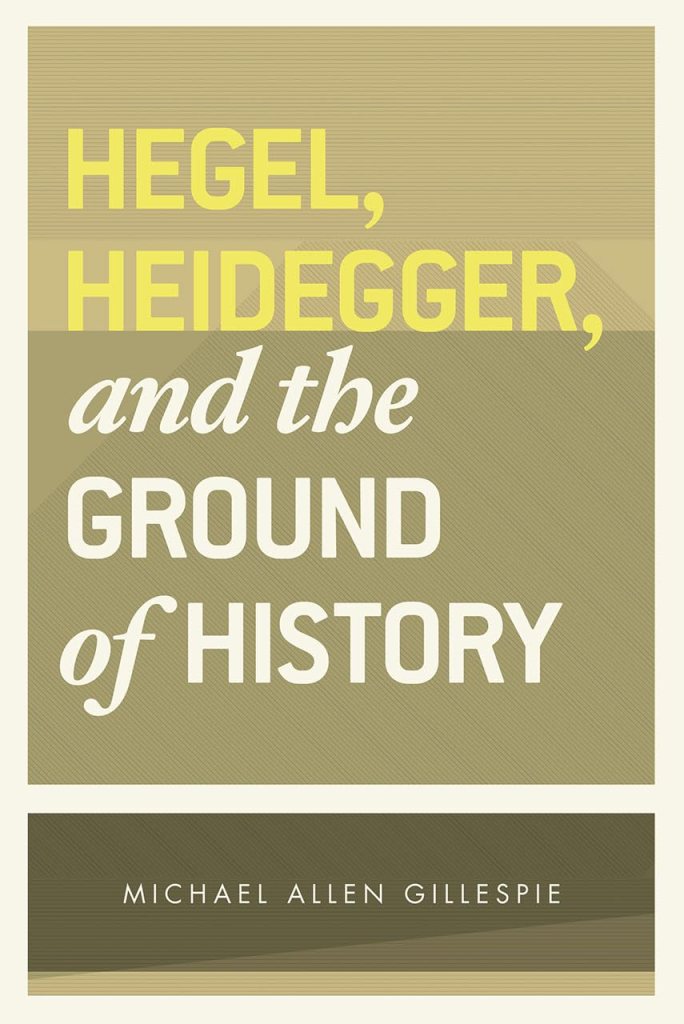
In Hegel, Heidegger, and the Ground of History, Michael Allen Gillespie offers a key examination of the philosophical underpinnings of the concept of history, engaging with the seminal works of Hegel and Heidegger to explore the most fundamental and often elusive questions about human existence, freedom, and the trajectory of civilization. This is an expansive rigorous study into whether there is an intelligible “ground” of history, a foundation upon which our understanding of historical progress, purpose, and meaning can be securely based, or whether history itself is an expression of human finitude and the opacity of Being. Gillespie does not merely explore Hegel’s systematic and optimistic articulation of history as the unfolding of rational freedom nor Heidegger’s somber and destabilizing critique of historical consciousness; he situates these two thinkers within the broader dialectic of modern philosophy that grapples with the tension between human nature and freedom, contingency and necessity, progress and nihilism.
Gillespie’s engagement with Hegel’s thought illuminates the architectonic structure of Hegel’s Phenomenology of Spirit, where history is conceived as the developmental path of consciousness toward absolute knowing, a progression in which spirit overcomes the alienation inherent in finite human experience. For Hegel, history is not simply a chronological series of events but a dialectical process that reflects the intrinsic rationality of existence itself. The “ground” of history, then, is the rational spirit, working through the conflicts and contradictions of human experience, aiming toward a reconciliation of subject and object, freedom and necessity. Gillespie provides an exceptional analysis of this Hegelian notion of history as the dynamic unfolding of freedom, while simultaneously subjecting Hegel’s optimism to a critical scrutiny that acknowledges the philosophical and political limitations of dialectical historicism.
Contrasting this optimistic teleology, Gillespie’s exploration of Heidegger’s philosophy reveals a radical disruption of the Hegelian synthesis. Heidegger dismantles the metaphysical certainties that Hegel sought to establish, offering instead a vision of history grounded not in the progressive realization of freedom but in the unveiling and concealing of Being. For Heidegger, history is not the rational unfolding of spirit but the destinal movement of Being, a process marked by the increasing forgetfulness of Being itself. Heidegger’s critique of modernity, which Gillespie masterfully elucidates, shows how the scientific and technological orientation of the modern world leads to a mode of existence that obscures the essential openness of Being. History, in this context, becomes a narrative of nihilism—a historical epoch in which humanity has lost its capacity for authentic existential reflection, instead becoming ensnared in a purely instrumental relationship to the world. Gillespie’s discussion underscores the significance of Heidegger’s thought for understanding the crisis of modernity, a crisis where history no longer appears to possess a coherent ground or a redemptive trajectory.
Gillespie’s work also situates Hegel and Heidegger within the context of pivotal philosophical predecessors—Rousseau, Kant, and Nietzsche—who each contributed to the unfolding debate about the nature of freedom, the limits of reason, and the possibility of historical meaning. Rousseau’s insight into the conflict between human freedom and natural necessity sets the stage for the modern conception of historical progress, while Kant’s antinomy of freedom and causality raises important questions about the compatibility of human agency with the deterministic framework of natural law. Gillespie shows how Hegel’s philosophy can be understood as a response to these Kantian dilemmas, offering a resolution through the dialectical process. Yet, the shadow of Nietzsche looms large over Hegel’s system, as Gillespie highlights how Nietzsche’s radical perspectivism and critique of metaphysical foundations prefigure Heidegger’s dismantling of historical optimism. For Nietzsche, the “death of God” signifies the collapse of historical meaning, a nihilistic condition that both Hegelian and Heideggerian thought must confront.
Gillespie’s study traces these philosophical threads, providing an unparalleled merger of the political and existential dimensions of historical thought. His analysis demonstrates how the question of the “ground of history” is not merely a theoretical puzzle but a matter with crucial ethical and political implications. If history has no intelligible ground, if human existence is not directed toward any higher purpose or meaning, then we are left with a vision of history that threatens to dissolve into chaos and nihilism. Conversely, if there is a rational ground of history, as Hegel suggests, then history becomes the arena in which human freedom realizes itself through the dialectical overcoming of contradictions.
Yet Gillespie does not allow the reader to rest comfortably with either position. His examination of Hegel and Heidegger reveals the deep tensions and unresolved problems within both thinkers’ attempts to ground history. Hegel’s dialectical optimism, with its emphasis on the rational progress of spirit, confronts the challenge of maintaining coherence in the face of historical catastrophes and the apparent irrationality of human suffering. Heidegger’s ontological approach, while offering a critique of modernity, risks collapsing into a fatalistic resignation that leaves little room for political agency or ethical responsibility. Gillespie analyses these complexities, providing a critical evaluation of both Hegel’s and Heidegger’s philosophies while acknowledging the enduring relevance of their insights for understanding the modern condition.
Hegel, Heidegger, and the Ground of History is more than a scholarly study of two great philosophers; it is a reflection on the fate of human freedom, the possibility of historical meaning, and the limits of philosophical thought itself. Gillespie’s work challenges us to consider whether history can still serve as a guide to human self-understanding in an age where both the certainties of Enlightenment rationality and the metaphysical assurances of religious faith have been called into question. His lucid and incisive prose makes this dense philosophical terrain accessible without sacrificing depth or rigor, offering readers a guide to the perplexities of historical thought and the existential stakes of our understanding of history.
In addressing the fundamental question of whether history possesses a coherent ground, Gillespie’s book serves as a vital contribution to contemporary philosophy, a work that dares to grapple with the very foundations of human existence and the historical consciousness that shapes our world. This is a study that will reward repeated readings, offering new insights with each encounter, and prompting us to reflect deeply on the meaning of our own historical moment.
 Simon Gros
Leave a comment