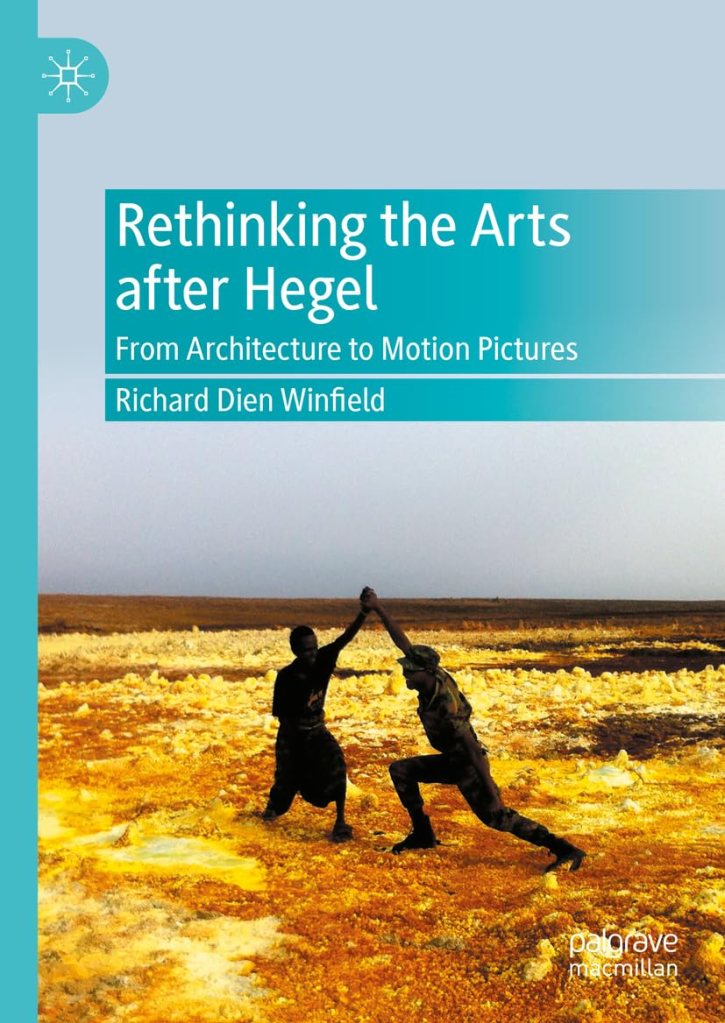
In Rethinking the Arts after Hegel: From Architecture to Motion Pictures, Richard Dien Winfield delivers nothing short of a magnum opus on the aesthetics of the individual arts, grounded in Hegelian principles yet transcending their limitations with philosophical rigor. Winfield reimagines the systematic architecture of Hegel’s Aesthetics, preserving its revolutionary insight into art’s mediation of meaning and configuration while boldly remedying critical inconsistencies and omissions that have long plagued its reception. This ambitious project illuminates not only the traditional fine arts—architecture, sculpture, painting, music, and literature—but also extends Hegel’s dialectical approach into uncharted territories, encompassing the emergent arts of photography and cinema that the great philosopher himself never had the opportunity to theorize. The result is a monumental synthesis that deftly unites historical breadth, systematic clarity, and contemporary relevance.
Winfield’s work begins by reaffirming the necessity of conceiving the arts within a structured philosophical framework. He contends, as Hegel did, that the essence of art lies in its ability to unify sensuous configuration with fundamental meaning, offering a concrete expression of humanity’s deepest ethical and spiritual self-understanding. Yet where Hegel arguably stumbles—particularly in his conflation of artistic media with the fundamental styles of Symbolic, Classical, and Romantic art—Winfield sets forth a sharper, more precise taxonomy. He distinguishes the differentiation of artistic media (sight, sound, and language) from the universal stylistic forms that may manifest within them, ensuring that each individual art achieves philosophical definition in its own right without being subsumed under predetermined stylistic hierarchies.
This methodological refinement allows Winfield to address what he identifies as two longstanding gaps in aesthetic theory. First, he critically reconstructs the aesthetic essence and stylistic trajectories of the traditional arts, beginning with architecture. Rather than accept Hegel’s assertion that architecture’s “instrumental” nature confines it to Symbolic expression, Winfield vindicates architecture as an independent fine art capable of embodying all three stylistic paradigms. He demonstrates how architectural design transforms its functional necessity into an aesthetic virtue, shaping space to express fundamental self-understandings through ingenious spatial configurations. In doing so, Winfield elevates architecture from its reductive categorization as mere mechanical form to an autonomous creation where beauty emerges through a dialectic of materiality, utility, and symbolic meaning.
From this foundation, Winfield proceeds to explore sculpture, painting, and music with unparalleled depth, navigating their unique material and perceptual challenges. He scrutinizes Hegel’s tendency to idealize sculpture as the “paradigmatic” Classical art, arguing instead that sculpture’s potential extends far beyond representational mimesis. Whether through Classical figuration or modern abstraction, sculpture configures space in a manner that harmonizes corporeal form and transcendent meaning, situating the human figure as a locus of aesthetic universality. Similarly, Winfield reexamines painting—Hegel’s quintessential Romantic art—tracing its evolution from symbolic representation to the abstract expressions of modernity. He incorporates photography as a natural extension of graphic fine art, defending its aesthetic legitimacy against critics who dismiss its mechanical reproducibility. Photography, Winfield argues, presents a dialectical tension between the immediacy of visual realism and the imaginative potential of artistic configuration, a tension that proves fertile for aesthetic exploration.
Winfield’s analysis of music marks one of the book’s most philosophically intricate achievements. Music, the most temporal and immaterial of the arts, transcends mere auditory pleasure to unify rhythm, melody, and tonal harmony in an idealized form of expression that eludes spatial constraints. By situating music within the broader landscape of Symbolic, Classical, and Romantic styles, Winfield reveals its capacity to articulate subjective interiority with unrivaled purity, often serving as an aesthetic counterpart to the inwardness of Romantic spirituality. Yet Winfield does not leave music trapped in abstraction; he situates it within its hybrid forms, from lyrical song to theatrical accompaniment, illuminating music’s integral role in the arts of performance.
The study culminates in Winfield’s groundbreaking exploration of photography and cinema—modern artforms that Hegelian aesthetics, bound by its historical limitations, never directly addressed. Winfield’s philosophical treatment of cinema in particular constitutes a decisive expansion of Hegel’s legacy, as he identifies motion pictures as a hybrid art that synthesizes visual, auditory, and narrative dimensions. Cinema, Winfield contends, transforms the static temporality of graphic art and literature into a dynamic flow of moving images, reimagining the dialectic of form and meaning in a medium uniquely suited to express the complexities of modern subjectivity. His distinction between pure cinema—where the moving image itself becomes an autonomous aesthetic form—and hybrid cinema—where sound, language, and performance intersect—underscores the sophistication of his philosophical framework.
What distinguishes Winfield’s Rethinking the Arts after Hegel is its seamless exchange of historical analysis, systematic reconstruction, and critical innovation. Drawing on a vast corpus of artistic examples from diverse cultural and historical contexts, Winfield engages in dialogue with aesthetic theorists across traditions, from classical antiquity to the present. He challenges reductive theories of mimesis and reception, defending instead a robust account of art as autonomous creation—where sensuous form and universal meaning achieve their highest reconciliation. This reconciliation, far from being confined to a static ideal, manifests as an evolving dialectic that continually transcends the limits of existing artforms, pointing toward new horizons of aesthetic possibility.
In Rethinking the Arts after Hegel, Richard Dien Winfield has produced a work of staggering philosophical scope and ambition. By renewing Hegelian aesthetics for the modern age and extending its systematic power to include photography and cinema, Winfield not only remedies the deficiencies of Hegel’s original project but also secures its relevance for contemporary debates on art’s significance. This book is essential reading for philosophers, art historians, and anyone committed to understanding art as a vehicle of humanity’s deepest self-expression. Winfield’s contribution reminds us that the dialectic of art is far from exhausted; it remains an open horizon where form and meaning continue to unfold in ever-new configurations.
 Simon Gros
Leave a comment